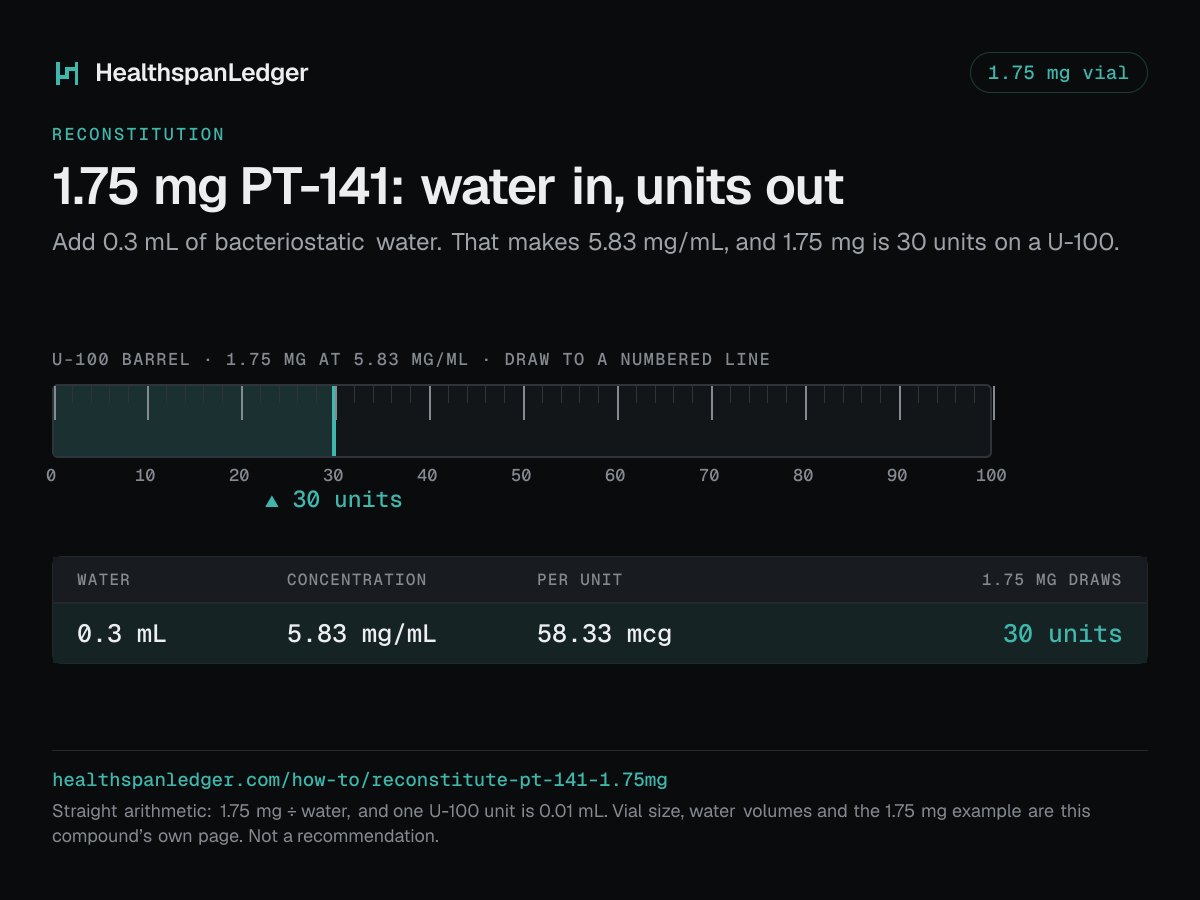
Put 0.3 mL of bacteriostatic water into the 1.75 mg PT-141 vial. That makes 5.83 mg/mL. A 1.75 mg dose is then 30.0 units on a U-100 syringe.
That volume is the one that lands the draw on a syringe line, so the reading can be checked by eye. More water makes a weaker mix and a bigger draw. Less water makes a stronger mix and a smaller one. The amount of PT-141 in the glass never changes. Only the number of marks it takes does.
What matters first
Water to add
0.3 mL
Resulting strength
5.83 mg/mL
Example 1.75 mg dose
30.0 U-100 units
What is PT-141?
PT-141 is the development code for bremelanotide. It acts on melanocortin receptors in the brain, rather than on blood flow the way the erectile-dysfunction pills do.
Medically reviewed by Jennifer Montecillo, MD · non-practicing medical reviewer·Reviewed 2026-08-12·open the primary sources
How much bacteriostatic water for a 1.75 mg PT-141 vial?
◆ Unique to the 1.75 mg vialU-100 example draws
Water added
Concentration
Per U-100 unit
Example: 1.75 mg =
0.3 mL
5.83 mg/mL
58.33 mcg
30.0 units
Straight arithmetic: concentration = 1.75 mg ÷ water, and 1 U-100 unit = 0.01 mL. The example column shows the math at 1.75 mg; it is not a dose recommendation.
Which volume to use is a practical choice rather than a dose. Pick the one that puts your draw somewhere you can actually read it on the syringe. The flags in the last column mark where that fails. “Hard to measure” means the draw is too small to judge by eye. “Won’t fit” means it is bigger than one U-100 syringe holds.
The 1.75 mg vial at 0.3 mL on a U-100 barrel. 1.75 mg fills to 30.0 units, at 5.83 mg/mL.
How many units is a documented dose from this vial?
The table above uses one worked example. These are the published quantities, converted into marks on a U-100 barrel at each water volume for a 1.75 mg vial. Where a quantity was never studied by injection, the row says so.
1.75 mg — FDA-approved label
1.75 mg as needed, at least 45 minutes before sexual activity, under the skin. No more than once in 24 hours and no more than 8 times a month.
Water added
Concentration
Draw
0.3 mL
5.83 mg/mL
30.0 units
FDA labelVYLEESI (bremelanotide) injection — FDA-approved Prescribing Information (DailyMed SPL) · retrieved 2026-08-12
One vial size, one volume, one row
Only one vial strength and one mixing volume are documented, so there is a single calculation to show.
3Read the full vial record — 3 notes
The approved product is never mixed at all
The approved medicine comes in a prefilled autoinjector and requires no mixing. A powder vial is a different preparation and is not described by that label.
The arithmetic still holds for the powder somebody actually bought. It simply has no label behind it, which is a different thing from having a label that disagrees.
One row means no water decision
Every other guide in this family exists partly to help choose between volumes. With a single listed volume there is nothing to weigh. The concentration settles the moment the powder dissolves.
That leaves only the reading itself, which lands comfortably in the middle of a U-100 barrel.
A small fill loses more to the glass
This is the smallest amount of liquid any preset on the site produces. Whatever clings to the vial wall and sits in the needle hub stays roughly constant. On a fill this small it makes up a larger fraction of the whole.
When the full vial is one dose, residue left behind means receiving slightly less than the full amount. The calculator cannot measure that loss.
How do you mix it, step by step?
Wipe both stoppers with an alcohol swab and let them dry.
Draw up the water volume you picked from the table.
Let the water run slowly down the inside wall of the PT-141 vial, rather than jetting it onto the powder.
Swirl gently until it dissolves. Shaking damages peptides.
Store it as the dispensing label directs. What happens after mixing differs by product — some labels direct against refrigerating the mixed solution at all.
What if your water volume is not on the table?
The table shows the offered water volumes. The calculator does the same arithmetic for any volume and any syringe, and shows its working line by line.