Cagrilintide is a weekly shot in weight-loss studies. It copies amylin, a natural signal that helps you feel full after eating.
What matters first
Why people look it up
Sellers offer unapproved cagrilintide for weight loss, sometimes paired with semaglutide under the name CagriSema.
What the evidence shows
A phase 2 trial found more average weight loss at higher doses. It has moved into phase 3 trials with semaglutide. Cagrilintide does not have FDA approval.
Dose status
Trials tested Cagrilintide at 0.3–4.5 mg once a week. There is no FDA-approved dose or dosing label. Every number below is a trial arm, not a treatment schedule.
Cagrilintide is a weekly shot being studied for weight loss. A phase 2 trial tested doses from 0.3 mg to 4.5 mg. People lost more weight at the higher doses. A 2.4 mg dose is now in phase 3 trials with semaglutide under the name CagriSema. Cagrilintide is not FDA-approved.
Cagrilintide research and regulatory details: evidence quality, approval status, doses, handling, and presentation.
Topic
Value
Strongest source
Human trial
FDA approval
Not FDA-approved
Studied dosing
0.3–4.5 mg once weekly (phase 2 dose-finding arms, with an initial dose-escalation period of up to 6 weeks)— from clinical trials
Typical vials
5 mg · 10 mg
Every row links back to a source listed below. These facts are for reference, not a personal recommendation.
How Cagrilintide works
Cagrilintide acts at amylin. Here is what that means.
Amylin is not a gut hormone, and this is the one class here that does not act on a gut hormone receptor at all. Your pancreas releases amylin alongside insulin, and its job is to say the meal is over. Natural amylin clumps together and clears fast. A long-acting version is rebuilt to be stable enough for a weekly injection. It holds a signal that normally lasts one meal across several days.
◆ Receptor targets1 of 4 · amylin
GLP-1not targeted
GIPnot targeted
Glucagonnot targeted
Amylintargeted
5What each receptor does — 5 rows in the data table
Receptors targeted by Cagrilintide, and what each receptor does
Receptor
Cagrilintide
What it does
GLP-1
not targeted
—
GIP
not targeted
—
Glucagon
not targeted
—
Amylin
targeted
area postrema and hindbrainAmylin works mainly on a small brainstem region that sits outside the blood-brain barrier and samples the blood directly. Switching it on produces fullness — the feeling that ends a meal — rather than damping hunger in the gaps between meals. That is a different lever from the gut-hormone one.
Gastric and islet effects
targeted
Amylin also slows stomach emptying and holds back the rise in glucagon after a meal, working alongside insulin on the same meal rather than repeating it.
The same four receptor groups are shown for every drug, so the differences are easy to compare. Targets come from the drug class. Any result specific to Cagrilintide comes from the cited sources.
Amylin and GLP-1 signals help fullness in different ways. That is why researchers combine the two instead of only raising one dose. The side effects can also differ, so results from a GLP-1 drug do not automatically carry over to an amylin drug.
What the evidence for Cagrilintide is
These numbers come from a study in people that was published in a peer-reviewed journal. The drug or dose may still be experimental and may not have FDA approval.
Lau DCW et al. Once-weekly cagrilintide for weight management: dose-finding phase 2 trial. Lancet 2021;398:2160-72 (PMID 34798060) · retrieved 2026-08-17
What it establishes
The study gave known doses to a defined group, monitored what happened and compared the results with another group.
What it does not establish
One trial cannot prove long-term safety or show that the result applies to everyone. The highest dose tested is a study dose, not a target for personal use.
Read each result with the study length, dose and number of participants. Results from separate trials are not a direct comparison because the people and study designs differ.
Evidence snapshot and shareable image
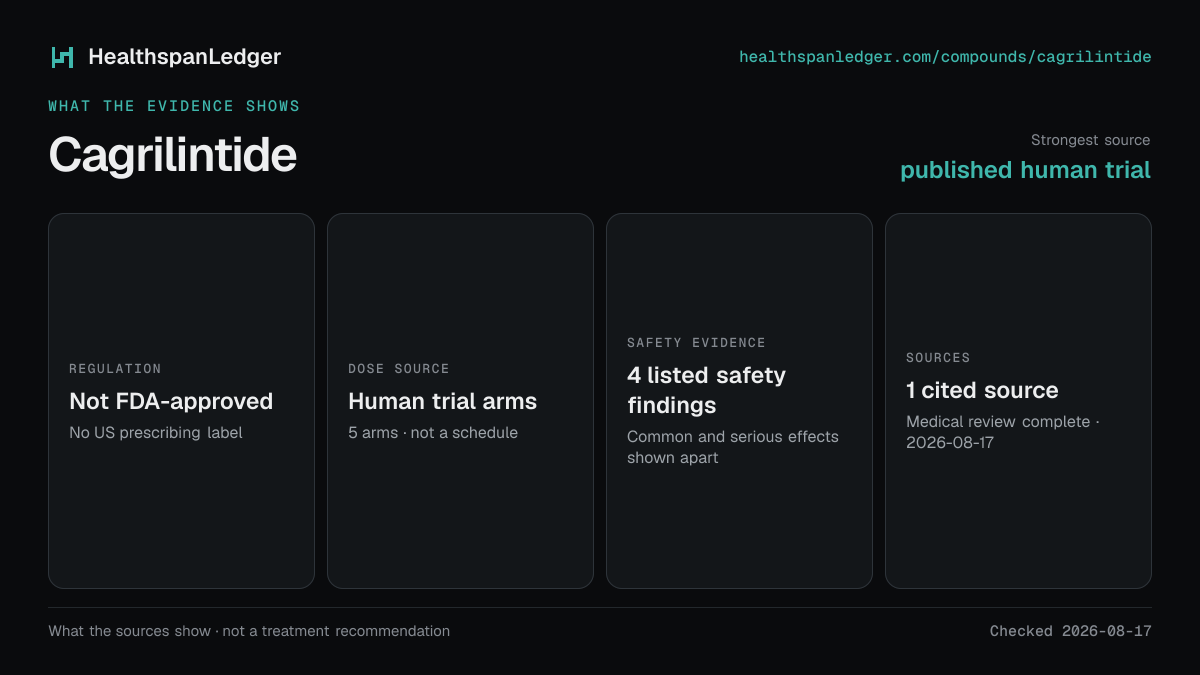
Cagrilintide at a glance: published human trial, dosing basis, regulatory status, safety coverage, and cited-source count. These details summarize the available sources; they are not treatment recommendations.
Evidence snapshot
Published human trial
The fastest way to see what kind of evidence this page is built on.
Regulation
Not FDA-approvedNo US prescribing label
Dose source
Human trial arms5 arms · not a schedule
Safety evidence
4 listed safety findingsCommon and serious effects shown apart
Cagrilintide at a glance: published human trial, dosing basis, regulatory status, safety coverage, and cited-source count. These details summarize the available sources; they are not treatment recommendations.
What each dose produced in the trial
These are the doses the trial gave and the weight change it reported for each one. It is a record of one experiment, not a schedule — no regulator has reviewed any of these doses.
Average weight change from the start of the trial, by weekly dose · the dashed rule marks placebo
0.3 mgnot reported for this group
0.6 mgnot reported for this group
1.2 mgnot reported for this group
2.4 mgnot reported for this group
the dose carried into phase 3 as part of CagriSema
4.5 mg−10.8%
highest arm: −10.8% (11.5 kg)
liraglutide 3.0 mg daily−9.0%
Placebo−3.0%
7Exact trial values — 7 rows in the data table
Cagrilintide — 26-week phase 2 dose-finding trial: average weight change from the start for each dose group
Once-weekly dose
Study group
Average weight change
What the paper notes
0.3 mg
Active
not reported for this group
—
0.6 mg
Active
not reported for this group
—
1.2 mg
Active
not reported for this group
—
2.4 mg
Active
not reported for this group
the dose carried into phase 3 as part of CagriSema
4.5 mg
Active
−10.8%
highest arm: −10.8% (11.5 kg)
liraglutide 3.0 mg daily
Comparator
−9.0%
Another drug tested in the same trial
Placebo
Control
−3.0%
The group used to compare every active dose
What the source does not report for each dose group
Mean weight loss ran 6.0%–10.8% across the cagrilintide arms versus 3.0% on placebo; the abstract reports the 4.5 mg arm individually and the rest as a range.
Source: Lau DCW et al. Once-weekly cagrilintide for weight management: dose-finding phase 2 trial. Lancet 2021;398:2160-72 (PMID 34798060) · retrieved 2026-08-17 · every value is quoted from that paper. 4 of 7 rows have no bar because the source reports no result for that group; drawing a point there would be an estimate, not a finding. Trial results describe averages across a study population, not an individual outcome.
Some bars are missing on purpose. Where the paper gives a range across arms instead of a figure per arm, that arm is left unplotted rather than filled in with a guess. The dashed line marks the placebo arm, so the part of each bar past it is the part the trial puts down to the drug rather than to being in a study.
44 registered studies; the program has reached phase 3, and 10 are still enrolling.
The soonest a running study expects to finish measuring people is January 2027. That is when the sponsor expects to finish collecting the main measurement. It is not a results date, and not a date anything goes on sale.
Some of these study CagriSema, a single injection combining cagrilintide with semaglutide. They test the pair, so they cannot show what cagrilintide does on its own.
Phase 3Recruiting
A Research Study to See How Much CagriSema Lowers Blood Sugar and Body Weight Compared to Placebo in Children and Adolescents With Type 2 Diabetes
Novo Nordisk A/S · Diabetes Mellitus, Type 2 · 80 participants planned · started August 2026
Main measurement due September 2029 (sponsor estimate)
A Research Study to Look at How Two Different Doses of CagriSema and One Dose of Semaglutide Help People Living With Obesity With or Without Type 2 Diabetes Lose Weight
Novo Nordisk A/S · Obesity, Type 2 Diabetes · 2,500 participants planned · started May 2026
Main measurement due February 2028 (sponsor estimate)
A registered study means a sponsor filed a plan and started enrolling. It is not evidence the drug works, and most drugs tested in people never reach a pharmacy. Sponsors write and update these sources themselves; the National Library of Medicine publishes them without checking them.
Cagrilintide is still in trials and is not FDA-approved.
The REDEFINE trials pair it with semaglutide in one shot called CagriSema. There is no approved cagrilintide product or dose. The amounts below come from studies, not a dosing guide.
Investigational compound — no approved dosing exists
Trial doses are study information, not a recommendation
Phase 3 studies cagrilintide co-formulated with semaglutide (CagriSema), not alone
Questions about Cagrilintide
Is Cagrilintide FDA-approved?
No. There is no prescribing label for it, so no approved dose exists — the regulatory status section above has the detail.
How is Cagrilintide taken?
By injection under the skin, once a week. The dosing page has every step, with the source on each row.
How does Cagrilintide differ from the other compounds in this class?
It acts at amylin. Adding or removing a receptor changes the effect. It also changes how much people can tolerate. These molecules are not swappable at the same number of milligrams. Comparing them milligram for milligram is the most common mistake in this category.
The nearest alternatives act elsewhere:
Tirzepatide (GIP + GLP-1)
Semaglutide (GLP-1 alone)
Liraglutide (GLP-1 alone)
Retatrutide (GIP + GLP-1 + glucagon)
Survodutide (glucagon + GLP-1)
Mazdutide (glucagon + GLP-1)
VK2735 (GIP + GLP-1)
Zenagamtide (GLP-1 + amylin)
Pemvidutide (glucagon + GLP-1)
Brenipatide (GIP + GLP-1)
Enicepatide (GIP + GLP-1)
MariTide (GIP + GLP-1)
What is not known about Cagrilintide?
One trial cannot prove long-term safety or show that the result applies to everyone. The highest dose tested is a study dose, not a target for personal use.
For this compound specifically: Mean weight loss ran 6.0%–10.8% across the cagrilintide arms versus 3.0% on placebo; the abstract reports the 4.5 mg arm individually and the rest as a range.
Is there a Cagrilintide dosing schedule on this site?
Not a schedule — there is no approved schedule to publish here. What you get instead is the trial dosing program: the doses each arm received and how the protocol worked up to them. The studied range was 0.3–4.5 mg once a week. See what the trials tested.
Questions readers ask
Is cagrilintide better than semaglutide?
Nobody has run the two against each other, so no head-to-head answers it. The phase 2 trial compared it against liraglutide 3.0 mg daily and placebo. The 4.5 mg arm lost 10.8%, liraglutide 9.0%, placebo 3.0%.
Phase 3 does not pit them against each other either. It combines them in one injection, as CagriSema, and tests the pair.
What is the difference between cagrilintide and tirzepatide?
Different receptors, and different standing. Cagrilintide copies amylin. Amylin acts mainly on a brainstem region that samples blood directly, producing the fullness that ends a meal.
Tirzepatide is a GIP/GLP-1 dual agonist, working on the two gut hormones released after eating. Tirzepatide also has an FDA-approved label, and cagrilintide has none.
What does cagrilintide peptide do?
It is a long-acting copy of amylin, the hormone the pancreas releases with insulin to say the meal is over. Natural amylin clumps and clears fast; this version is rebuilt to hold that signal across a week.
In a 706-participant phase 2 trial, weekly doses ran from 0.3 mg to 4.5 mg. Mean weight loss ran 6.0% to 10.8%, against 3.0% on placebo.
Who should not take cagrilintide?
A label is where that list lives, and cagrilintide does not have one — it is still investigational. Phase 3 studies it combined with semaglutide rather than alone.
The phase 2 trial screened its 706 participants before enrolling them. Those rules belong to that trial, and nobody published them as guidance for anyone else.
1primary source, each with the day we read it — open the documents used on this page