Page last checked
GIP/GLP-1 dual receptor agonist · dosing
Tirzepatide dosage chart: the label’s dosing schedule
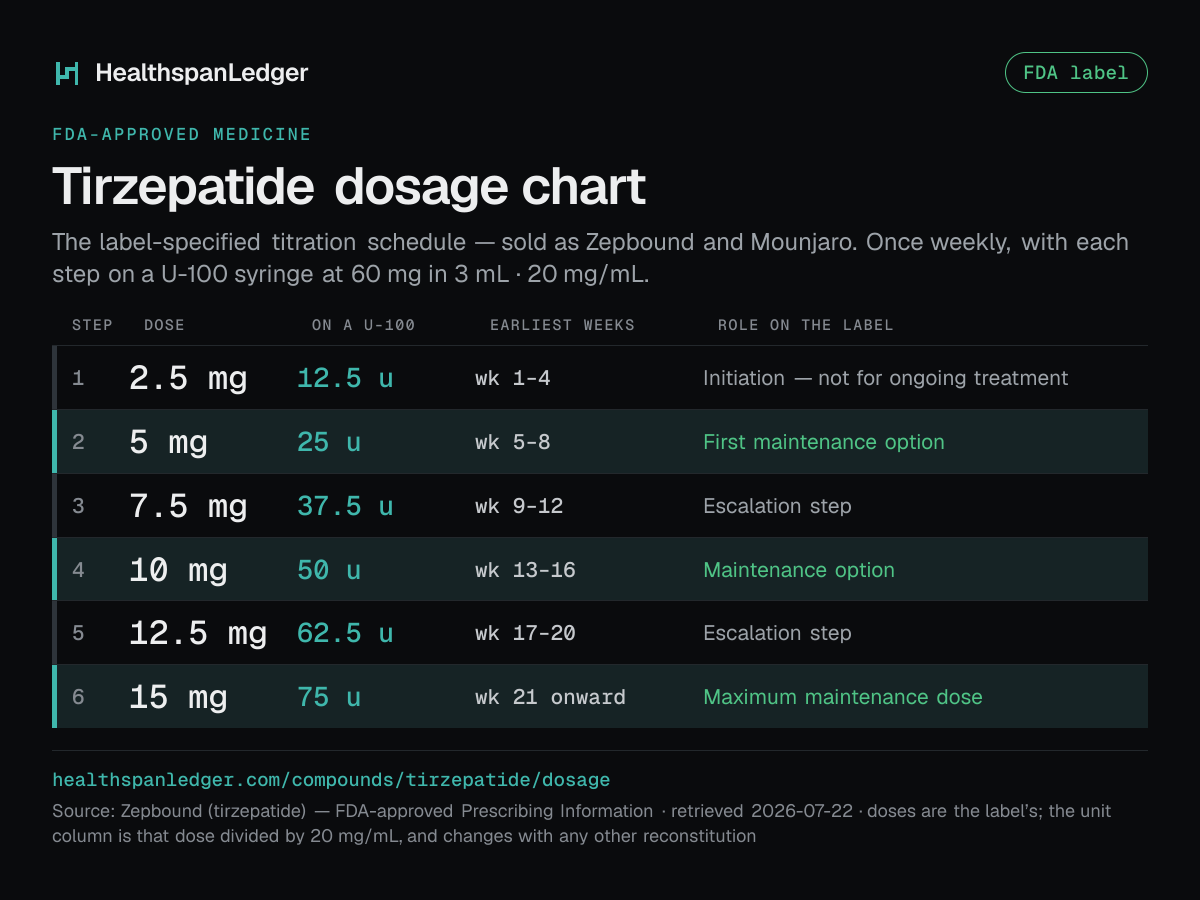
Tirzepatide is started at 2.5 mg once weekly for 4 weeks — an opening dose that is not meant for ongoing treatment. The label then raises it in steps if the current dose is manageable. Maintenance dosing is 5–15 mg once weekly (5, 10, or 15 mg).
Source for this answer
Source: Zepbound (tirzepatide) — FDA-approved Prescribing Information
Source: Zepbound (tirzepatide) — FDA-approved Prescribing Information
Key dose facts
What matters first
- Starting dose
- 2.5 mg once weekly for 4 weeks
- Maintenance range
- 5–15 mg once weekly (5, 10, or 15 mg)
- Where it comes from
- The FDA-approved product label.
Label boundary
Does the FDA label include a tirzepatide microdosing chart?
No. The Zepbound label does not define microdosing or publish a lower-dose chart.
Its first step is 2.5 mg once weekly for 4 weeks, and the label says that dose is not approved as a maintenance dosage. There is no FDA-label microdosing schedule to reproduce. The figures come from the Zepbound prescribing information, fetched 2026-09-19.
The titration schedule
The label raises the dose in steps to reduce stomach and gut side effects. Each step lasts at least four weeks. The next increase comes only if the current dose is manageable.
| Step | Dose | Time at this dose | Earliest start | What this step means |
|---|---|---|---|---|
| 1 | 2.5 mg | ≥ 4 weeks | weeks 1–4 | Initiation — not for ongoing treatment |
| 2 | 5 mg | ≥ 4 weeks | weeks 5–8 | First maintenance option |
| 3 | 7.5 mg | ≥ 4 weeks | weeks 9–12 | Dose increase |
| 4 | 10 mg | ≥ 4 weeks | weeks 13–16 | Maintenance option |
| 5 | 12.5 mg | ≥ 4 weeks | weeks 17–20 | Dose increase |
| 6 | 15 mg | ongoing | week 21 onward | Maximum maintenance dose |
Stay on each step for at least 4 weeks before the next increase. Moving up also depends on how the current dose feels; it is not automatic. The week numbers show the earliest possible start, not a fixed calendar. Source: Zepbound (tirzepatide) — FDA-approved Prescribing Information · retrieved 2026-09-19 · every step cites the label.
Zepbound and Mounjaro dosage — the same molecule under different names
Zepbound and Mounjaro are trade names for tirzepatide. The milligram figures in the table above are properties of the molecule and its cited label, not of the packaging. A branded pen delivers those figures in fixed pre-set increments; a compounded vial reaches the same figures by measurement, which is where the unit arithmetic below comes in.
One caveat that matters more than it looks: each brand carries its own approved label, and those labels do not agree. Two products built on this molecule can differ on who they cover, on where the schedule stops and on how long a missed week can run. The schedule above is the subcutaneous one, from the source cited under the table.
The per-brand schedules are published separately: the Zepbound dose schedule and the Mounjaro dose schedule.
Tirzepatide dosage in units: the same schedule on a syringe
A syringe measures liquid, not milligrams. The table converts each dose above into volume and U-100 syringe units at one example concentration. It does the vial math once for the full schedule.
| Weeks | Dose | Volume | Draw on a U-100 syringe |
|---|---|---|---|
| Weeks 1–4 | 2.5 mg | 0.125 mL | 12.5 units |
| Weeks 5–8 | 5 mg | 0.25 mL | 25 units |
| Weeks 9–12 | 7.5 mg | 0.375 mL | 37.5 units |
| Weeks 13–16 | 10 mg | 0.5 mL | 50 units |
| Weeks 17–20 | 12.5 mg | 0.625 mL | 62.5 units |
| Weeks 21–24and ongoing | 15 mg | 0.75 mL | 75 units |
Illustrative arithmetic at 60 mg in 3 mL bacteriostatic water, shown over a 24-week horizon. The doses are the label’s; the units are division. A different vial size or water volume changes every unit figure in the last column and changes no dose in the second.
4Reference details
Which syringe barrel the units are read on
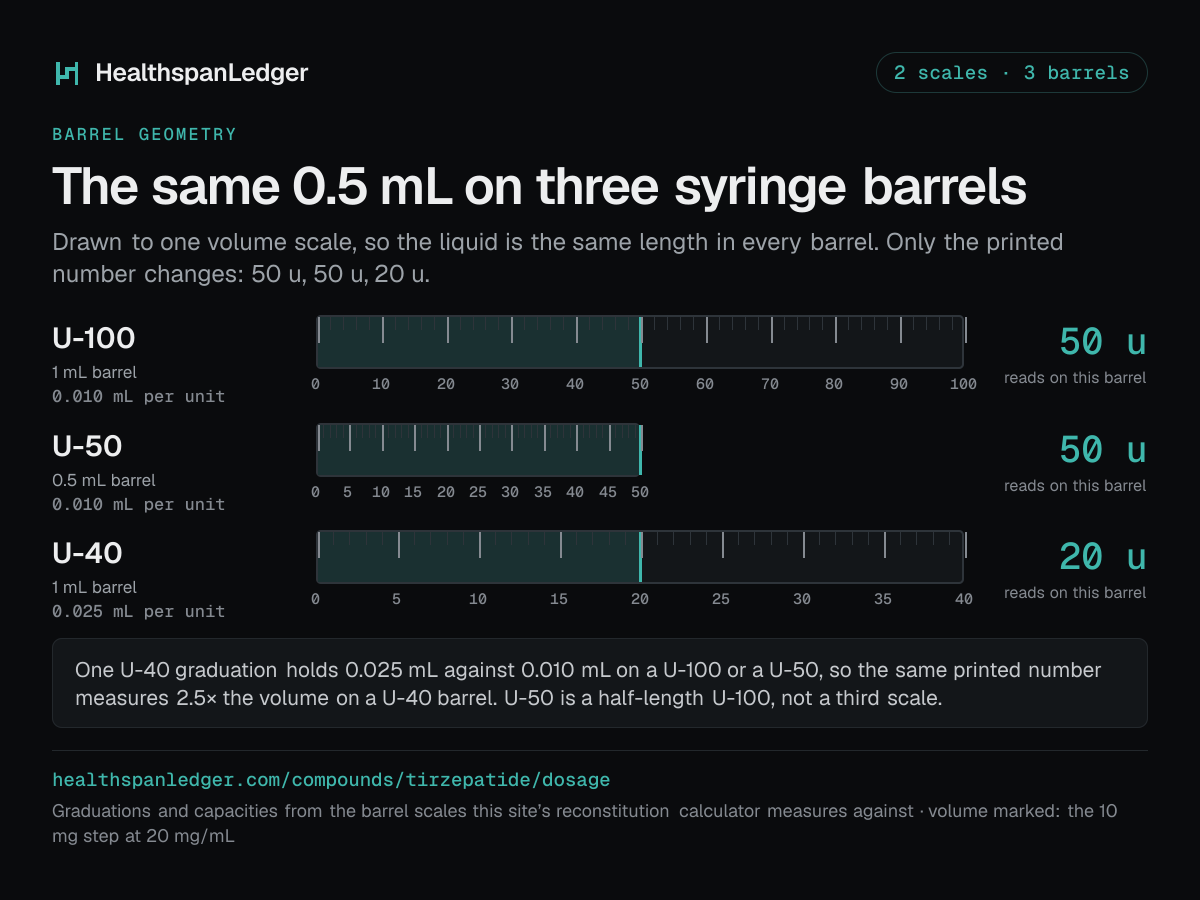
A unit is not a unit. A U-100 and a U-50 barrel both print 0.01 mL per graduation; a U-40 barrel prints 0.025 mL. The same printed number therefore measures 2.5× the volume on a U-40. That is why every unit figure on this page names its barrel. It is also why a unit count copied from someone else’s syringe means nothing on its own.
| Barrel | Capacity | One graduation | 0.5 mL reads as |
|---|---|---|---|
| U-100 insulin syringe · 1 mL · lines every 2 units | 1 mL | 0.010 mL | 50 units |
| U-100 insulin syringe · 0.5 mL · lines every 1 unit | 0.5 mL | 0.010 mL | 50 units |
| U-40 insulin syringe · 1 mL · lines every 1 unit | 1 mL | 0.025 mL | 20 units |
Barrel capacities and graduation spacing are the printed scales this site’s calculator measures against, not estimates. Three barrels carry only two scales: a U-50 is a half-length U-100, so it reads identically per unit and simply runs out sooner.
What one graduation is worth at each concentration
Reconstitution fixes a concentration, and the concentration fixes what a single graduation carries — before anyone decides what to draw. Below is every pairing of this page’s vial sizes and water volumes, as a concentration and as the mass one U-100 graduation holds at it. No dose is implied by any cell; it is division.
| Vial | + 1 mL water | + 2 mL water | + 3 mL water |
|---|---|---|---|
| 5 mg | 5 mg/mL50 mcg per unit | 2.5 mg/mL25 mcg per unit | 1.67 mg/mL16.7 mcg per unit |
| 10 mg | 10 mg/mL100 mcg per unit | 5 mg/mL50 mcg per unit | 3.33 mg/mL33.3 mcg per unit |
| 15 mg | 15 mg/mL150 mcg per unit | 7.5 mg/mL75 mcg per unit | 5 mg/mL50 mcg per unit |
| 30 mg | 30 mg/mL300 mcg per unit | 15 mg/mL150 mcg per unit | 10 mg/mL100 mcg per unit |
| 60 mg | 60 mg/mL600 mcg per unit | 30 mg/mL300 mcg per unit | 20 mg/mL200 mcg per unit |
Vial strengths and water volumes are the Tirzepatide record’s own presets. One U-100 graduation is 0.01 mL, so the mass it carries is the concentration times that volume. That is the entire reason the same milligram figure produces a different unit count in every row.
How dosing works in this class
Why the dose escalates instead of starting where it ends
The dose climbs in steps for one reason: how well people tolerate it, not how well it works. The receptors that produce the effect you want are the same ones that slow your stomach down, and your gut reacts hardest when the exposure is new. Hold it steady and the reaction fades. Stepping up gradually is a way of using that — each step is a stretch of time for your body to settle at where it is before the next increase arrives.
The length of each step matters. Shortening it moves the next increase into a period when the body may not have adjusted. Labels and trial plans state the intervals that were tested. A faster ramp was not tested.
What the starting dose does, and what dose people stay on
The first step is chosen to help the body adjust. It may be too low to produce the intended effect. That is why a starting dose is sometimes called non-therapeutic. Judging the drug by this step alone can be misleading.
A maintenance dose is one a person may stay on. Some schedules list more than one option. In that case, the highest step is not automatic. A clinician chooses the dose for each person.
Concentration changes the units, not the dose
The dose and the syringe draw are two different things. The dose is a mass in milligrams. The draw is a volume in syringe units. It depends on the concentration after mixing. Adding more bacteriostatic water changes the unit reading, but not the dose.
This matters because a unit count copied from someone else’s vial means nothing without their concentration. That mismatch is the most common way a self-injected dose ends up ten times off. The arithmetic is fixed and safe to state as fact. The dose you apply it to is a clinical decision, and it is not.
A missed Tirzepatide dose
A once-weekly injection turns one mistake into two different problems. Leave it too long and the gap in exposure widens, which can push the next step back. Take it too soon and a new dose stacks on top of drug that has not cleared yet. A missed-dose rule is the window a label draws between those two, which is why it comes as a stretch of time rather than a single instruction.
Missed dose: take within 4 days (96 h), otherwise skip; keep doses ≥ 72 h apart
Compounded vial?
Branded Tirzepatide ships in pens. If a licensed pharmacy dispensed a vial instead, the calculator converts any dose on this schedule into an exact draw for your syringe.
Open the Tirzepatide calculator →Questions about Tirzepatide dosing
What are the typical Tirzepatide dosages?
The label prints 6 steps, from 2.5 mg up to 15 mg once weekly for 4 weeks. Only 5–15 mg is dosing the label treats as ongoing. The others are steps on the way, and no figure outside that ladder appears in the document this page quotes.
How fast can the Tirzepatide dose increase?
No faster than the schedule above. Each step holds for at least 4 weeks before the next increase, and the increase is conditional on the current step being tolerated rather than automatic. The FDA-approved label specifies that interval — a compressed ramp is not a faster version of the schedule, it is an untested one.
What if side effects make the next step too hard?
The next increase is optional, not automatic. The label allows a longer stay at the current step when needed. A clinician decides what happens after a dose is hard to handle; the schedule alone cannot make that decision.
Does the starting Tirzepatide dose treat the condition?
No. The label calls 2.5 mg once weekly for 4 weeks a starting dose. It sits below the amount expected to produce the intended effect. Its job is to make the later steps easier to handle.
What is the highest Tirzepatide dose on the page?
15 mg is the last step on the schedule above, described on the label as: maximum maintenance dose. Higher is not an extension of the chart; it is outside the document the chart comes from, and this page has nothing sourced to say about it.
Does a compounded vial change the schedule?
No. The dose is a mass in milligrams and comes from the source; the draw is a volume in syringe units and comes from dividing that mass by the concentration reconstitution produced. Adding more bacteriostatic water to the same vial changes every unit figure and changes no dose at all. That is also why a unit count copied from someone else’s vial means nothing without their concentration.
Why do some compounds here have a chart and others do not?
Because a chart is a claim about provenance, not a formatting choice. Where an FDA-approved label specifies a schedule, this site quotes it row by row and cites the label under the table. Where no label exists, the guide shows what trials tested and says plainly that it is not a schedule.
What should you know about a missed Tirzepatide dose?
The rule on the page is quoted above, verbatim: Missed dose: take within 4 days (96 h), otherwise skip; keep doses ≥ 72 h apart. It is reproduced rather than paraphrased, because paraphrasing an interval is how intervals drift.
Where to go next on Tirzepatide
Why compounded tirzepatide stopped being legal
Every reaction on the tirzepatide page, with its frequency
Tirzepatide milligrams to units, step by step
What the Zepbound label approves, separate from tirzepatide
Where tirzepatide is injected, and what each step is in units
Mounjaro doses, read off a label and not off tirzepatide
- Zepbound (tirzepatide) — FDA-approved Prescribing Informationretrieved 2026-09-19FDA label