Page last checked
FDA-approved medicine
Semaglutide Wegovy · Ozempic · Rybelsus
Semaglutide is the drug in Wegovy, Ozempic and Rybelsus. It copies a gut hormone called GLP-1, which helps control appetite and blood sugar.
What matters first
- Why people look it up
- People take Wegovy for long-term weight management, and Ozempic or Rybelsus for type 2 diabetes.
- What the evidence shows
- All three products have FDA approval. Wegovy and Ozempic are weekly injections; Rybelsus is a daily tablet, and each has its own schedule.
- Dose status
- With semaglutide, you start at 0.25 mg once a week for the first 4 weeks. That opening step is not the working dose — it is there to let your body get used to the drug before the label steps it up toward 1.7–2.4 mg.
What is known about Semaglutide
Semaglutide is the drug in Wegovy, Ozempic and Rybelsus. Wegovy is FDA-approved for long-term weight management, and Ozempic for type 2 diabetes. The weekly injection starts at 0.25 mg. The dose may rise every 4 weeks toward 1.7 mg or 2.4 mg.
| Topic | Value |
|---|---|
| Strongest source | FDA label |
| FDA approval | Approved (Wegovy, Ozempic, Rybelsus) |
| Starting dose | 0.25 mg once weekly for 4 weeks — from the FDA-approved label |
| Maintenance dosing | 1.7–2.4 mg once weekly — from the FDA-approved label |
| Half-life | ≈ 7 days |
| Typical vials | 2 mg · 5 mg · 10 mg |
Every row links back to a source listed below. These facts are for reference, not a personal recommendation.
How Semaglutide works
Semaglutide acts at GLP-1 alone. Here is what that means.
GLP-1 is a hormone your gut releases when you eat. It lasts only a few minutes — an enzyme called DPP-4 breaks it down almost straight away — so the natural signal is a short burst after a meal. A GLP-1 receptor agonist is a redesigned copy of that hormone, built to survive the enzyme and to stick to proteins in your blood. That stretches a few minutes into a signal one weekly injection can hold. Everything these drugs do follows from one receptor staying switched on far longer than your body ever intended.
| Receptor | Semaglutide | What it does |
|---|---|---|
| GLP-1 | pancreatic isletTells the pancreas to release more insulin, but only while blood sugar is already climbing, and to hold back glucagon at the same time. Because it acts only when sugar is rising, this class does not on its own push blood sugar below normal the way insulin or a sulfonylurea can.stomach and gutSlows how fast food leaves your stomach, so a meal empties gradually and you stay full for longer. This is also where the nausea, early fullness and constipation come from. The effect people want and the effect they complain about are the same effect.hindbrain and hypothalamusActs on the parts of the brain that decide when a meal is over and how appealing food seems. Appetite drops rather than having to be fought off, and most of the weight effect comes from here — not from the stomach. | |
| GIP | — | |
| Glucagon | — | |
| Amylin | — |
The same four receptor groups are shown for every drug, so the differences are easy to compare. Targets come from the drug class. Any result specific to Semaglutide comes from the cited sources.
Single-target GLP-1 drugs are the yardstick for every newer molecule. They act on one receptor, and their effects are well mapped. Stomach and gut side effects often limit how high the dose can go. Dual and triple agonists add other receptors in an effort to push past that limit.
What repeated weekly dosing accumulates to
A new dose can arrive before the prior one has cleared. The amount then rises toward a steady pattern over several doses. The curve uses one cited figure: the 7 days half-life. It is arithmetic, not a measurement of anyone’s blood.
Estimated amount compared with one dose, taken once weekly. Based on the cited half-life, not on blood test results.
| Week | Just after that dose | Just before the next dose | Toward long-term level |
|---|---|---|---|
| 1 | 1.00× | 0.50× | 50% |
| 2 | 1.50× | 0.75× | 75% |
| 3 | 1.75× | 0.88× | 87% |
| 4 | 1.88× | 0.94× | 94% |
| 5 | 1.94× | 0.97× | 97% |
| 6 | 1.97× | 0.98× | 98% |
| 7 | 1.98× | 0.99× | 99% |
| 8 | 1.99× | 1.00× | 100% |
| 9 | 2.00× | 1.00× | 100% |
| long-term level | 2.00× | 1.00× | 100% |
This is a math estimate based on the cited half-life of 7 days. Each dose is added to what has not yet left the body, so the curve rises toward 2.00× one dose — within 5% of that level by week 5. This is not a measured blood level and does not predict one person’s result. Source of the half-life: Wegovy (semaglutide) — FDA-approved Prescribing Information (DailyMed) · retrieved 2026-08-20.
What the evidence for Semaglutide is
The dosing numbers come from an FDA-approved prescribing label. FDA reviewed the manufacturer’s studies before approving the product, and the label can change when new dosing or safety information appears.
- What it establishes
- What it does not establish
Use these numbers for the named product and approved use. A different brand, product form or use may have a different schedule.
Evidence snapshot and shareable image
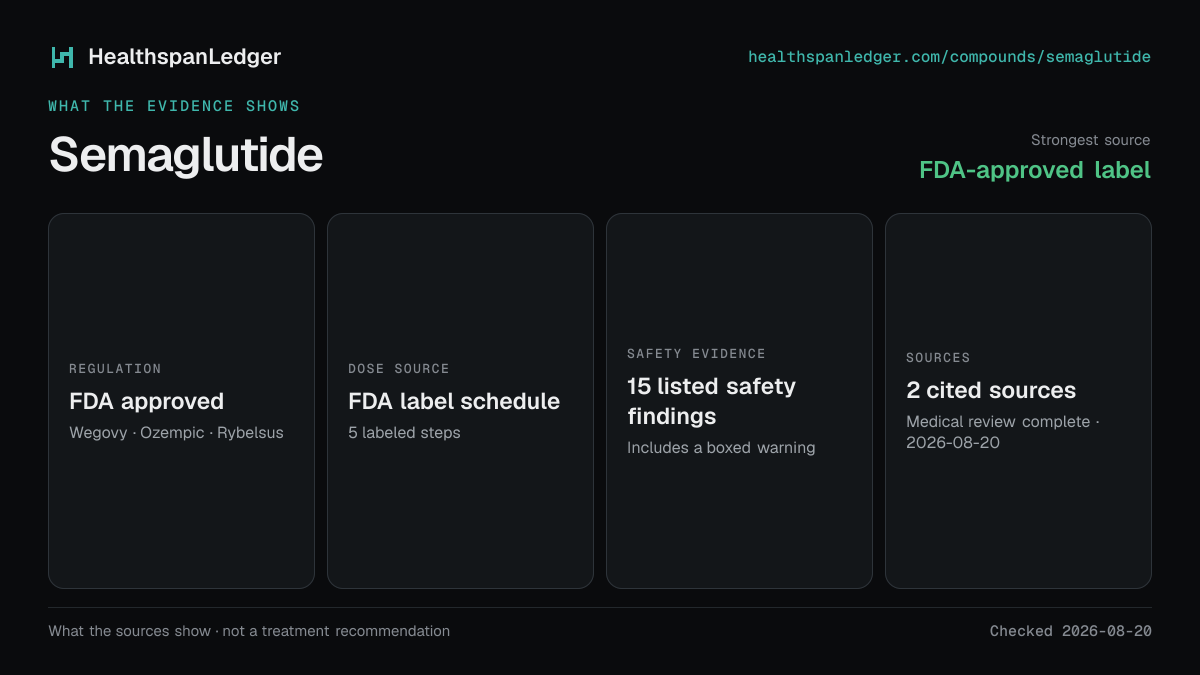
Evidence snapshot
FDA-approved label
- Regulation
- Dose source
- Safety evidence
- Sources
Where Semaglutide is in clinical trials
540 registered studies; the program has reached phase 4, and 119 are still enrolling.
The soonest a running study expects to finish measuring people is September 2026. That is when the sponsor expects to finish collecting the main measurement. It is not a results date, and not a date anything goes on sale.
- Phase 4Recruiting
- Phase 4Recruiting
- Phase 4Recruiting
ClinicalTrials.gov · retrieved 2026-09-27
Regulatory status
FDA has approved the branded pens, and the oral tablet Rybelsus.
FDA declared the semaglutide shortage resolved in February 2025. Mass compounding has wound down since. FDA has also proposed dropping it from the 503B bulks list.
Semaglutide is not on FDA’s shortage list, checked 14 August 2026. That matters here because shortage listing is what allowed compounded copies, and it is the one part of this page that can change any day.
Full regulatory tracker →How Semaglutide compares
Each page says which kind of comparison it is: one trial that tested both, or two separate trials read side by side — which is much weaker, however close the numbers look.
The weight-loss evidence by goal
Where to go next on Semaglutide
The related pages keep each topic with its evidence.
How long each semaglutide step is held before the next
Every reaction on the semaglutide page, with its frequency
What each water volume does to the 2 mg semaglutide vial
Reconstituting semaglutide at 5 mg, step by step
The semaglutide reconstitution calculator for mixing math
Wegovy access in United Kingdom, from semaglutide
The label behind Ozempic, separate from semaglutide in general
What Wegovy treats, alongside the semaglutide medicine guide
What semaglutide adds to the alcohol evidence
Semaglutide injection sites, timing and rotation
Safety notes
Questions about Semaglutide
Is Semaglutide FDA-approved?
How is Semaglutide taken?
How does Semaglutide differ from the other compounds in this class?
What is not known about Semaglutide?
Is there a Semaglutide dosing schedule on this site?
Questions readers ask
How long to lose 30 pounds on semaglutide?
What is the downside of semaglutide?
Is semaglutide the same as Ozempic?
Does semaglutide get rid of belly fat?
- Wegovy (semaglutide) — FDA-approved Prescribing Information (DailyMed)retrieved 2026-08-20FDA label