MOTS-c is a peptide sixteen amino acids long. What makes it unusual is where it is coded: inside mitochondrial DNA, not in the cell nucleus that codes for nearly everything else.
What matters first
Why people look it up
It is sold for fat loss, exercise capacity and metabolic aging, on the observation that blood levels fall as people get older.
What the evidence shows
The metabolic results are mouse experiments, injected into the abdomen. Levels do fall with age in people. But falling with age is not the same as helping when topped up, and nobody has tested the second thing. No trial has published a dose for a person.
Dose status
No completed controlled human trial has shown which dose works for MOTS-c. A few people may have received it in small reports, but that cannot show which dose works. The sections below separate study findings from what people report using.
That is the answer to the chart question too. A dosage chart is a schedule an agency has reviewed and a manufacturer is held to. MOTS-c has been through none of that, so there is no MOTS-c dosing chart to publish and no starting dose to quote. Vendors print one anyway. What a dosage chart is, and which compounds here have one.
MOTS-c is a sixteen-residue peptide read from an open reading frame inside mitochondrial DNA — one of a small set encoded by the mitochondrial genome rather than the nuclear one, which is why its 2015 description attracted attention well beyond metabolism laboratories. In mice it shifts folate-methionine metabolism, activates AMPK and improves insulin sensitivity, and circulating levels in people fall with age. No trial has ever published a dose for it in people, so there is no human figure to report — only what the mouse work showed.
MOTS-c research and regulatory details: evidence quality, approval status, doses, handling, and presentation.
Topic
Value
Strongest source
no human dose shown to work
FDA approval
Not FDA-approved
Typical vials
5 mg · 10 mg
Every row links back to a source listed below. These facts are for reference, not a personal recommendation.
What the evidence for MOTS-c is
No completed controlled human trial has shown which dose works. People may report using a range, but that is not a tested dosing schedule.
no human dose shown to work
What it establishes
Animal studies or small reports can show that researchers are exploring the compound. They cannot show which dose works in people.
What it does not establish
A validated dose, schedule, duration, safety margin, or reliable figure for how long it stays in the body.
If a number appears, it describes what people report using. It is not a trial result or a recommendation. If there is no number, no study has produced one.
Evidence snapshot and shareable image
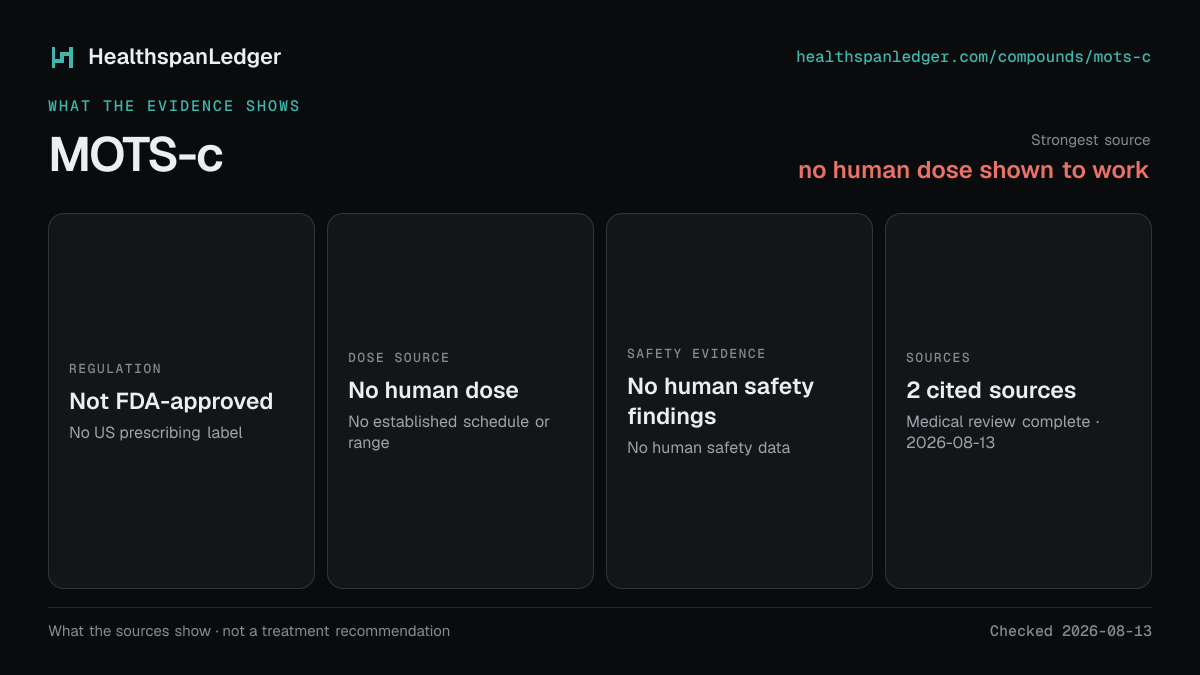
MOTS-c at a glance: no human dose shown to work, dosing basis, regulatory status, safety coverage, and cited-source count. These details summarize the available sources; they are not treatment recommendations.
Evidence snapshot
No human dose shown to work
The fastest way to see what kind of evidence this page is built on.
Regulation
Not FDA-approvedNo US prescribing label
Dose source
No dose listedSee the guide for evidence limits
Safety evidence
No safety findings listedAn empty list does not establish safety
MOTS-c at a glance: no human dose shown to work, dosing basis, regulatory status, safety coverage, and cited-source count. These details summarize the available sources; they are not treatment recommendations.
Where MOTS-c is in clinical trials
No trial of this compound is registered on ClinicalTrials.gov.
That is worth sitting with. Nobody has registered a study to find out whether MOTS-c works in people, so no result is coming and no date is worth waiting for. Sellers are not waiting for that work either.
We left one registration out of the count above. Registering a study does not prove it is running, and these did not hold up.
NCT07505745 — template batch: 7 of 8 studies from “Hudson Biotech” claim the same primary completion date 2027-02-14, all at Peking University Shenzhen Hospital; NCT07481734 declares itself an example
Check them yourself and disagree with us if you think we got it wrong.
A registered study means a sponsor filed a plan and started enrolling. It is not evidence the drug works, and most drugs tested in people never reach a pharmacy. Sponsors write and update these sources themselves; the National Library of Medicine publishes them without checking them.
Everything published on MOTS-c is preclinical or observational.
That means mouse studies and cell work. It also means human data linking natural blood levels to age and fitness. No trial has reported giving it to people.
FDA’s advisory committee took it up on 23 July 2026, for obesity and osteoporosis. The nominator had already withdrawn, and FDA went ahead anyway. FDA, not the committee, proposed against adding it to the 503A bulks list.
No trial has published a dose for MOTS-c in people. A trial registration exists, but it comes from a set of eight entries by one sponsor in which three openly describe themselves as fictional example records, so it is not evidence anyone has been dosed
Everything else is mouse metabolic work plus human association data: circulating levels tracking with age and fitness does not establish that supplying more of it helps
The mouse work does have exact quantities. Every one is per kilogram and goes into the abdominal cavity: 0.5 mg/kg a day in the obesity-prevention runs, 5 mg/kg a day in the short insulin experiments, 15 mg/kg a day in the aging work. No study in any species used an injection under the skin, which is the route this vial is sold for
No peer-reviewed paper prints a self-administration quantity for MOTS-c. Two 2026 reviews list it among the compounds people take unsupervised and give no figure for it. So there is not even a circulating convention to report with its provenance attached
The human measurements do not agree with one another. Published resting blood levels span from picograms to hundreds of nanograms per milliliter across studies. An anti-doping laboratory that built a mass-spectrometry method could not reproduce what the antibody kits were returning
A trial participant receives investigational material of tested identity and strength, under monitoring, alongside standardized lifestyle counseling — none of which travels with a vial bought elsewhere
FDA evaluated the substance for obesity and osteoporosis at its July 2026 advisory-committee meeting and proposed against adding it to the 503A bulks list; no outcome document has been published since
Questions about MOTS-c
Is MOTS-c FDA-approved?
No. There is no prescribing label for it, so no approved dose exists — the regulatory status section above has the detail.
How is MOTS-c taken?
No completed controlled human trial has established a dose, frequency, or route, so no human schedule is published.
How does MOTS-c differ from the other compounds in this class?
MOTS-c works through a different system from GLP-1 and amylin drugs. No completed human study has set a dose, so a direct comparison would be misleading.
What is not known about MOTS-c?
A validated dose, schedule, duration, safety margin, or reliable figure for how long it stays in the body.
Questions readers ask
What is Mot C good for?
Nothing has been established in people, because no published study has given it to anyone. In mice it shifted folate and methionine metabolism, switched on AMPK, and improved insulin sensitivity.
The human work is observation alone. Researchers measure what already circulates and watch it fall with age. That tells you the level moves; it does not tell you that topping it up helps.
Is MOTS-c legal to buy?
It is not an approved medicine anywhere, and no regulator inspects what a vial sold under this name contains. FDA’s compounding committee took it up in July 2026 for obesity and osteoporosis, and the agency proposed against letting pharmacies prepare it.
That proposal is not a ban, and no outcome document has appeared since. What sellers ship is labeled for laboratory research, which describes the paperwork rather than what a buyer does with it.
What are the side effects of MOTS-c?
None have been published because no study has given it to a person. Without human data, there is no evidence-based side-effect table to show.
The mouse work used quantities per kilogram into the abdominal cavity, from half a milligram a day up to fifteen. No study in any species used an injection under the skin, which is the route the vial is sold for.
Is MOTS-c good for weight loss?
No trial in people has tested that. The mouse arms people point to ran on a sixty-percent fat diet. Half a milligram per kilogram a day for eight weeks was the arm where they gained less weight.
Gaining less on a fixed laboratory diet is a different claim from a person losing weight. Nobody has carried it across, and the peptide has never reached a human dosing study.
2primary sources, each with the day we read it — open the documents used on this page