34 of the 51 compounds in this trial census are being tested in registered clinical trials. The other 17 are not. That second number is the one worth knowing, because most of them are sold anyway.
Everything below is read from ClinicalTrials.gov, the public register where anyone running a study in people is meant to file it. We read it on September 27, 2026 and saved what it said, so the dates on this page are dated too.
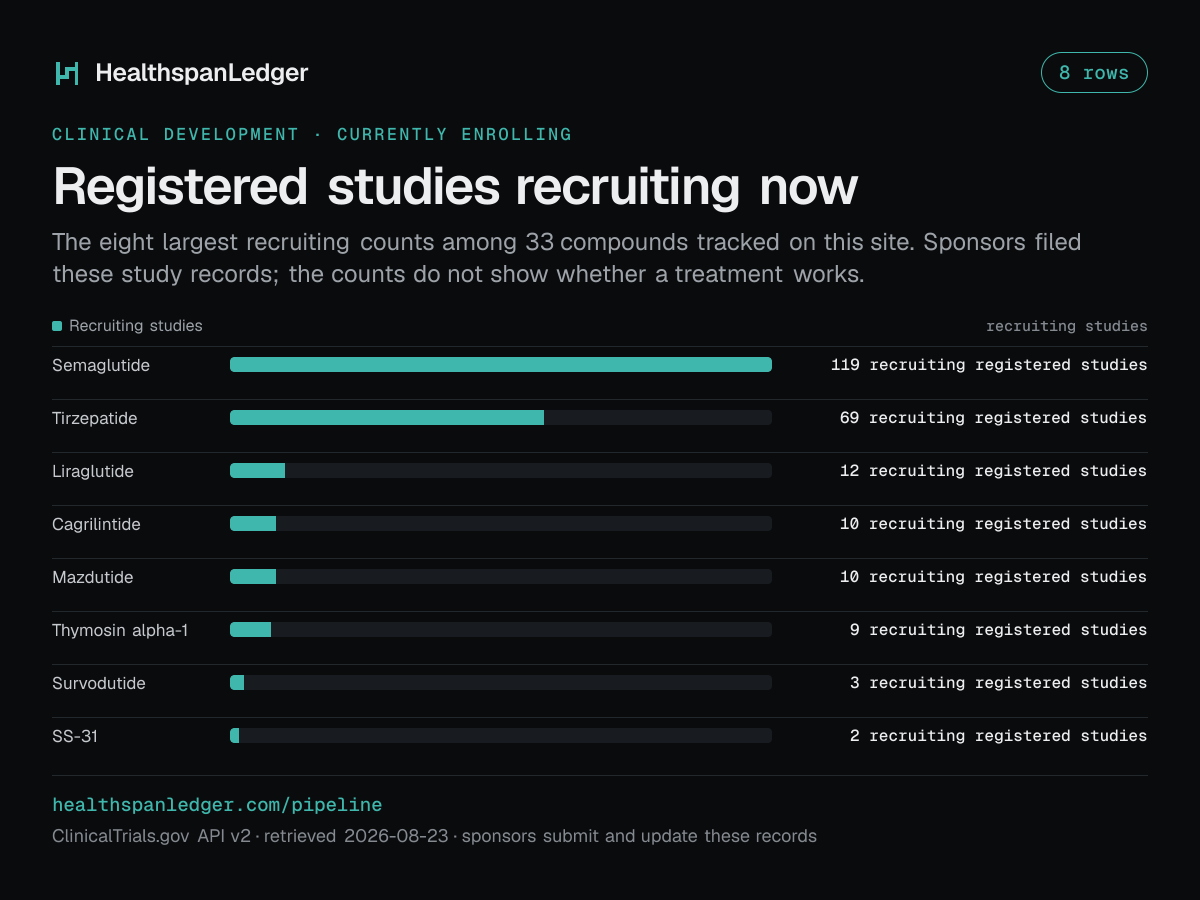
The eight largest recruiting counts in the tracked ClinicalTrials.gov census, retrieved 2026-09-27. A registered study is not proof that a compound works.
The forward calendar
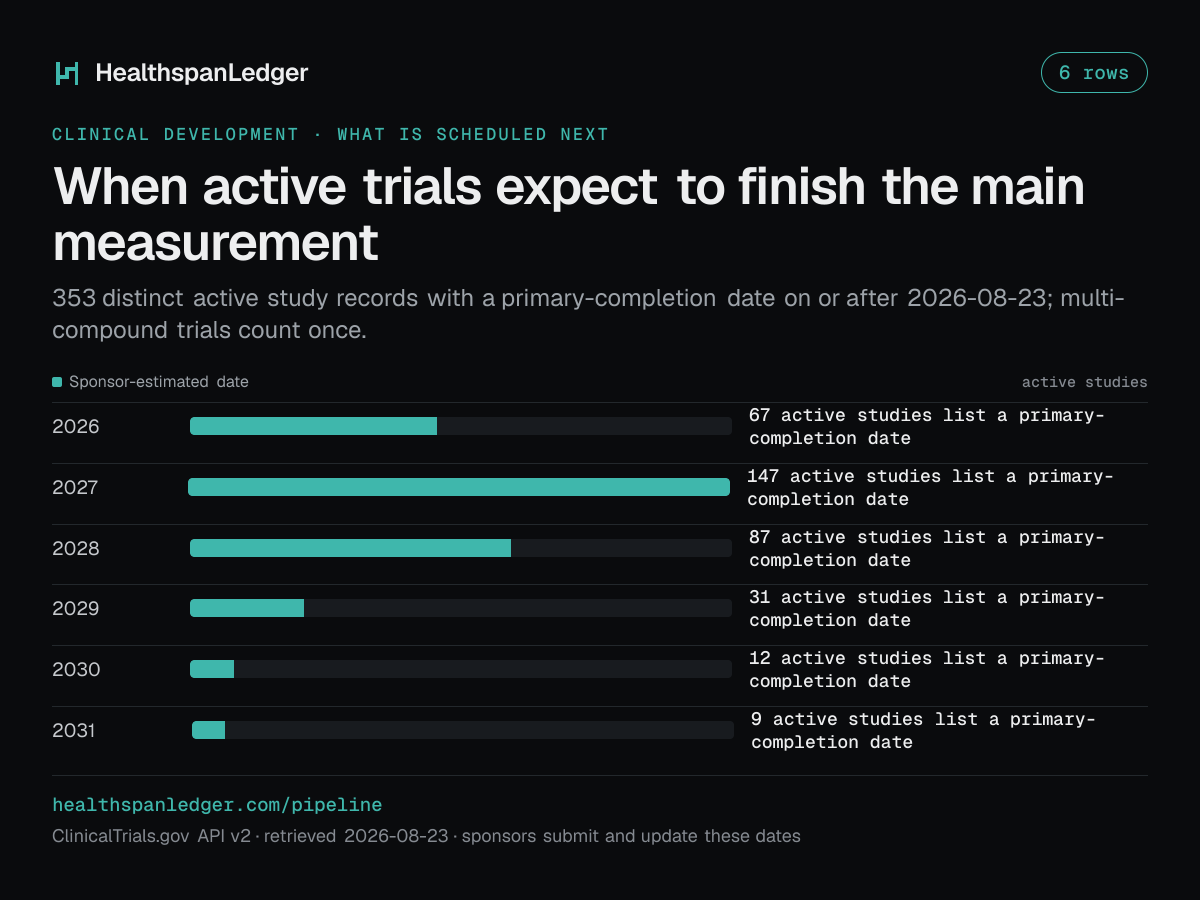
When active trials expect to finish the main measurement
500 active registered studies list a main-measurement date on or after September 27, 2026. 2027 has the largest current group: 208 studies.
Every future date in this snapshot is sponsor-estimated. A date tells you when the sponsor expects to finish collecting the main measurement. It does not tell you when a result, approval or product will arrive.
ClinicalTrials.gov calendar retrieved 2026-09-27. These are sponsor-filed primary-completion dates, not result dates, approval dates or launch dates.
What the chart measures: Unique active studies by Primary-completion year. It also records Sponsor-estimated dates and Compound-study associations without treating a study of two compounds as two separate trials.
120
active records still carry a main-measurement date in the past. That can be registry update lag; it is not proof that a result exists or that a study failed.
1
active registry record hasno main-measurement date. It staysoutside the future calendar instead of being assigned a year.
What a trial does and does not tell you
A registered study means a sponsor filed a plan and set out to test something. It does not mean the drug works. Most drugs that get tested in people fail, and failing is the normal outcome, not a scandal.
The dates are the part people misread most. Each study has a date the sponsor expects to finish measuring people. That is not the day results appear, and it is not the day anything goes on sale. After it come the analysis, the filing and the review, and any of the three can end the whole thing.
One more thing worth knowing: sponsors write these sources themselves. Nobody checks them before they go up.
Still enrolling people
These are the compounds with at least one study open to new participants on the day we read the register.
Furthest along first. The stage shown is the most advanced study that gives the compound to people — not a study that merely measures it.
Phase 4
A study run after the drug is already approved and on sale.
Phase 3
A large study comparing the drug against placebo or an existing treatment. This is the stage a regulator expects before approval — reaching it is not the same as passing it.
Phase 2
A mid-sized study looking for a dose that does something useful, and for the side effects that come with it.
Phase 1
A small safety study, usually in a few dozen people, testing how the drug is handled and tolerated rather than whether it works.
44 registered studies · 10 still enrolling · next main measurement due January 2027
Some of these study CagriSema, a single injection combining cagrilintide with semaglutide. They test the pair, so they cannot show what cagrilintide does on its own.
Phase 3Recruiting
A Research Study to See How Much CagriSema Lowers Blood Sugar and Body Weight Compared to Placebo in Children and Adolescents With Type 2 Diabetes
Novo Nordisk A/S · Diabetes Mellitus, Type 2 · 80 participants planned · started August 2026
Main measurement due September 2029 (sponsor estimate)
5 registered studies · 1 still enrolling · next main measurement due June 2028
Phase 3Recruiting
AMBITION 7: A Research Study Investigating How Well Zenagamtide Lowers Blood Sugar and Body Weight Compared to Insulin Glargine in People With Type 2 Diabetes and Increased Risk of Diseases That Affect the Heart and Blood Vessels Treated With 1-3 Other Diabetes Medications
Novo Nordisk A/S · Type 2 Diabetes, Cardiovascular Risk · 1,778 participants planned · started August 2026
A Randomized, Double Blind, Placebo-Controlled, Multi-Center Phase III Study in Men With Acquired Hypogonadotropic Hypogonadism to Compare Changes in Testosterone and Sperm Concentration Following Treatment With 12.5 mg or 25 mg Androxal or AndroGel 1.62%
Repros Therapeutics Inc. · Secondary Hypogonadism · 120 participants · started January 2014
48 Weeks, Study to Evaluate Overall Safety and Tolerability of Co-administration of Tesofensine and Metoprolol in Subjects With Hypothalamic Injury-induced Obesity (HIO)
Saniona · Hypothalamic Injury-induced Obesity (HIO) · 21 participants · started February 2019
Nobody has filed a study to find out whether these work in people. There is no result on the way and no date to wait for. They are still sold, and the selling is not waiting on the evidence.
Being on the register is not proof a study is real. 36 records were left out of every count on this page. Some say in their own text that they are examples; the rest came from the same account, filed on one day, at one hospital, all claiming to finish on the same date.
This matters more than it sounds. Four of them were the only trial on the register for a compound we cover, so taking them at face value would have turned “nobody has tested this” into “a phase 2 trial is recruiting”. They are listed here so you can read them and disagree.
NCT07481747 — template batch: 7 of 8 studies from “Hudson Biotech” claim the same primary completion date 2027-02-14, all at Peking University Shenzhen Hospital; NCT07481734 declares itself an example
NCT07467447 — template batch: 7 of 8 studies from “Hudson Biotech” claim the same primary completion date 2027-02-14, all at Peking University Shenzhen Hospital; NCT07481734 declares itself an example
NCT07437547 — template batch: 7 of 8 studies from “Hudson Biotech” claim the same primary completion date 2027-02-14, all at Peking University Shenzhen Hospital; NCT07481734 declares itself an example
NCT07481734 — self-declared example: title declares itself an example (“Mock Stud”)
NCT07487363 — self-declared example: brief summary declares itself an example (“fictional”)
NCT07437586 — template batch: 7 of 8 studies from “Hudson Biotech” claim the same primary completion date 2027-02-14, all at Peking University Shenzhen Hospital; NCT07481734 declares itself an example
NCT07505745 — template batch: 7 of 8 studies from “Hudson Biotech” claim the same primary completion date 2027-02-14, all at Peking University Shenzhen Hospital; NCT07481734 declares itself an example
NCT07437560 — self-declared example: brief summary declares itself an example (“This example”)
NCT00496860 — alias identity mismatch: matched only a non-primary development code, and lead sponsor “Altor BioScience” does not match a registry record linking that code to “pemvidutide”
NCT01029873 — alias identity mismatch: matched only a non-primary development code, and lead sponsor “Altor BioScience” does not match a registry record linking that code to “pemvidutide”
NCT01326871 — alias identity mismatch: matched only a non-primary development code, and lead sponsor “Altor BioScience” does not match a registry record linking that code to “pemvidutide”
NCT01478074 — alias identity mismatch: matched only a non-primary development code, and lead sponsor “Altor BioScience” does not match a registry record linking that code to “pemvidutide”
NCT01625260 — alias identity mismatch: matched only a non-primary development code, and lead sponsor “Altor BioScience” does not match a registry record linking that code to “pemvidutide”
NCT01670994 — alias identity mismatch: matched only a non-primary development code, and lead sponsor “Altor BioScience” does not match a registry record linking that code to “pemvidutide”
NCT01568528 — self-declared example: detailed description declares itself an example (“fictional”)
NCT01834261 — self-declared example: detailed description declares itself an example (“fictional”)
NCT04548453 — self-declared example: detailed description declares itself an example (“this example”)
NCT00214500 — alias identity mismatch: sponsor/title identifies migalastat (GR181413A); the derived larazotide term collides through reused AT1001
NCT00283933 — alias identity mismatch: sponsor/title identifies migalastat (GR181413A); the derived larazotide term collides through reused AT1001
NCT00283959 — alias identity mismatch: sponsor/title identifies migalastat (GR181413A); the derived larazotide term collides through reused AT1001
NCT00304512 — alias identity mismatch: sponsor/title identifies migalastat (GR181413A); the derived larazotide term collides through reused AT1001
NCT00526071 — alias identity mismatch: sponsor/title identifies migalastat (GR181413A); the derived larazotide term collides through reused AT1001
NCT00925301 — alias identity mismatch: sponsor/title identifies migalastat (GR181413A); the derived larazotide term collides through reused AT1001
NCT01196871 — alias identity mismatch: sponsor/title identifies migalastat (GR181413A); the derived larazotide term collides through reused AT1001
NCT01218659 — alias identity mismatch: sponsor/title identifies migalastat (GR181413A); the derived larazotide term collides through reused AT1001
NCT01458119 — alias identity mismatch: sponsor/title identifies migalastat (GR181413A); the derived larazotide term collides through reused AT1001
NCT01476163 — alias identity mismatch: sponsor/title identifies migalastat (GR181413A); the derived larazotide term collides through reused AT1001
NCT01730469 — alias identity mismatch: sponsor/title identifies migalastat (GR181413A); the derived larazotide term collides through reused AT1001
NCT01730482 — alias identity mismatch: sponsor/title identifies migalastat (GR181413A); the derived larazotide term collides through reused AT1001
NCT01853852 — alias identity mismatch: sponsor/title identifies migalastat (GR181413A); the derived larazotide term collides through reused AT1001
NCT02082327 — alias identity mismatch: sponsor/title identifies migalastat (GR181413A); the derived larazotide term collides through reused AT1001
NCT02194985 — alias identity mismatch: sponsor/title identifies migalastat (GR181413A); the derived larazotide term collides through reused AT1001
NCT03500094 — alias identity mismatch: sponsor/title identifies migalastat (GR181413A); the derived larazotide term collides through reused AT1001
NCT04020055 — alias identity mismatch: sponsor/title identifies migalastat (GR181413A); the derived larazotide term collides through reused AT1001
NCT04049760 — alias identity mismatch: sponsor/title identifies migalastat (GR181413A); the derived larazotide term collides through reused AT1001
NCT06904261 — alias identity mismatch: sponsor/title identifies migalastat (GR181413A); the derived larazotide term collides through reused AT1001
How we built this
Drugs get filed under a code before they have a name. Searching for survodutide finds 25 studies; searching for BI 456906, the same drug, finds 30. So each compound is searched under every name it goes by, and we only treat two names as the same drug when a study on the register uses both.
A study counts here only when the compound is one of the things the study gives people. A trial of something else that happens to measure our compound is not a trial of it, and does not count.
A registered study means a sponsor filed a plan and started enrolling. It is not evidence the drug works, and most drugs tested in people never reach a pharmacy. Sponsors write and update these sources themselves; the National Library of Medicine publishes them without checking them.
Source: ClinicalTrials.gov API v2, a US National Library of Medicine service · retrieved 2026-09-27
One row per compound, including the ones with nothing registered. The zeros are rows too, because a compound nobody is testing is the answer this page exists to give.
Both files carry the counts, the highest phase, the next main-measurement date and the names each compound was searched under.
HealthspanLedger. Registered clinical trials by peptide and GLP-1 compound. Edition 2026.09 (version 4a02f8c12e91). Derived from ClinicalTrials.gov API v2.0.5, US National Library of Medicine, retrieved 2026-09-27. Licensed CC BY 4.0. https://healthspanledger.com/pipeline
Analysis by HealthspanLedger · edition 2026.09 · version 4a02f8c12e91 · retrieved 2026-09-27
The underlying records are us government work, public domain and carry no copyright: the publisher’s own license. This table — how we select, join, label and bound the facts — is ours, and it is published under Creative Commons Attribution 4.0 International (CC BY 4.0). Reuse it, including commercially, and credit HealthspanLedger with a link to this page.
Download the completion calendar
One row per future calendar year. Unique studies are deduplicated by registry record; the separate association count preserves studies that name more than one tracked compound.
The files carry the snapshot date, sponsor-estimate split and complete tracked-compound list behind every year.
HealthspanLedger. Sponsor-filed primary-completion calendar for active peptide and GLP-1 trials. Edition 2026.09 (version 99b7da09ef52). Derived from ClinicalTrials.gov API v2.0.5, US National Library of Medicine, retrieved 2026-09-27. Licensed CC BY 4.0. https://healthspanledger.com/pipeline
Analysis by HealthspanLedger · edition 2026.09 · version 99b7da09ef52 · retrieved 2026-09-27
The underlying records are us government work, public domain and carry no copyright: the publisher’s own license. This table — how we select, join, label and bound the facts — is ours, and it is published under Creative Commons Attribution 4.0 International (CC BY 4.0). Reuse it, including commercially, and credit HealthspanLedger with a link to this page.