What do GLP-1s cost?
Compare manufacturer offers for 9 GLP-1 brands. Choose how you’ll pay, then check the conditions for your prescription. Savings cards do not apply to Medicare or Medicaid.
Source for this answer
Source: Read from each manufacturer’s own program terms, 2026-09-07
Source: Read from each manufacturer’s own program terms, 2026-09-07
How are you paying?
Insurance options mean commercial insurance. All 9 brands stay in the comparison; prices have separate eligibility rules.
| Brand | If your plan covers it | If your plan does not cover it | If you pay cash | If you are on Medicare |
|---|---|---|---|---|
| Foundayo |
|
| $149 to $299Advertised self-pay offers; dose and eligibility conditions apply.Full cash price and conditions | $50 a monthEligibility and product-form limits apply.Check Medicare eligibility |
| Zepbound |
|
| $299 to $449Advertised self-pay offers; dose and eligibility conditions apply.Full cash price and conditions | $50 a monthEligibility and product-form limits apply.Check Medicare eligibility |
| Wegovy |
| No offer stated | $149 to $399Advertised self-pay offers; dose and eligibility conditions apply.Full cash price and conditions | $50 a monthEligibility and product-form limits apply.Check Medicare eligibility |
| Ozempic |
| No offer stated | Injection only$199 to $499The manufacturer also publishes Ozempic tablet prices. They are not included in this table’s injection range.Advertised self-pay offers; dose and eligibility conditions apply.Full cash price and conditions | Not covered by the Medicare $50 program |
| Mounjaro |
|
| No manufacturer cash price found | Not covered by the Medicare $50 program |
| Trulicity |
| No offer stated | No manufacturer cash price found | Not covered by the Medicare $50 program |
| Victoza | No savings card published | No offer stated | No manufacturer cash price found | Not covered by the Medicare $50 program |
| Saxenda | No savings card published | No offer stated | No manufacturer cash price found | Not covered by the Medicare $50 program |
| Rybelsus |
| No offer stated | No manufacturer cash price found | Not covered by the Medicare $50 program |
- Savings cards
- 7 of the 9 brands list one for eligible commercial coverage.
- Cash prices
- 4 publish a manufacturer cash price. Your pharmacy may quote a price even when no manufacturer offer is listed.
Compare the advertised cash-price ranges
A range can include different doses, devices and introductory offers. Its lowest price may not apply to your prescription or later refills.
| Product | Lowest published price | Highest published price |
|---|---|---|
| Foundayo | $149 | $299 |
| Zepbound | $299 | $449 |
| Wegovy | $149 | $399 |
| Ozempic shot | $199 | $499 |
Medically reviewed by Jennifer Montecillo, MD · non-practicing medical reviewerReviewed 2026-08-12every price here is sourced
2Read the federal price record
Why is the sticker price nothing like the paid price?
Your pharmacy quote depends on the prescription, your coverage and any discount you qualify for. An advertised savings-card price may differ from your final bill.
- Your plan. A commercial plan that covers the drug sets your share of the cost. If it excludes the drug, check whether a separate uncovered-plan offer or cash price applies.
- A card, and its ceiling. Each card advertises $25 and then caps what it will pay. Lilly caps Zepbound at $100 a month. Above the cap, the rest is yours.
- A cash offer. Some products have manufacturer prices outside insurance. Compare the full cash price with your insured quote, including the offer’s eligibility and refill conditions.
The federal TrumpRx site prints its own price beside the price it compares it to. We are using its own column headings. The checked page does not define the comparison column as a manufacturer list price.
| Listed as | Lowest Presidential Deal | Original Price |
|---|---|---|
| Wegovy pill | $149/mo | $1,349 |
| Wegovy pen | $199/mo | $1,349 |
| Ozempic | $199/mo | $1,028 |
| Zepbound | $299/mo | $1,087 |
Read from U.S. federal government — federal program page · retrieved 2026-08-12 · You cannot buy from the site itself. Medicare’s own page says so and tells people to compare the price against what their plan charges.
What does the pharmacy pay for it?
Every week the federal government publishes an average of what surveyed retail pharmacies report paying to buy each of these drugs. It is an acquisition benchmark, not a patient price or a lower bound on one.
Two numbers sit side by side below. The first is the average acquisition benchmark. The second is the selected manufacturer amount for the matched presentation, which may be a standard self-pay price or a conditional purchase offer. Its applicable condition is printed in the same cell. These are different types of amounts, and neither explains the other.
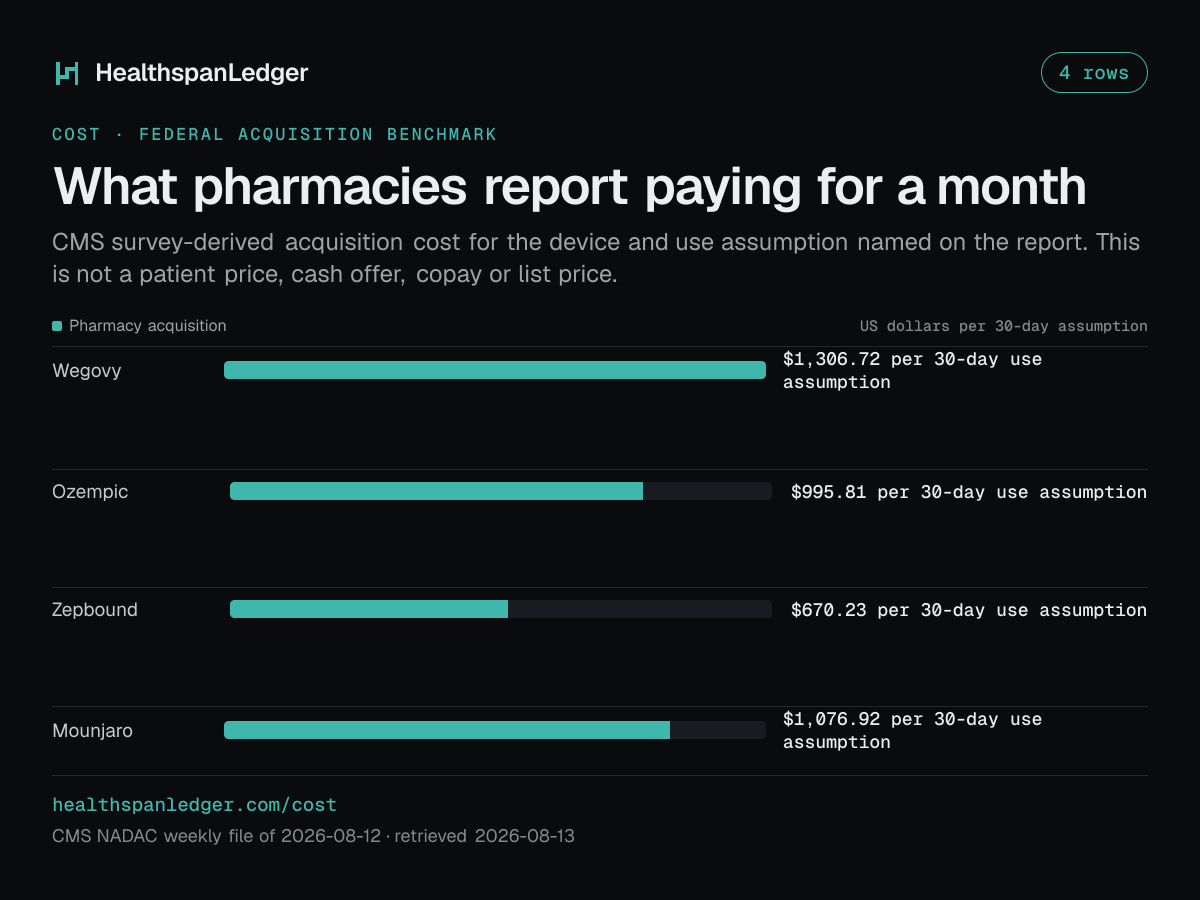
| Brand | Device | CMS acquisition estimate | Manufacturer price or offer | Effective date | Matched package |
|---|---|---|---|---|---|
| Wegovy | single-dose pen2.4 mg | $1,306.58 | $349Standard price | 2026-09-23 | Both figures describe four single-dose pens. The selected manufacturer amount is the standard $349 price for 0.25–2.4 mg pens. |
| Ozempic | multi-dose pen2 mg | $995.92 | $499Standard self-pay price; $150 more than the 0.25 mg, 0.5 mg and 1 mg pens | 2026-09-23 | Both figures are one 8 mg/3 mL pen, which holds four weekly 2 mg doses and is what Novo Nordisk counts as a month. |
| Zepbound | KwikPen15 mg | $675.43 | $449At 7.5 mg and above, the first $449 purchase offer applies automatically. To keep it, complete the next KwikPen purchase within 45 days of the previous fill’s delivery or receipt. | 2026-09-23 | Both figures are one KwikPen holding four weekly 15 mg doses, the presentation named in Lilly’s conditional purchase offer. |
| Mounjaro | single-dose pen15 mg | $1,077.04 | No separate self-pay program price | 2026-09-23 | The checked Lilly page publishes no separate self-pay program price for Mounjaro to pair with this row. Its savings card separately advertises as low as $499 for eligible commercially insured people whose plan does not cover Mounjaro. |
A month means, per row — 28 days and one box of four single-dose pens, one a week · one box holding one pen, which is how Novo Nordisk counts a month for Ozempic · 28 days and one KwikPen, which holds four weekly doses · four single-dose pens, one a week, because the label doses Mounjaro once weekly. The per-unit figures are CMS’s; the monthly figures are ours, from that arithmetic.
The checked Lilly page does not publish a separate self-pay program price for Mounjaro. Its savings card separately advertises as low as $499 for a 1-month fill for eligible commercially insured people whose plan does not cover it. The federal file instead gives an average acquisition benchmark: surveyed retail pharmacies report paying $1,077.04 to buy a month. It is not a patient price or a lower bound; retail totals vary by pharmacy and coverage.
The federal site’s comparison column, checked
TrumpRx prints an “Original Price” beside its own price without defining that column on the checked page. Below, we compare it with the CMS acquisition estimate for the same package. Similar amounts do not establish how TrumpRx calculated its comparison price.
| Listed as | Original Price | CMS acquisition estimate | Difference | Acquisition figure in force since |
|---|---|---|---|---|
| Wegovy penfour single-dose pens, 28 days | $1,349.00 | $1,306.58 | +3.2% | 2026-09-23 |
| Ozempicone pen holding four weekly doses | $1,028.00 | $995.92 | +3.2% | 2026-09-23 |
| Zepboundfour single-dose pens, 28 days | $1,087.00 | $1,051.84 | +3.3% | 2026-09-23 |
The 3 comparison prices are 3.2 to 3.3 percent above the matched CMS estimates. These figures come from different sources and dates; the difference does not establish a pricing method or a pharmacy’s profit.
Read from U.S. federal government — federal program page · retrieved 2026-08-12 · the acquisition figures beside it are CMS’s, not this site’s
What this number is not
- It is an acquisition cost, not a patient price. What you pay is set by your plan, your pharmacy and any manufacturer program you qualify for, and none of those are in this file.
- CMS prices these products per milliliter or per tablet. Any monthly figure on this site is our arithmetic, based on the package size from the product’s own label. It is labeled as derived wherever it appears.
- Wholesalers, pharmacy benefit managers, plans and manufacturers settle further amounts between themselves that are not public. A difference between what a pharmacy pays and what anyone is charged is not evidence of wrongdoing, and this site does not present it as one.
- Each row carries its own effective date, and CMS marks whether the figure came from the latest survey or was carried forward from an earlier file. Both are printed rather than averaged away.
Who cannot use a savings card?
These manufacturer savings cards exclude government drug coverage, including Medicare and Medicaid. Commercially insured applicants must also meet each card’s other terms.
Lilly names the programs one by one: Medicaid, Medicare, Medicare Part D, Medicare Advantage, Medigap, DoD, VA, TRICARE, and any state drug assistance program. Novo Nordisk uses shorter wording that covers the same people.
Novo Nordisk states that these three plan types do not count as government programs for this exclusion. Other eligibility rules still apply.
- The Federal Employees Health Benefits Program
- Health exchange plans bought under the Affordable Care Act
- Insurance provided through state employee plans
Read from Novo Nordisk — manufacturer program terms · retrieved 2026-09-01
Two more conditions apply everywhere. You have to be 18 or older, and the prescription has to be for something the label covers. A Mounjaro card used for weight loss fails that second test, because the Mounjaro label is written for type 2 diabetes.
What if you are on Medicare?
Manufacturer savings cards exclude Medicare. The separate Medicare GLP-1 Bridge offers a $50 a month copay for eligible people and products; it does not cover every GLP-1 prescription.
The Medicare GLP-1 Bridge is a short-term program run by Medicare itself. It runs from 2026-07-01 to 2027-12-31. It covers three drugs, and Medicare lists them like this:
- Foundayo (tablet)
- Wegovy (injection or tablet)
- Zepbound (KwikPen only. The program doesn’t cover single-dose Zepbound vials or pens)
Who qualifies
Who does not
Check these program limits before budgeting for the copay:
- The Part D deductible does not apply, and no part of the $50 counts toward your out-of-pocket limit.
- There is no low-income subsidy on it, so people who get help with drug costs may pay more here than under their plan.
- Your provider has to send the prescription and complete a prior authorization, and certify you are also on a diet and exercise program.
Read from Centers for Medicare & Medicaid Services — federal program page · retrieved 2026-08-12
What if you have no insurance at all?
Some brands have manufacturer cash offers. Compare the dose, device, days supplied and refill conditions—not just the starting price.
The comparison includes manufacturer offers for Foundayo, Zepbound, Wegovy and Ozempic. Starting prices may be introductory or apply only to a lower dose. The checked Mounjaro program page offers self-pay access but does not quote a price.
Check both the days supplied and yearly fill limit. Zepbound uses a 28-day supply; Foundayo uses 30 days and limits its self-pay program to 10 fills per calendar year. A 28-day supply is not a calendar month.
- What Foundayo costs, in full — Foundayo cash prices change by dose.
- What Zepbound costs, in full — Zepbound KwikPen’s $449 purchase offer applies at 7.
- What Wegovy costs, in full — Wegovy has separate pen and tablet self-pay offers.
- What Ozempic costs, in full — Ozempic is a diabetes drug, and that changes the Medicare answer completely.
- What Mounjaro costs, in full — LillyDirect offers Mounjaro for self-pay but does not publish a price.
- What Trulicity costs, in full — Trulicity’s savings card pays up to $150 a month and $1,950 a year.
- What Victoza costs, in full — The checked Novo Nordisk pages do not publish a Victoza savings card, cash price or list price.
- What Saxenda costs, in full — Novo Nordisk publishes a $1,349.
- What Rybelsus costs, in full — Novo Nordisk publishes the same $997.
- What the Wegovy pill costs — tablet prices, savings offers and the CMS acquisition estimates.
- Which of these has a generic — approved products and the available acquisition-price comparisons.
- Which patient-assistance programs still list a GLP-1 — the current no-charge lists include Ozempic and Trulicity, not every product made by either company.
- Why Costco, CVS and Walmart prices do not match — what six chains show online, and how to compare the same prescription and payer.
What you still need to check
Before you fill a prescription, confirm the current terms, your eligibility and the pharmacy’s final quote.
- Apply for a savings card through the manufacturer and confirm that you meet its terms. The prices listed here do not enroll you in a program.
- Use the manufacturer’s current terms if they differ from this page. An advertised minimum may depend on coverage, savings limits or the number of fills.
- Ask the pharmacy for a quote for your exact product, dose and days supplied, with your insurance or cash offer applied.
When can these prices change?
An offer can change before its stated end date. Source dates show when we checked the terms, not a promise that today’s pharmacy quote will match.
- A manufacturer changes or ends a program. Check the current terms before applying or refilling.
- Many cards list 2026-12-31 as their expiry. Rybelsus has no stated end date in the checked terms; that does not mean its offer is permanent.
- The Medicare program ends. Medicare has already set 2027-12-31 as the last day.
Each brand’s cost page gives the dates and conditions for its offers. Check whether an introductory price ends after a set number of fills, even if the program continues.
Check the dose and device
Use the brand guides to check the labeled dose schedule and available forms. A dose change does not necessarily mean a price change.
Take the acquisition-cost table
Download CMS acquisition estimates with their effective dates. These are averages reported by surveyed pharmacies, not patient prices.
The per-package and per-month columns are arithmetic on CMS’s own figure, with the working stated in the file header.
How to cite this table
Analysis by HealthspanLedger · edition 2026.09 · version 03734f4c262a · retrieved 2026-09-27
The underlying records are us government work, public domain and carry no copyright: the publisher’s own license. This table — how we select, join, label and bound the facts — is ours, and it is published under Creative Commons Attribution 4.0 International (CC BY 4.0). Reuse it, including commercially, and credit HealthspanLedger with a link to this page.
Questions readers ask
Can I lose 20 pounds in 3 months on Ozempic?
Can I lose 20 pounds in 3 months on Ozempic?
The trial averages quoted on this site do not establish that you will lose 20 pounds in three months.
Ozempic’s label covers type 2 diabetes, not weight management. The cost offers on this page have their own prescription and coverage requirements.
Which GLP-1 program is the cheapest?
Which GLP-1 program is the cheapest?
For eligible Medicare participants, the GLP-1 Bridge advertises $50 a month. Medicare runs the program itself.
The covered forms are Foundayo (tablet); Wegovy (injection or tablet); Zepbound (KwikPen only. The program doesn’t cover single-dose Zepbound vials or pens).
The program rules out people with type 2 diabetes, moderate-to-severe sleep apnea, or fatty liver disease. Medicare says your Part D plan might cover the drug for those.
7 manufacturer cards advertise prices as low as $25 for eligible people with commercial insurance that covers the drug. The offer conditions decide whether that price applies.
How much is Ozempic at Costco?
How much is Ozempic at Costco?
Costco’s Member Prescription Program tool searches by medication, strength and quantity. Costco says displayed prices can change and vary by location.
Search by drug name, review the strength and quantity, then ask the pharmacy to confirm the current total.
Will insurance pay for GLP-1?
Will insurance pay for GLP-1?
Coverage depends on the prescription’s approved use, the plan’s formulary, prior authorization, and the plan’s own rules. Those gates can produce different answers for different people.
This site reads labels and manufacturer program terms, not plan formularies. What your own plan does is a question only your plan can answer.
24 program documents — every price on this page was read from one of them
- Foundayo coverage and savings — commercial card, self-pay prices and Medicare route · Eli Lilly and Company · manufacturer program terms · retrieved 2026-09-06
- Foundayo Connecticut prescriber disclosure — wholesale acquisition cost by strength · Lilly USA, LLC · manufacturer price disclosure · retrieved 2026-09-06
- Novo Nordisk Patient Assistance Program — 2026 eligibility and insurance rules · Novo Nordisk · manufacturer program terms · retrieved 2026-08-14
- Novo Nordisk Patient Assistance Program — current available products · Novo Nordisk · manufacturer assistance product list · retrieved 2026-08-14
- Novo Nordisk Patient Assistance Program application · Novo Nordisk · manufacturer assistance application · retrieved 2026-08-14
- Lilly Cares Patient Assistance Program — 2026 application, medication list and eligibility rules · Lilly Cares Foundation · manufacturer assistance application · retrieved 2026-08-14
- Zepbound Savings Card program terms and conditions, and LillyDirect self-pay pricing · Eli Lilly and Company · manufacturer program terms · retrieved 2026-08-12
- Mounjaro Single-Dose Pen Savings Card eligibility, terms and conditions · Eli Lilly and Company · manufacturer program terms · retrieved 2026-08-12
- Wegovy Savings Offer and Self-Pay Offer terms and conditions, with per-NDC pricing tables · Novo Nordisk · manufacturer program terms · retrieved 2026-09-01
- What to pay for Wegovy — savings offer, self-pay pricing and Medicare GLP-1 Bridge · Novo Nordisk · manufacturer program terms · retrieved 2026-08-12
- Save on Ozempic — savings offer, self-pay pricing and coverage answers · Novo Nordisk · manufacturer program terms · retrieved 2026-09-05
- Medicare GLP-1 Bridge — frequently asked questions for plans and pharmacies · Centers for Medicare & Medicaid Services · federal program page · retrieved 2026-08-12
- Weight loss drugs — what Medicare covers under the Medicare GLP-1 Bridge · Centers for Medicare & Medicaid Services · federal program page · retrieved 2026-08-12
- HealthCare.gov glossary — formulary, prior authorization, self-insured plan, excluded services, Summary of Benefits and Coverage, and appeal · Centers for Medicare & Medicaid Services · federal program page · retrieved 2026-08-12
- Trulicity Savings Card eligibility, terms and conditions · Eli Lilly and Company · manufacturer program terms · retrieved 2026-08-13
- Novo Nordisk diabetes savings-offer terms and conditions, with the per-strength Rybelsus and Ozempic tables · Novo Nordisk · manufacturer program terms · retrieved 2026-08-13
- How to save on Novo Nordisk diabetes medicines — the full list of insulin and non-insulin savings offers · Novo Nordisk · manufacturer program terms · retrieved 2026-08-13
- List price and insurance coverage explained — Rybelsus, with the per-strength list price · Novo Nordisk · manufacturer program terms · retrieved 2026-08-13
- Victoza cost, coverage and savings resources — the whole of what NovoCare offers for Victoza · Novo Nordisk · manufacturer program terms · retrieved 2026-08-13
- Saxenda cost, coverage and savings resources, carrying the notice that the Saxenda Savings Offer closed · Novo Nordisk · manufacturer program terms · retrieved 2026-08-13
- List price and insurance coverage explained — Saxenda · Novo Nordisk · manufacturer program terms · retrieved 2026-08-13
- FDA drug shortages database via openFDA — semaglutide rows, showing Rybelsus 3 mg, 7 mg and 14 mg as To Be Discontinued · U.S. Food and Drug Administration · federal program page · retrieved 2026-08-13
- Drugs@FDA via openFDA — the liraglutide applications, including the approved abbreviated new drug applications and the label each one carries · U.S. Food and Drug Administration · federal program page · retrieved 2026-08-13
- TrumpRx — Most-Favored-Nation prices listed against the price each drug is compared to · U.S. federal government · federal program page · retrieved 2026-08-12
Where these prices lead
The oral semaglutide price page
Care teams and license details by market
Why GLP-1 pharmacy prices do not match
Which GLP-1 assistance programs still exist
The four gates a claim passes
Which routes work, and who they shut out
Who the Rybelsus savings terms shut out
Trulicity on Medicare, and the separate route