Page last checked
Being studied in people · not FDA-approved
Retatrutide
Retatrutide is an experimental weekly injection being tested for weight loss. It acts on three hormone signals linked to appetite and metabolism.
What matters first
- Why people look it up
- People buy unapproved versions under the nickname Reta in hopes of losing weight.
- What the evidence shows
- A published phase 2 trial found large average weight loss. Phase 3 trials are underway, but FDA has not approved retatrutide.
- Dose status
- Trials tested Retatrutide at 1–12 mg once a week. There is no FDA-approved dose or dosing label. Every number below is a trial arm, not a treatment schedule.
What is known about Retatrutide
Retatrutide is a drug in late-stage weight-loss trials. It acts on three hormone pathways: GIP, GLP-1 and glucagon. The FDA has not approved it, so there is no official dose. In a published 48-week trial, researchers tested 1, 4, 8 and 12 mg once a week. Lilly has since announced early results from several phase 3 trials.
| Topic | Value |
|---|---|
| Strongest source | Human trial |
| FDA approval | Not FDA-approved |
| Studied dosing | 1–12 mg once weekly — from clinical trials |
| Typical vials | 10 mg · 20 mg · 30 mg |
Every row links back to a source listed below. These facts are for reference, not a personal recommendation.
Weight-loss results over time
Retatrutide: Average weight loss at each study check-in
The studies checked weight after 24, 48 and 80 weeks. Results are group averages, not a forecast for one person.
Phase 2 check-in
24 weeks7.2%–17.5%
Peer-reviewed · 338 participants in the full 48-week trial
Phase 2 final result
48 weeks8.7%–24.2%
Peer-reviewed · 338 participants · same phase 2 trial
TRIUMPH-1 phase 3 trial result
80 weeks19.0%–28.3%
Company announcement · 2,339 participants · NCT05929066
What these numbers mean
What they cannot tell you
How Retatrutide works
Retatrutide acts at GIP + GLP-1 + glucagon. Here is what that means.
A triple agonist adds glucagon to the two gut-hormone signals. Glucagon is usually described as insulin’s opposite — the hormone that raises blood sugar when fuel runs low — so putting it in a weight-loss drug looks like a mistake until you separate its two jobs. Raising blood sugar is one. Raising how much energy you burn is the other, and the second one is the point.
| Receptor | Retatrutide | What it does |
|---|---|---|
| GLP-1 | Less appetite, slower stomach emptying, and insulin while blood sugar is rising. This is the intake side of the equation, and it is also what offsets what the glucagon arm does to blood sugar. | |
| GIP | The second gut-hormone signal: more insulin while sugar is rising, plus effects on fat tissue and on appetite circuits that are still being argued about. | |
| Glucagon | liver and adipose tissueRaises how much energy you burn, and pushes the liver to break down and burn fat. Where the gut-hormone arms cut what comes in, this arm raises what goes out — and pulls fat out of the liver while doing it. | |
| Amylin | — |
The same four receptor groups are shown for every drug, so the differences are easy to compare. Targets come from the drug class. Any result specific to Retatrutide comes from the cited sources.
Glucagon also makes the liver release glucose. The GLP-1 arm must therefore hold blood sugar steady while the glucagon arm works. A third pathway can add both power and new limits, including effects on heart rate and liver sugar. That balance is why these drugs are still being tested at several doses instead of prescribed.
What the evidence for Retatrutide is
These numbers come from a study in people that was published in a peer-reviewed journal. The drug or dose may still be experimental and may not have FDA approval.
The trial behind the numbers
48-week phase 2 dose-finding trial · 338 participants · 48 weeks
- What it establishes
- What it does not establish
Read each result with the study length, dose and number of participants. Results from separate trials are not a direct comparison because the people and study designs differ.
Evidence snapshot and shareable image
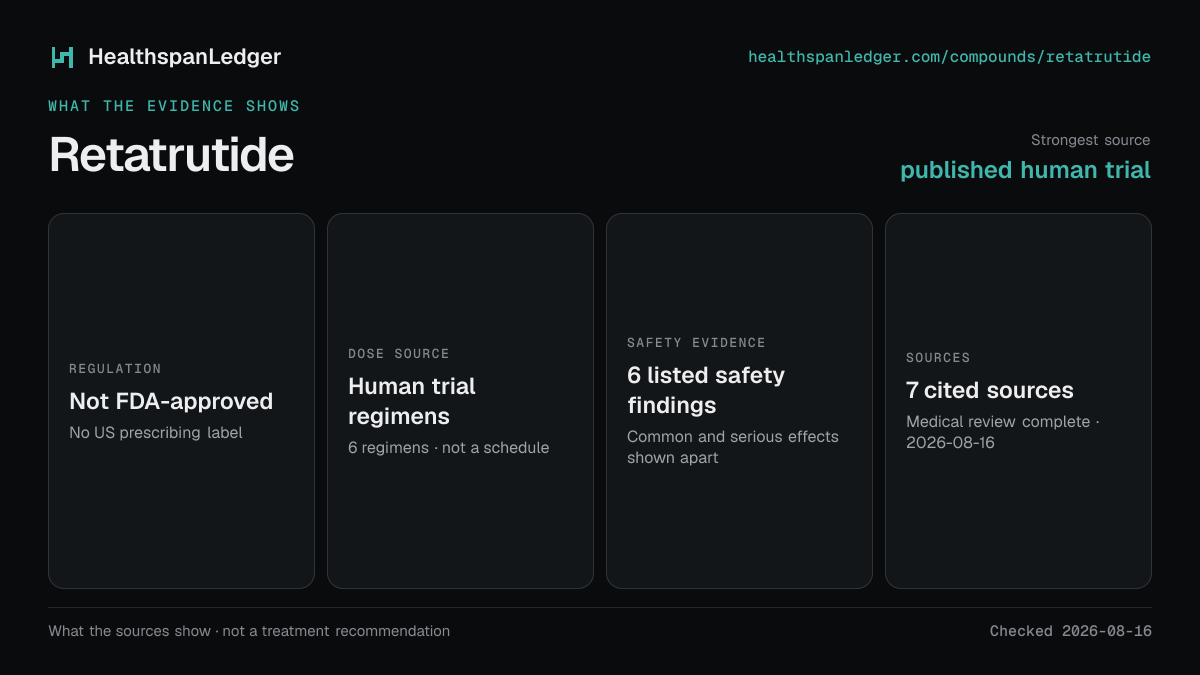
Evidence snapshot
Published human trial
- Regulation
- Dose source
- Safety evidence
- Sources
What each dose produced in the trial
These are the doses the trial gave and the weight change it reported for each one. It is a record of one experiment, not a schedule — no regulator has reviewed any of these doses.
Average weight change from the start of the trial, by weekly dose · the dashed rule marks placebo
| Once-weekly dose | Study group | Average weight change | What the paper notes |
|---|---|---|---|
| 1 mg | Active | −8.7% | 1 mg group |
| 4 mg | Active | −17.1% | combined result for the two 4 mg groups |
| 8 mg | Active | −22.8% | combined result for the two 8 mg groups |
| 12 mg | Active | −24.2% | 12 mg group |
| Placebo | Control | −2.1% | The group used to compare every active dose |
What the source does not report for each dose group
Source: Jastreboff AM et al. Triple-Hormone-Receptor Agonist Retatrutide for Obesity — A Phase 2 Trial. N Engl J Med 2023;389:514-26 (PMID 37366315) · retrieved 2026-08-12 · every value is quoted from that paper. Trial results describe averages across a study population, not an individual outcome.
Where Retatrutide is in clinical trials
32 registered studies; the program has reached phase 3, and one is still enrolling.
The soonest a running study expects to finish measuring people is October 2026. That is when the sponsor expects to finish collecting the main measurement. It is not a results date, and not a date anything goes on sale.
- Phase 3Recruiting
- Phase 3Running, closed to new participants
- Phase 3Running, closed to new participants
We left one registration out of the count above. Registering a study does not prove it is running, and these did not hold up.
ClinicalTrials.gov · retrieved 2026-09-27
Regulatory status
FDA has not approved retatrutide.
It is still in trials and has no dosing label. Any product sold today is unapproved. The doses here describe study groups, not advice.
Full regulatory tracker →How Retatrutide compares
Each page says which kind of comparison it is: one trial that tested both, or two separate trials read side by side — which is much weaker, however close the numbers look.
Where to go next on Retatrutide
The related pages keep each topic with its evidence.
How the retatrutide trials escalated to their top arm
The retatrutide reactions reported most often
Convert a retatrutide amount to units with the retatrutide reconstitution calculator
The 10 mg retatrutide vial: concentrations and example draws
What each water volume does to the 20 mg retatrutide vial
Every published price for retatrutide, and its conditions
Retatrutide and Australia’s Peptide products pathway
The 30 mg retatrutide vial: concentrations and example draws
The official Canada Peptide products page beyond retatrutide
Who else is sold for weight loss besides retatrutide
Safety notes
Questions about Retatrutide
Is Retatrutide FDA-approved?
How is Retatrutide taken?
How does Retatrutide differ from the other compounds in this class?
What is not known about Retatrutide?
Is there a Retatrutide dosing schedule on this site?
- Jastreboff AM et al. Triple-Hormone-Receptor Agonist Retatrutide for Obesity — A Phase 2 Trial. N Engl J Med 2023;389:514-26 (PMID 37366315)retrieved 2026-08-12Human trial
- NCT04881760 — A Study of LY3437943 in Participants Who Have Obesity or Are Overweightretrieved 2026-08-14Human trial
- Eli Lilly. Retatrutide delivered weight loss in the phase 3 TRIUMPH-1 trial. May 21, 2026retrieved 2026-08-16Human trial
- NCT05929066 — Retatrutide in participants without type 2 diabetes who have obesity or overweightretrieved 2026-08-16Human trial
- Eli Lilly. Retatrutide successful in two additional phase 3 obesity trials (TRIUMPH-2 and TRIUMPH-3). July 23, 2026retrieved 2026-08-14Human trial
- NCT05929079 — Retatrutide in participants with type 2 diabetes and obesity or overweightretrieved 2026-08-14Human trial
- NCT05882045 — Retatrutide in participants with obesity and cardiovascular diseaseretrieved 2026-08-14Human trial