Victoza
This is a daily product with 3 labeled uses. Its ladder has 3 steps and stops at 1.8 mg.
Read the Victoza label schedulePage last checked
FDA-approved medicine
Liraglutide is the drug in the daily injection pens Victoza and Saxenda. The brands have different approved uses and dose schedules.
Liraglutide is a once-daily GLP-1 receptor agonist sold in two FDA-approved prefilled pens with different jobs and different schedules. Victoza is labeled for type 2 diabetes and stops at 1.8 mg daily; Saxenda is labeled for chronic weight management and reaches 3 mg daily. There is no single liraglutide ladder that safely substitutes for choosing the product first.
| Topic | Value |
|---|---|
| Strongest source | FDA label |
| FDA approval | Approved (Victoza, Saxenda) |
| Half-life | ≈ 13 hours |
| Presentation | FDA-approved liraglutide products are prefilled pens and are not reconstituted. |
Every row links back to a source listed below. These facts are for reference, not a personal recommendation.
The drug name is only the shared starting point. Each product has its own use, dose schedule and limit. HealthspanLedger keeps those facts on the product label that states them.
Victoza
This is a daily product with 3 labeled uses. Its ladder has 3 steps and stops at 1.8 mg.
Read the Victoza label scheduleSaxenda
This is a daily product with 2 labeled uses. Its ladder has 5 steps and stops at 3 mg.
Read the Saxenda label scheduleLiraglutide acts at GLP-1 alone. Here is what that means.
GLP-1 is a hormone your gut releases when you eat. It lasts only a few minutes — an enzyme called DPP-4 breaks it down almost straight away — so the natural signal is a short burst after a meal. A GLP-1 receptor agonist is a redesigned copy of that hormone, built to survive the enzyme and to stick to proteins in your blood. That stretches a few minutes into a signal one weekly injection can hold. Everything these drugs do follows from one receptor staying switched on far longer than your body ever intended.
| Receptor | Liraglutide | What it does |
|---|---|---|
| GLP-1 | pancreatic isletTells the pancreas to release more insulin, but only while blood sugar is already climbing, and to hold back glucagon at the same time. Because it acts only when sugar is rising, this class does not on its own push blood sugar below normal the way insulin or a sulfonylurea can.stomach and gutSlows how fast food leaves your stomach, so a meal empties gradually and you stay full for longer. This is also where the nausea, early fullness and constipation come from. The effect people want and the effect they complain about are the same effect.hindbrain and hypothalamusActs on the parts of the brain that decide when a meal is over and how appealing food seems. Appetite drops rather than having to be fought off, and most of the weight effect comes from here — not from the stomach. | |
| GIP | — | |
| Glucagon | — | |
| Amylin | — |
The same four receptor groups are shown for every drug, so the differences are easy to compare. Targets come from the drug class. Any result specific to Liraglutide comes from the cited sources.
Single-target GLP-1 drugs are the yardstick for every newer molecule. They act on one receptor, and their effects are well mapped. Stomach and gut side effects often limit how high the dose can go. Dual and triple agonists add other receptors in an effort to push past that limit.
A new dose can arrive before the prior one has cleared. The amount then rises toward a steady pattern over several doses. The curve uses one cited figure: the 13 hours half-life. It is arithmetic, not a measurement of anyone’s blood.
Estimated amount compared with one dose, taken once daily. Based on the cited half-life, not on blood test results.
| Day | Just after that dose | Just before the next dose | Toward long-term level |
|---|---|---|---|
| 1 | 1.00× | 0.28× | 72% |
| 2 | 1.28× | 0.36× | 92% |
| 3 | 1.36× | 0.38× | 98% |
| 4 | 1.38× | 0.38× | 99% |
| 5 | 1.38× | 0.38× | 100% |
| 6 | 1.38× | 0.39× | 100% |
| long-term level | 1.39× | 0.39× | 100% |
This is a math estimate based on the cited half-life of 13 hours. Each dose is added to what has not yet left the body, so the curve rises toward 1.39× one dose — within 5% of that level by day 3. This is not a measured blood level and does not predict one person’s result. Source of the half-life: Victoza (liraglutide) injection — FDA-approved Prescribing Information (DailyMed) · retrieved 2026-09-19.
The dosing numbers come from an FDA-approved prescribing label. FDA reviewed the manufacturer’s studies before approving the product, and the label can change when new dosing or safety information appears.
Use these numbers for the named product and approved use. A different brand, product form or use may have a different schedule.
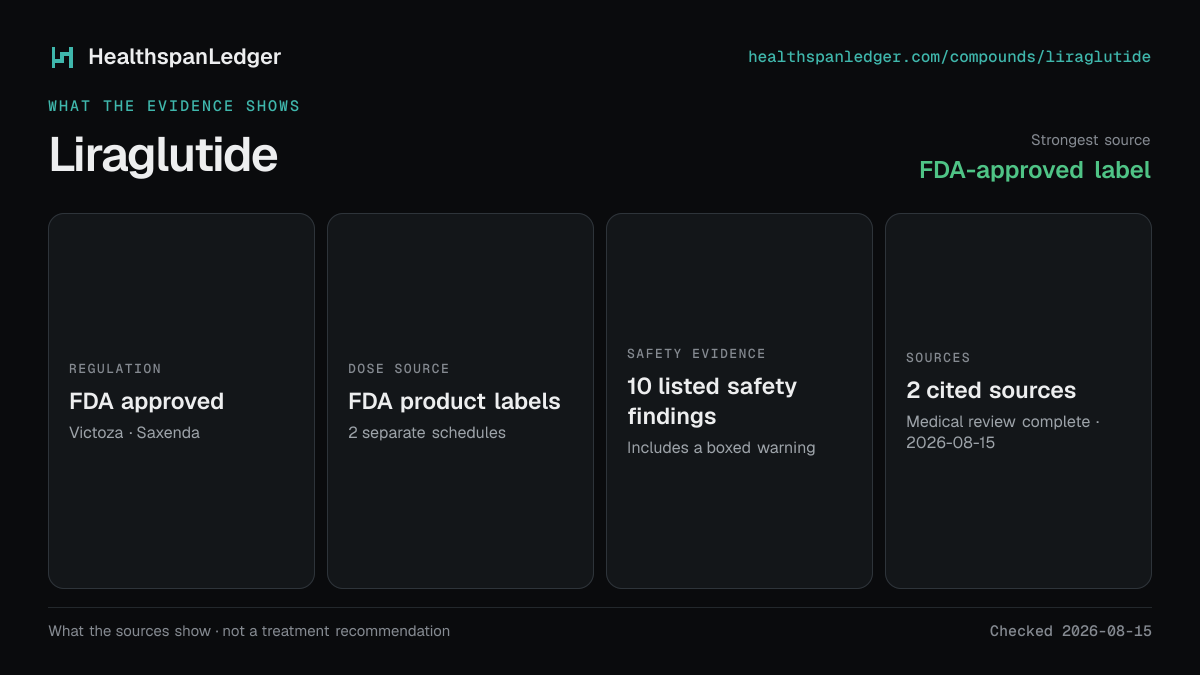
Evidence snapshot
FDA-approved label
412 registered studies; the program has reached phase 4, and 12 are still enrolling.
The soonest a running study expects to finish measuring people is December 2026. That is when the sponsor expects to finish collecting the main measurement. It is not a results date, and not a date anything goes on sale.
ClinicalTrials.gov · retrieved 2026-09-27
FDA has approved liraglutide as Victoza and Saxenda, with generic versions tied to the Victoza application.
The approved products are prefilled pens, not powder vials, and their product labels are not interchangeable dosing instructions.
Full regulatory tracker →The related pages keep each topic with its evidence.
Every reaction on the liraglutide page, with its frequency
Liraglutide dosing evidence, without an approved schedule
The Victoza product overview, beyond liraglutide
Saxenda as a product, not only liraglutide as a molecule
Where liraglutide sits among the weight loss compounds
Take the liraglutide arithmetic to any other vial
The source-checked brenipatide entry, beyond the liraglutide one
Enicepatide in the full list, alongside liraglutide
MariTide in the full list, alongside liraglutide
Petrelintide in the full list, alongside liraglutide