Page last checked
GIP/GLP-1 dual receptor agonist (investigational) · dosing
VK2735 dosage: what the trials studied
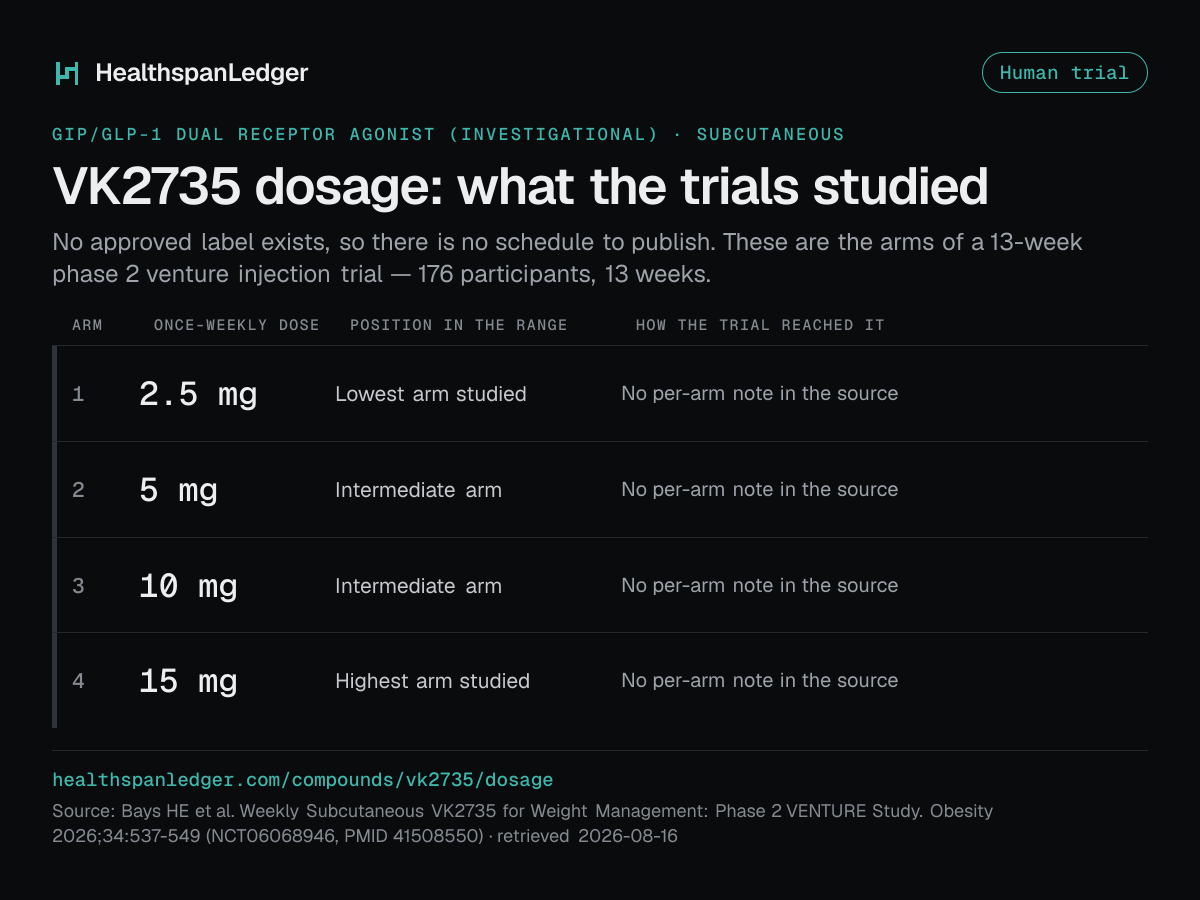
The published trial tested 2.5–15 mg once weekly (13-week phase 2 injection arms: 2.5, 5, 10 or 15 mg). It enrolled 176 participants and ran as the 13-week phase 2 VENTURE injection trial. VK2735 has no approved dosing label. The registry records 4 active regimens. Those are randomized study regimens, not a schedule for personal use.
Source for this answer
Source: Bays HE et al. Weekly Subcutaneous VK2735 for Weight Management: Phase 2 VENTURE Study. Obesity 2026;34:537-549 (NCT06068946, PMID 41508550)
Source: Bays HE et al. Weekly Subcutaneous VK2735 for Weight Management: Phase 2 VENTURE Study. Obesity 2026;34:537-549 (NCT06068946, PMID 41508550)
Key dose facts
What matters first
- What trials tested
- 2.5–15 mg once weekly (13-week phase 2 injection arms: 2.5, 5, 10 or 15 mg)
- Study size
- 176 participants
- Approved schedule
- No FDA-approved VK2735 dosing label exists.
The published trial dosing program
These are the once-weekly dose groups used in the published trial. The table prints only the dose detail the source supplies. They describe a randomized protocol under monitoring, not a recommended titration schedule.
| Arm | Once-weekly dose | Position in the studied range | How the trial reached it |
|---|---|---|---|
| 1 | 2.5 mg weekly | Lowest arm studied | — |
| 2 | 5 mg weekly | Intermediate arm | — |
| 3 | 10 mg weekly | Intermediate arm | — |
| 4 | 15 mg weekly | Highest arm studied | — |
Source: Bays HE et al. Weekly Subcutaneous VK2735 for Weight Management: Phase 2 VENTURE Study. Obesity 2026;34:537-549 (NCT06068946, PMID 41508550) · retrieved 2026-08-16 · the paths above reproduce only the doses the source names. The source does not turn those paths into advice.
| Target-dose group | Mean change at 13 weeks | How the paper reports it |
|---|---|---|
| 2.5 mg weekly | 9.1% decrease | Target-dose group |
| 5 mg weekly | 10.9% decrease | Target-dose group |
| 10 mg weekly | 12.9% decrease | Target-dose group |
| 15 mg weekly | 14.7% decrease | Target-dose group |
| Placebo | 1.7% decrease | Placebo group |
Source: Bays HE et al. Weekly Subcutaneous VK2735 for Weight Management: Phase 2 VENTURE Study. Obesity 2026;34:537-549 (NCT06068946, PMID 41508550) · retrieved 2026-08-16. Only outcomes the cited paper reports for a named arm appear here; no missing result is estimated.
Why there is no VK2735 dosage chart
A dosage chart is a regulatory artifact before it is an editorial one. It exists when an agency has reviewed a sponsor’s trials, agreed a schedule, and bound the manufacturer to a product of stated identity and potency. VK2735 has none of that yet.
One trial cannot prove long-term safety or show that the result applies to everyone. The highest dose tested is a study dose, not a target for personal use.
VK2735 is not FDA-approved and has no prescribing label.
The published numbers are from a short dose-finding trial, not an approved schedule. Its tablet and injection programs use different doses and must not be read as one regimen.
Sites that publish a titration chart for a compound at this stage have built it by inference. They take a trial’s target dose and reverse-engineer a plausible ramp toward it. The result looks exactly like a supported schedule and should not be read as one. The table shows only the trial arms that were actually studied.
What this trial record still does not connect
The table above answers one narrow question: what the completed injection study tested. It does not join separate formulations or unfinished trials into a single path. Three boundaries remain attached to the record:
- The completed injection study lasted 13 weeks; the 78-week phase 3 trials have no result yet
- Oral and injected VK2735 use different doses and are not interchangeable
1Reference details
How dosing works in this class
Why the dose escalates instead of starting where it ends
The dose climbs in steps for one reason: how well people tolerate it, not how well it works. The receptors that produce the effect you want are the same ones that slow your stomach down, and your gut reacts hardest when the exposure is new. Hold it steady and the reaction fades. Stepping up gradually is a way of using that — each step is a stretch of time for your body to settle at where it is before the next increase arrives.
The length of each step matters. Shortening it moves the next increase into a period when the body may not have adjusted. Labels and trial plans state the intervals that were tested. A faster ramp was not tested.
Why trial dose groups are not a dosing schedule
A dose-finding trial is an experiment about doses, not a recommendation of one. Its arms exist to spread people across a range so researchers can see the shape of the curve. Some arms are set deliberately low, where too little effect is expected. Others are set high, where people are expected to struggle. Reading the top arm as the target gets the design backwards: the reason for running the whole range was that nobody yet knew which part of it was right.
Trial doses came with screening, monitoring, a set schedule and drug of tested strength and purity. Removing a milligram figure from those conditions removes much of what made it meaningful. The table therefore shows what researchers tested, not a schedule to follow.
Questions about VK2735 dosing
What are the typical VK2735 dosages?
The trial ran 4 once-weekly regimens between 2.5 mg and 15 mg for 13 weeks. An arm is a group a protocol assigned, not a dosage anybody settled on. These are study regimens, not an approved dosing schedule.
How fast can the VK2735 dose increase?
The trial ran as a 13-week phase 2 venture injection trial. The page’s own description is once weekly (13-week phase 2 injection arms: 2.5, 5, 10 or 15 mg). Nothing published here establishes what a faster ramp would produce.
What if side effects make the next step too hard?
The next increase is optional, not automatic. The label allows a longer stay at the current step when needed. A clinician decides what happens after a dose is hard to handle; the schedule alone cannot make that decision.
Does the starting VK2735 dose treat the condition?
Yes. One randomized group received 2.5 mg once weekly for 13 weeks and the group changed by an average of -9.1% by week 13. That proves the dose was studied; it does not make it an approved starting dose or a recommendation.
What is the highest VK2735 dose on the page?
The highest arm studied was 15 mg once weekly. It is simply the highest amount the trial tested. It is not a maximum dose, because no regulator has set one.
Why do some compounds here have a chart and others do not?
Because a chart is a claim about provenance, not a formatting choice. Where an FDA-approved label specifies a schedule, this site quotes it row by row and cites the label under the table. Where no label exists, the guide shows what trials tested and says plainly that it is not a schedule. For VK2735, that is the 13-week phase 2 venture injection trial above.