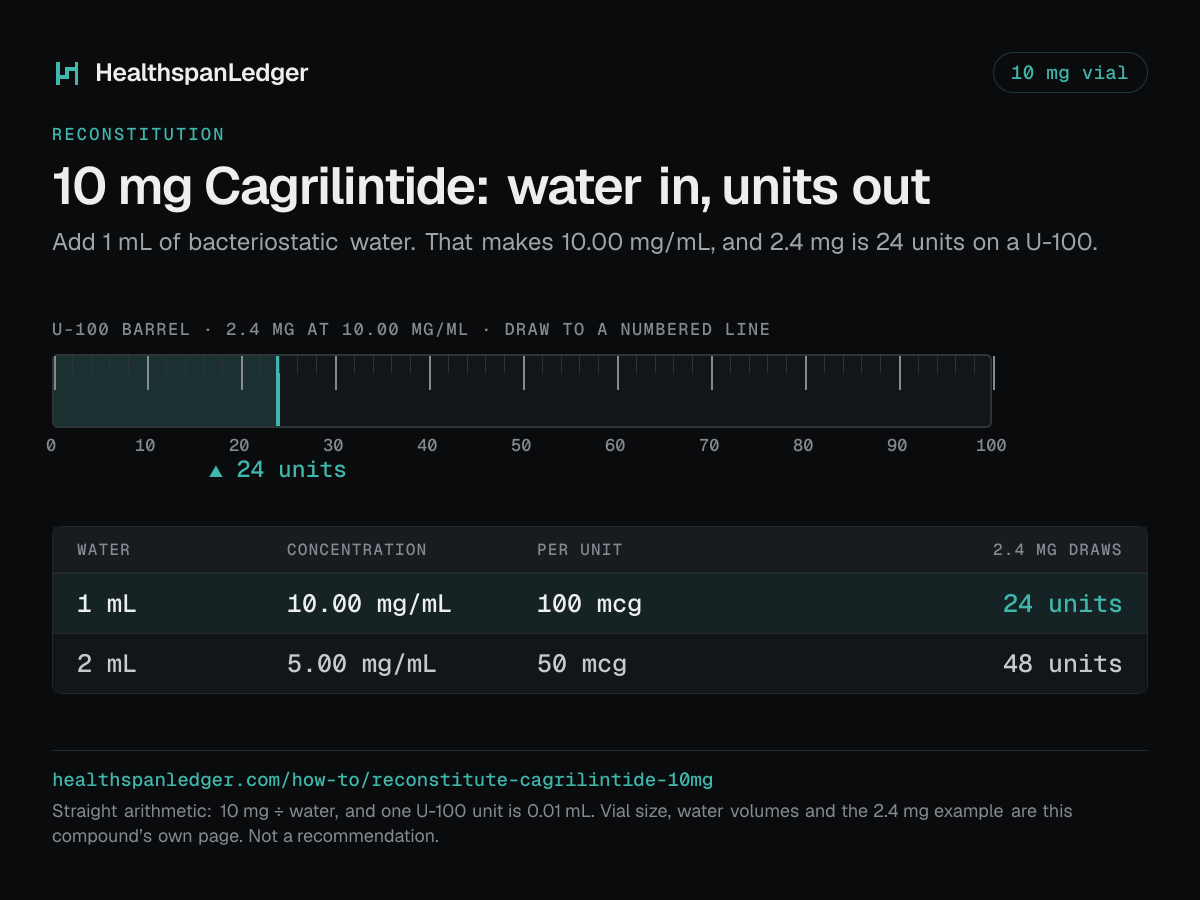
In this example, 1 mL of bacteriostatic water in a 10 mg Cagrilintide vial gives 10.00 mg/mL. An example 2.4 mg amount is then 24.0 units on a U-100 syringe.
This example lands on a syringe line. More water makes a weaker mix and a bigger draw. Less water makes a stronger mix and a smaller one. The amount of Cagrilintide stays the same. Use the diluent and volume specified for your product; the arithmetic alone does not choose them.
What matters first
Example water volume
1 mL
Resulting strength
10.00 mg/mL
Example 2.4 mg dose
24.0 U-100 units
How much bacteriostatic water for a 10 mg Cagrilintide vial?
◆ Unique to the 10 mg vialU-100 example draws
Water added
Concentration
Per U-100 unit
Example: 2.4 mg =
1 mL
10.00 mg/mL
100 mcg
24.0 units
2 mL
5.00 mg/mL
50 mcg
48.0 units
Straight arithmetic: concentration = 10 mg ÷ liquid volume, and 1 U-100 unit = 0.01 mL. The example column shows the math at 2.4 mg; it is not a dose recommendation.
The table compares possible concentrations; it does not establish which diluent or volume suits your product. Follow its dispensing instructions.
“Hard to measure” means the example draw is below two U-100 units. “Won’t fit” means it exceeds this syringe’s capacity.
The 10 mg vial at 1 mL on a U-100 barrel. 2.4 mg fills to 24.0 units, at 10.00 mg/mL.
Cagrilintide is a weekly shot in weight-loss studies. It copies amylin, a natural signal that helps you feel full after eating.
How many units is a documented dose from this vial?
The table above uses one worked example. These are the published quantities, converted into marks on a U-100 barrel at each listed liquid volume for a 10 mg vial. Where a quantity was never studied by injection, the row says so.
0.3–4.5 mg — studied in a trial
0.3–4.5 mg once weekly, under the skin. (phase 2 dose-finding arms, with an initial dose-escalation period of up to 6 weeks).
Water added
Concentration
Draw, low to high
1 mL
10.00 mg/mL
3.0 to 45.0 units
2 mL
5.00 mg/mL
6.0 to 90.0 units
Human trialLau DCW et al. Once-weekly cagrilintide for weight management: dose-finding phase 2 trial. Lancet 2021;398:2160-72 (PMID 34798060) · retrieved 2026-08-17
Four doses, and every reading halves
Twice the powder of the smaller vial, so the same amount draws half as far up the barrel at the same water volume. Four doses instead of two, and neither listed volume runs past the end of a syringe.
3Read the full vial record — 3 notes
A reading that also appears on the other page
Mixed into the larger listed volume, this vial produces exactly the strength and draw the smaller vial produces at the smaller volume. The two pages print the same number for different glass.
So a unit count recognized from elsewhere confirms nothing. It is consistent with two different vials, and only the strength printed on the one in your hand settles which.
Four doses is the whole supply question
The ingredient and portion count do not establish a storage period for a specific preparation.
Four draws is what the powder divides into. How long you have to take them is not something this page can tell you.
The larger vial is the easier one to read
Because the solution is stronger at any given volume, the draws land lower on the barrel and further from its top. Neither listed volume overruns the syringe here.
One example for the smaller vial is close to the barrel’s capacity. That contrast explains the volume difference, but does not establish which vial is suitable, how either product should be prepared or which is better value.
How do you mix it, step by step?
Wipe both stoppers with an alcohol swab and let them dry.
Check the product’s mixing instructions for the correct diluent and volume before drawing it up.
Let the water run slowly down the inside wall of the Cagrilintide vial, rather than jetting it onto the powder.
Follow the product’s instructions for mixing and checking the solution before use. Do not assume every powder uses the same method.
Store it as the dispensing label directs. What happens after mixing differs by product — some labels direct against refrigerating the mixed solution at all.
What if your water volume is not on the table?
The calculator lets you enter your product’s vial strength and mixing volume, then shows the arithmetic for your syringe.
Whichever you pick, this vial still holds four draws at the 2.4 mg its table uses. The water adds none and removes none.
It moves the reading instead. One milliliter makes 10 mg per mL, and the draw reads 24 units. Two milliliters makes 5 mg per mL, and the same dose reads 48.
How many units of cagrilintide?
For the 2.4 mg worked amount, the draw is 24 units with 1 mL of water or 48 units with 2 mL. On a U-100 syringe, one unit equals 0.01 mL.
That 2.4 mg is the phase 2 arm carried into phase 3, where it sits co-formulated with semaglutide. It is trial information, and cagrilintide has no approved dosing label anywhere.
How to mix cagrilintide with tirzepatide?
No published study has given cagrilintide and tirzepatide together, so there is no evidence-based mixing method to report.
What is published is a different pairing. Phase 3 studies cagrilintide co-formulated with semaglutide, as CagriSema, in one injection. Nothing in that program transfers to tirzepatide.
How to reconstitute cagrilintide?
After the powder dissolves, concentration equals the vial amount divided by the water added. The two offered water volumes produce two concentrations.
Neither water amount changes the dose. No published source says how long the mixed vial keeps, so four draws is a count—not proof of four weeks of usable supply.
Where to read next about Cagrilintide
The arithmetic on this page is only half the question. These are the pages that carry the other half.