Page last checked

How-to · reconstitution

How to reconstitute Cagrilintide 5 mg

Put 1 mL of bacteriostatic water into the 5 mg Cagrilintide vial. That makes 5.00 mg/mL. A 2.4 mg dose is then 48.0 units on a U-100 syringe.

That volume is the one that lands the draw on a syringe line, so the reading can be checked by eye. More water makes a weaker mix and a bigger draw. Less water makes a stronger mix and a smaller one. The amount of Cagrilintide in the glass never changes. Only the number of marks it takes does.

What matters first

Water to add
1 mL
Resulting strength
5.00 mg/mL
Example 2.4 mg dose
48.0 U-100 units

What is Cagrilintide?

Cagrilintide is a weekly shot in weight-loss studies. It copies amylin, a natural signal that helps you feel full after eating.

Medically reviewed by Jennifer Montecillo, MD · non-practicing medical reviewerReviewed 2026-08-17open the primary sources

How much bacteriostatic water for a 5 mg Cagrilintide vial?

◆ Unique to the 5 mg vialU-100 example draws
Water addedConcentrationPer U-100 unitExample: 2.4 mg =
1 mL5.00 mg/mL50 mcg48.0 units
2 mL2.50 mg/mL25 mcg96.0 units

Straight arithmetic: concentration = 5 mg ÷ water, and 1 U-100 unit = 0.01 mL. The example column shows the math at 2.4 mg; it is not a dose recommendation.

Which volume to use is a practical choice rather than a dose. Pick the one that puts your draw somewhere you can actually read it on the syringe. The flags in the last column mark where that fails. “Hard to measure” means the draw is too small to judge by eye. “Won’t fit” means it is bigger than one U-100 syringe holds.

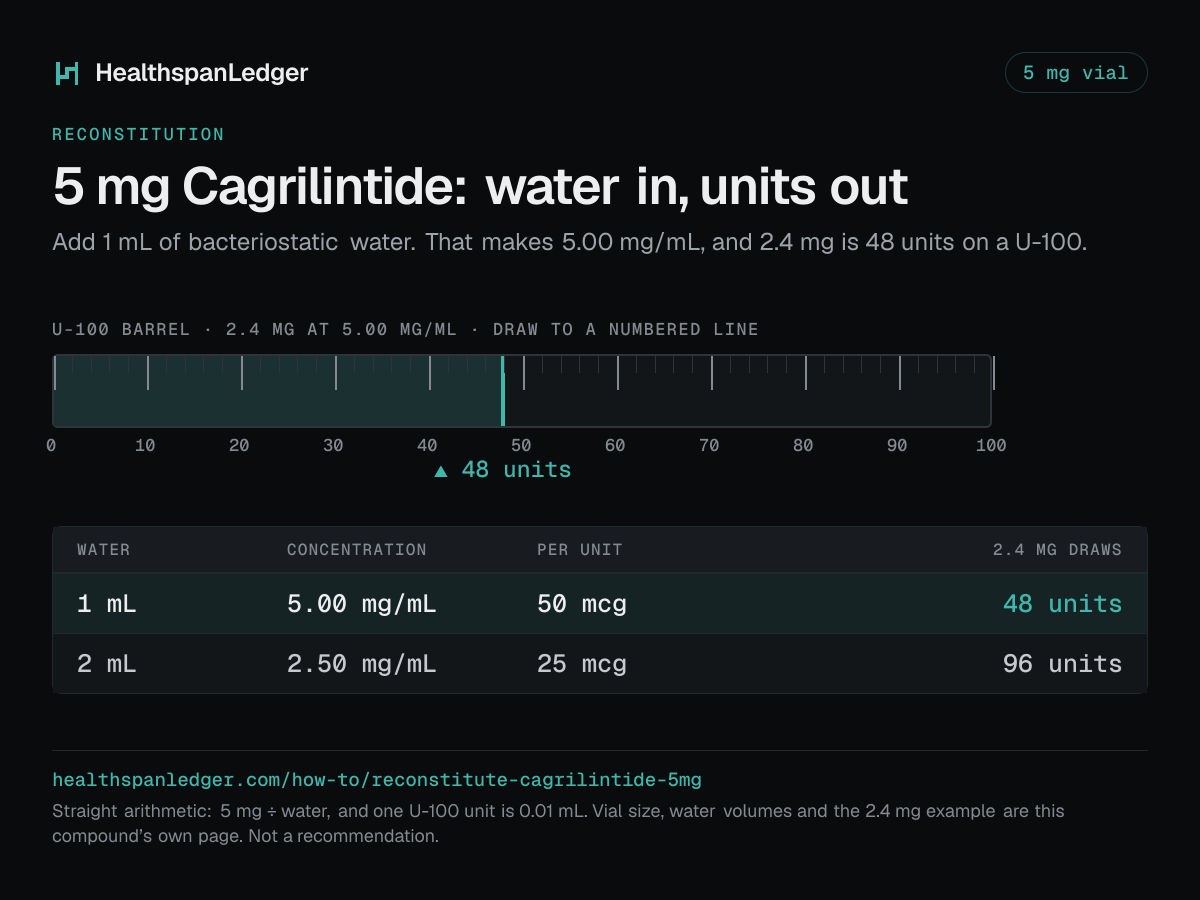
Cagrilintide 5 mg vial: how much water to add. Each row is what that amount draws on a U-100 syringe. 1 mL makes 5.00 mg/mL, or 50 mcg a unit, and 2.4 mg is 48 units. 2 mL makes 2.50 mg/mL, or 25 mcg a unit, and 2.4 mg is 96 units. The barrel drawn here is filled to 48 units, the draw at 1 mL. The sum is 5 mg divided by the water. One U-100 unit is 0.01 mL.
The 5 mg vial at 1 mL on a U-100 barrel. 2.4 mg fills to 48.0 units, at 5.00 mg/mL.

How many units is a documented dose from this vial?

The table above uses one worked example. These are the published quantities, converted into marks on a U-100 barrel at each water volume for a 5 mg vial. Where a quantity was never studied by injection, the row says so.

0.3–4.5 mgstudied in a trial

0.3–4.5 mg once weekly, under the skin. (phase 2 dose-finding arms, reached by 4-week escalation steps).

Water addedConcentrationDraw, low to high
1 mL5.00 mg/mL6.0 to 90.0 units
2 mL2.50 mg/mL12.0 to 180.0 unitswon’t fit

Human trialLau DCW et al. Once-weekly cagrilintide for weight management: dose-finding phase 2 trial. Lancet 2021;398:2160-72 (PMID 34798060) · retrieved 2026-08-17

Two doses, and one of them nearly fills the barrel

The worked amount uses nearly half the vial, so it empties in two draws. With the larger water amount, one draw nearly fills a U-100 syringe.

3Read the full vial record 3 notes

A vial that is two draws

There is no rationing to plan and no schedule to fit a vial this size into. Mix it, draw twice, and it is gone.

The vial is used in very few draws, so long-term storage is less likely to matter. Even so, no published source gives a storage window for the mixed vial.

Two draws also gives whatever uncertainty attaches to storing a mixed research peptide the least possible time to matter. It is the one advantage a vial this small has.

Nearly a full barrel in one pull

At the larger listed volume the draw covers almost the whole syringe. It fits, but there is no headroom, and the upper end of the studied range would not fit at all.

That is the practical argument for the smaller volume on this page, and it is the reverse of the advice most of these guides give.

Amylin amounts are simply larger

The figures here look alarming beside a semaglutide page, and the comparison is meaningless. This compound copies a pancreatic hormone rather than a gut one, and its studied amounts sit higher in milligrams.

Milligrams compared across compounds tell you nothing. Only the draw, on your vial, at your water volume, does.

How do you mix it, step by step?

  1. Wipe both stoppers with an alcohol swab and let them dry.
  2. Draw up the water volume you picked from the table.
  3. Let the water run slowly down the inside wall of the Cagrilintide vial, rather than jetting it onto the powder.
  4. Swirl gently until it dissolves. Shaking damages peptides.
  5. Store it as the dispensing label directs. What happens after mixing differs by product — some labels direct against refrigerating the mixed solution at all.

What if your water volume is not on the table?

The table shows the offered water volumes. The calculator does the same arithmetic for any volume and any syringe, and shows its working line by line.

Open the Cagrilintide calculator →

Questions readers ask

How much water to add to reconstitute peptides?

On this vial the barrel sets the ceiling, not the powder. Two milliliters puts the 2.4 mg draw at 96 units, close to the top of a U-100 syringe. One milliliter halves it to 48 units.

Extra water usually makes small draws easier to read. But when one dose uses nearly half the vial, more water can make the draw exceed the syringe’s capacity.

How many units of cagrilintide?

Forty-eight units at 1 mL here, or 96 units at 2 mL, for the 2.4 mg in the table. Two draws empty the vial.

Forty-eight also appears on the 10 mg guide, at twice the water. Concentration is vial divided by water, so doubling both leaves it unchanged. A unit count you recognize from elsewhere therefore confirms nothing about the glass in your hand.

How to mix cagrilintide with tirzepatide?

Nobody has published a method, and this site will not supply one. The question assumes a pairing no trial in the page has given to a person.

Cagrilintide’s own phase 3 work pairs it with semaglutide instead, in a single co-formulated injection. Tirzepatide appears nowhere in that program. Arithmetic for a mixed syringe would still leave the safety question entirely unstudied.

Where is the best place to inject cagrilintide?

No label names one, because cagrilintide has no approved label in any country. This site transcribes injection guidance from labels, and holds it for tirzepatide and semaglutide only.

The cagrilintide trial used a once-weekly injection under the skin but did not name an injection site. Instructions from another GLP-1 do not automatically apply to a different molecule.

Where to read next about Cagrilintide

The arithmetic on this page is only half the question. These are the pages that carry the other half.

1primary source, each with the day we read it — open the documents used on this page