Page last checked

How-to · reconstitution

How to reconstitute IGF-1 LR3 0.1 mg

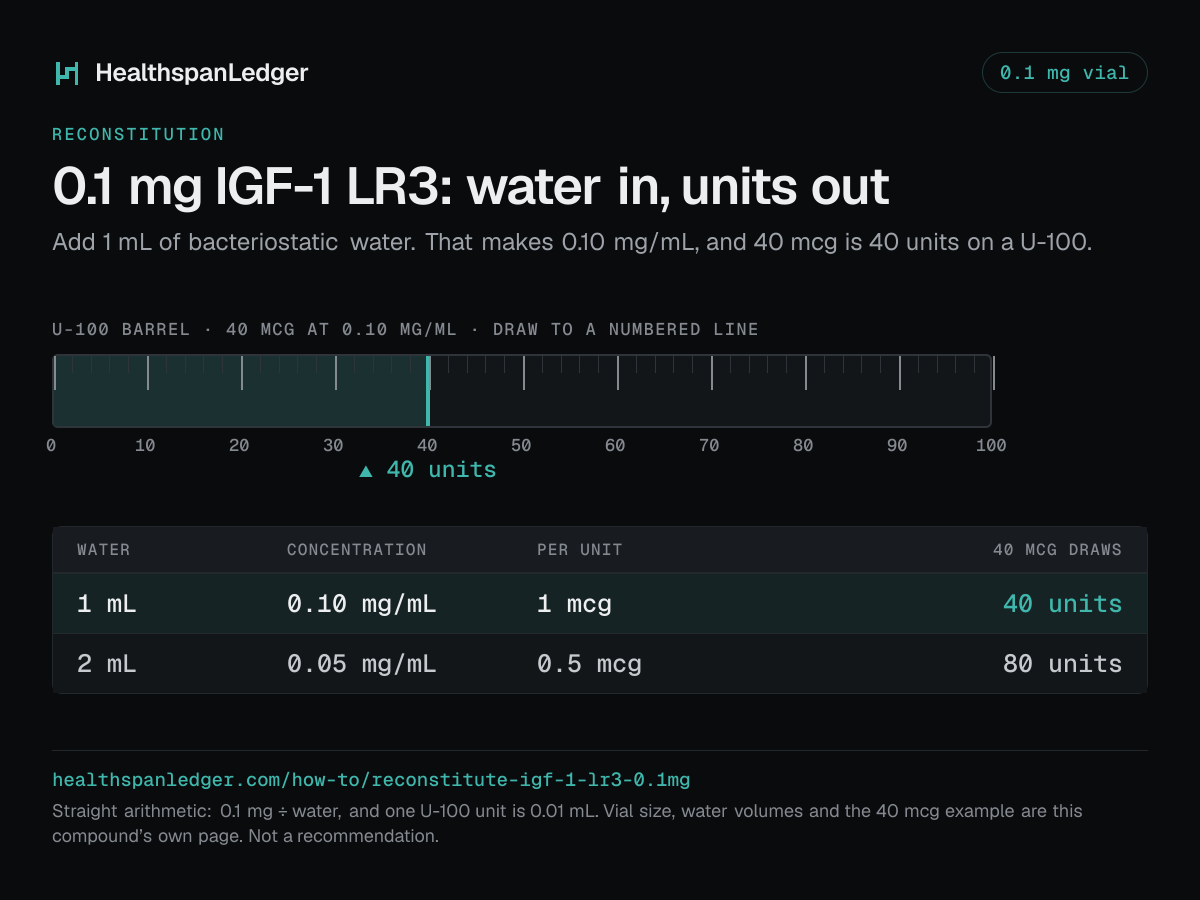
Put 1 mL of bacteriostatic water into the 0.1 mg IGF-1 LR3 vial. That makes 0.10 mg/mL. A 40 mcg dose is then 40.0 units on a U-100 syringe.

That volume is the one that lands the draw on a syringe line, so the reading can be checked by eye. More water makes a weaker mix and a bigger draw. Less water makes a stronger mix and a smaller one. The amount of IGF-1 LR3 in the glass never changes. Only the number of marks it takes does.

What matters first

Water to add
1 mL
Resulting strength
0.10 mg/mL
Example 40 mcg dose
40.0 U-100 units

What is IGF-1 LR3?

IGF-1 LR3 is a re-engineered insulin-like growth factor 1. The changes stop your carrier proteins holding it back, so it stays active far longer than the natural version.

No completed controlled human trial has shown which dose works for IGF-1 LR3. The range people report using is not a study result, tested schedule or recommendation.

no human dose shown to work

Medically reviewed by Jennifer Montecillo, MD · non-practicing medical reviewerReviewed 2026-08-12open the primary sources

How much bacteriostatic water for a 0.1 mg IGF-1 LR3 vial?

◆ Unique to the 0.1 mg vialU-100 example draws
Water addedConcentrationPer U-100 unitExample: 40 mcg =
1 mL0.10 mg/mL1 mcg40.0 units
2 mL0.05 mg/mL0.5 mcg80.0 units

Straight arithmetic: concentration = 0.1 mg ÷ water, and 1 U-100 unit = 0.01 mL. The example column shows the math at 40 mcg; it is not a dose recommendation.

Which volume to use is a practical choice rather than a dose. Pick the one that puts your draw somewhere you can actually read it on the syringe. The flags in the last column mark where that fails. “Hard to measure” means the draw is too small to judge by eye. “Won’t fit” means it is bigger than one U-100 syringe holds.

IGF-1 LR3 0.1 mg vial: how much water to add. Each row is what that amount draws on a U-100 syringe. 1 mL makes 0.10 mg/mL, or 1 mcg a unit, and 40 mcg is 40 units. 2 mL makes 0.05 mg/mL, or 0.5 mcg a unit, and 40 mcg is 80 units. The barrel drawn here is filled to 40 units, the draw at 1 mL. The sum is 0.1 mg divided by the water. One U-100 unit is 0.01 mL.
The 0.1 mg vial at 1 mL on a U-100 barrel. 40 mcg fills to 40.0 units, at 0.10 mg/mL.

How many units is a documented dose from this vial?

The table above uses one worked example. These are the published quantities, converted into marks on a U-100 barrel at each water volume for a 0.1 mg vial. Where a quantity was never studied by injection, the row says so.

20–40 mcgreported, not studied

20–40 mcg once a day, ideally after training, under the skin. Runs of four to six weeks with an equal break follow it. Published research on this analogue is limited to animals and cells. No study in a person has ever been registered.

Water addedConcentrationDraw, low to high
1 mL0.10 mg/mL20.0 to 40.0 units
2 mL0.05 mg/mL40.0 to 80.0 units

indirect evidenceDominikowski A, Rękoś Z, Olejarz M, Szczepanek-Parulska E, Domin R, Ruchała M. The emerging landscape of performance-enhancing peptides modulating GH-IGF1 axis: bridging the gap between clinical evidence and patient self-administration. Front Endocrinol 2026 — tabulates self-reported online dosing patterns beside the clinical doses, stating the reported values must not be read as clinically validated, regulatory-approved or safe · retrieved 2026-08-12

The weak vial: two long draws, and nothing here is hard to read

This is the smaller of two strengths sold under one name. It makes the thinnest solution any record on this site produces. A single dose travels most of the way up the barrel. That is as comfortable as measuring gets, and it means the glass is finished after two of them.

3Read the full vial record 3 notes

Easy to see, and quickly gone

Both listed water volumes put the plunger high on the syringe. That is well away from the crowded bottom, where one graduation is a big share of the dose. Both also land on a syringe line. Nothing on this page is difficult to measure.

That ease costs supply. There was very little powder in the glass to begin with. It yields two draws and stops. The protocols circulating for this analogue describe taking it daily for weeks. This vial covers two days of that.

No published storage window for the mixed solution

No cited source gives a beyond-use date, so no estimate is shown. Because this vial empties in two draws, that missing information matters less than it would for a larger vial.

It still means the count is a division result and not a duration. It says how the powder splits. It says nothing about how long what is in the glass stays what it was.

The printing on the label is all that separates this page from the other

The same name ships at a strength ten times this one, in glass that looks no different. Read the wrong page and every figure is out by an order of magnitude. The error runs in the direction that puts far more into the syringe than intended.

The draw would still land on a syringe line. It would still look like a comfortable reading. Nothing about the measurement itself would warn you. That is why these two sizes are written as separate pages, with the strength in each title.

How do you mix it, step by step?

  1. Wipe both stoppers with an alcohol swab and let them dry.
  2. Draw up the water volume you picked from the table.
  3. Let the water run slowly down the inside wall of the IGF-1 LR3 vial, rather than jetting it onto the powder.
  4. Swirl gently until it dissolves. Shaking damages peptides.
  5. Store it as the dispensing label directs. What happens after mixing differs by product — some labels direct against refrigerating the mixed solution at all.

What if your water volume is not on the table?

The table shows the offered water volumes. The calculator does the same arithmetic for any volume and any syringe, and shows its working line by line.

Open the IGF-1 LR3 calculator →

Where to read next about IGF-1 LR3

The arithmetic on this page is only half the question. These are the pages that carry the other half.

1primary source, each with the day we read it — open the documents used on this page