IGF-1 LR3 is a re-engineered insulin-like growth factor 1. The changes stop your carrier proteins holding it back, so it stays active far longer than the natural version.
What matters first
Why people look it up
Bodybuilding forums use it to grow muscle, usually on the back of a growth-hormone course.
What the evidence shows
Its documented job is industrial. It is sold as a catalogue reagent for growing cells in tanks, where staying active is exactly the selling point. No study of it in people has ever been registered. The change that makes it useful in a tank is the change that removes your body’s own brake on the signal.
Dose status
No completed controlled human trial has shown which dose works for IGF-1 LR3. A few people may have received it in small reports, but that cannot show which dose works. The sections below separate study findings from what people report using.
IGF-1 LR3 is a modified form of insulin-like growth factor 1. Two changes keep it from binding to carrier proteins, so it stays active longer than native IGF-1. Its documented use is in media used to grow cells. Published work is limited to animals and manufacturing. No trial in people is registered or published.
IGF-1 LR3 research and regulatory details: evidence quality, approval status, doses, handling, and presentation.
Topic
Value
Strongest source
no human dose shown to work
FDA approval
Not FDA-approved
What people report using
20–40 mcg once a day, ideally after training; runs of four to six weeks with an equal break follow it. Published research on this analogue is limited to animals and cells. No study in a person has ever been registered— no trial has tested this quantity
Typical vials
0.1 mg · 1 mg
Every row links back to a source listed below. These facts are for reference, not a personal recommendation.
The row headed “what people report using” is not evidence. No trial produced that quantity. It is printed because it is what circulates, and because it is better read here, beside what the studies actually did, than on a page that is selling the vial. It describes a practice. It is not a starting point.
What the evidence for IGF-1 LR3 is
No completed controlled human trial has shown which dose works. People may report using a range, but that is not a tested dosing schedule.
no human dose shown to work
What it establishes
Animal studies or small reports can show that researchers are exploring the compound. They cannot show which dose works in people.
What it does not establish
A validated dose, schedule, duration, safety margin, or reliable figure for how long it stays in the body.
If a number appears, it describes what people report using. It is not a trial result or a recommendation. If there is no number, no study has produced one.
Evidence snapshot and shareable image
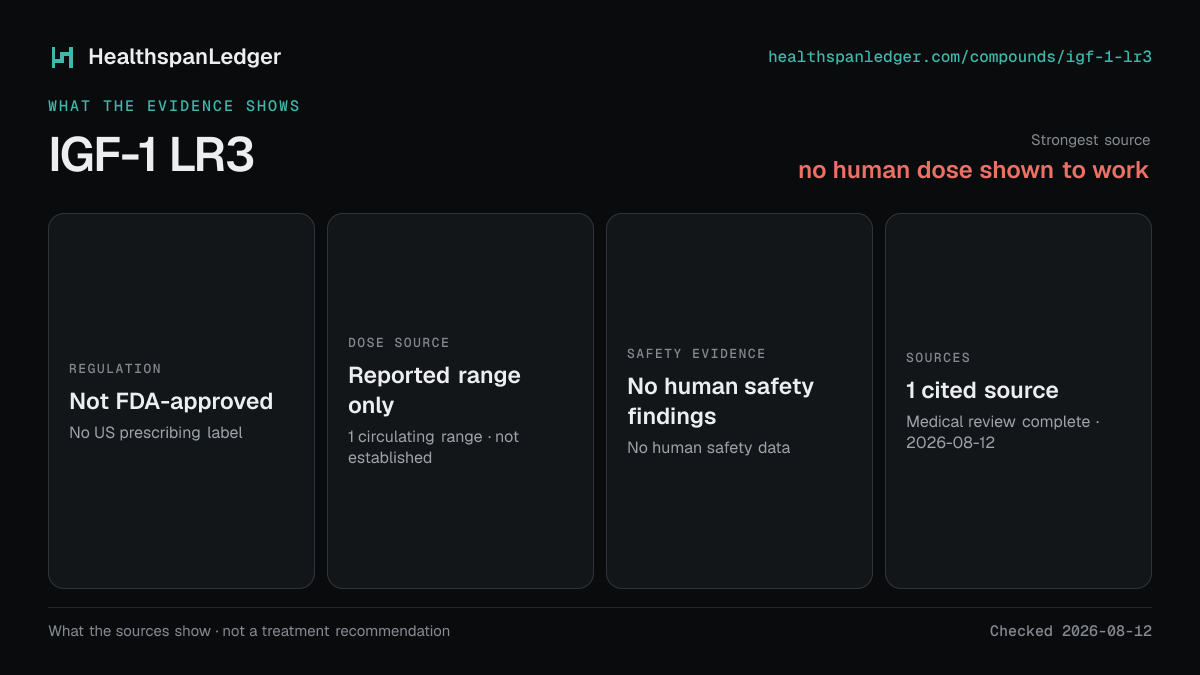
IGF-1 LR3 at a glance: no human dose shown to work, dosing basis, regulatory status, safety coverage, and cited-source count. These details summarize the available sources; they are not treatment recommendations.
Evidence snapshot
No human dose shown to work
The fastest way to see what kind of evidence this page is built on.
Regulation
Not FDA-approvedNo US prescribing label
Dose source
Reported range only1 circulating range · not established
Safety evidence
No safety findings listedAn empty list does not establish safety
IGF-1 LR3 at a glance: no human dose shown to work, dosing basis, regulatory status, safety coverage, and cited-source count. These details summarize the available sources; they are not treatment recommendations.
Where IGF-1 LR3 is in clinical trials
No trial of this compound is registered on ClinicalTrials.gov.
That is worth sitting with. Nobody has registered a study to find out whether IGF-1 LR3 works in people, so no result is coming and no date is worth waiting for. Sellers are not waiting for that work either.
A registered study means a sponsor filed a plan and started enrolling. It is not evidence the drug works, and most drugs tested in people never reach a pharmacy. Sponsors write and update these sources themselves; the National Library of Medicine publishes them without checking them.
The commercial supply of this analogue exists to serve bioprocessing.
Catalogues list it as a research and manufacturing reagent, not as a medicine. No regulator anywhere has reviewed it for use in people. A ClinicalTrials.gov search returns no registered study of it.
That is a weaker position than an unapproved drug, which at least has a trial running. Insulin-like growth factors and their releasing factors sit on the World Anti-Doping Agency prohibited list at all times. A reagent-grade certificate speaks to a bioreactor.
Vials sold under this name differ tenfold in strength, 0.1 mg and 1 mg. A concentration read off the wrong page is wrong by an order of magnitude
The published research on this analogue is animal and manufacturing work. It covers mouse lactation, fetal sheep heart cells, and rat intestinal absorption. It also covers an intranasal mouse model of Alzheimer’s disease, where the analogue changed amyloid plaque but did not preserve cognition. The rest is papers on producing it recombinantly for industrial cell culture
A ClinicalTrials.gov search on 12 August 2026 returned no registered study of IGF-1 LR3. No trial is under way and no result is pending
The quantity on this page is the one that circulates on forums, printed in a peer-reviewed review of self-administration patterns. The review marks that row with its own footnote: no peer-reviewed clinical study reports a dosing regimen for this analogue in humans
Evading IGF binding proteins is the design goal. Those binding proteins keep almost all circulating IGF-1 inactive until the body needs it. The change that makes the analogue useful in a bioreactor is the same change that removes the body’s own brake on the signal
Insulin-like growth factor activity drives blood glucose down. The nearest regulated comparator is mecasermin, the FDA-approved recombinant human IGF-1. Its label warns of severe hypoglycemia leading to hypoglycemic seizures
The same label says it must not be used in malignant neoplasia or in closed growth plates. It also warns on anaphylaxis, raised intracranial pressure, tonsillar and adenoidal enlargement, slipped capital femoral epiphysis and worsening scoliosis. Those are mecasermin’s labeled risks under monitoring, not measurements of this analogue, which has none
A 2026 endocrinology review of self-administered growth-hormone-axis peptides places this compound in its lowest evidence band. It calls the tumor-growth concern biologically plausible and unproven — neither established nor ruled out
Insulin-like growth factors sit on the World Anti-Doping Agency prohibited list at all times, in and out of competition
Catalogued for cell culture and bioprocessing, not for use in people
Questions about IGF-1 LR3
Is IGF-1 LR3 FDA-approved?
No. There is no prescribing label for it, so no approved dose exists — the regulatory status section above has the detail.
How is IGF-1 LR3 taken?
No completed controlled human trial has established a dose, frequency or route. A separately labeled protocol from reported practice is available, but it is not study dosing. The reported cadence is once a day, ideally after training.
How does IGF-1 LR3 differ from the other compounds in this class?
IGF-1 LR3 works through a different system from GLP-1 and amylin drugs. No completed human study has set a dose, so a direct comparison would be misleading.
What is not known about IGF-1 LR3?
A validated dose, schedule, duration, safety margin, or reliable figure for how long it stays in the body.
Is there a IGF-1 LR3 dosing schedule on this site?
Not a schedule — there is no approved schedule to publish here. What you get instead is the trial dosing program: the doses each arm received and how the protocol worked up to them. See what the trials tested.
1primary source, each with the day we read it — open the documents used on this page