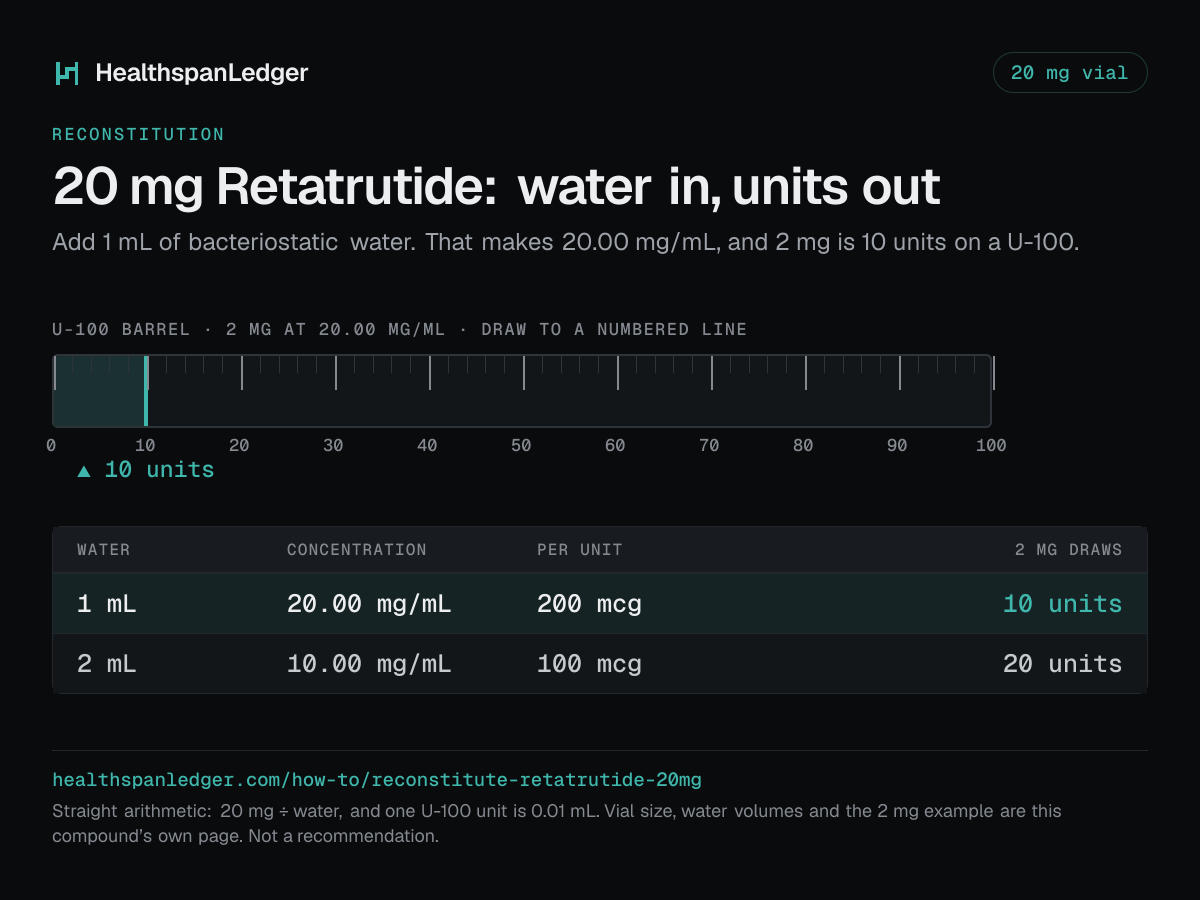
In this example, 1 mL of bacteriostatic water in a 20 mg Retatrutide vial gives 20.00 mg/mL. An example 2 mg amount is then 10.0 units on a U-100 syringe.
This example lands on a syringe line. More water makes a weaker mix and a bigger draw. Less water makes a stronger mix and a smaller one. The amount of Retatrutide stays the same. Use the diluent and volume specified for your product; the arithmetic alone does not choose them.
What matters first
Example water volume
1 mL
Resulting strength
20.00 mg/mL
Example 2 mg dose
10.0 U-100 units
How much bacteriostatic water for a 20 mg Retatrutide vial?
◆ Unique to the 20 mg vialU-100 example draws
Water added
Concentration
Per U-100 unit
Example: 2 mg =
1 mL
20.00 mg/mL
200 mcg
10.0 units
2 mL
10.00 mg/mL
100 mcg
20.0 units
Straight arithmetic: concentration = 20 mg ÷ liquid volume, and 1 U-100 unit = 0.01 mL. The example column shows the math at 2 mg; it is not a dose recommendation.
The table compares possible concentrations; it does not establish which diluent or volume suits your product. Follow its dispensing instructions.
“Hard to measure” means the example draw is below two U-100 units. “Won’t fit” means it exceeds this syringe’s capacity.
The 20 mg vial at 1 mL on a U-100 barrel. 2 mg fills to 10.0 units, at 20.00 mg/mL.
Retatrutide is an experimental weekly injection being tested for weight loss. It acts on three hormone signals linked to appetite and metabolism.
How many units is a documented dose from this vial?
The table above uses one worked example. These are the published quantities, converted into marks on a U-100 barrel at each listed liquid volume for a 20 mg vial. Where a quantity was never studied by injection, the row says so.
1–12 mg — studied in a trial
1–12 mg once weekly, under the skin.
Water added
Concentration
Draw, low to high
1 mL
20.00 mg/mL
5.0 to 60.0 units
2 mL
10.00 mg/mL
10.0 to 120.0 unitswon’t fit
Human trialJastreboff AM et al. Triple-Hormone-Receptor Agonist Retatrutide for Obesity — A Phase 2 Trial. N Engl J Med 2023;389:514-26 (PMID 37366315) · retrieved 2026-08-12
The middle vial, and the one that repeats its smaller sibling
Twice the powder of the small vial and twice the doses, with both listed volumes still landing on syringe lines. It also produces a reading that already exists one page down the ladder.
3Read the full vial record — 3 notes
This vial at the larger volume is the small vial at the smaller one
Concentration is vial divided by water, so doubling both leaves it unchanged. Mixed into the larger listed volume, this vial gives precisely the strength and precisely the draw that the smallest vial gives at the smaller volume.
The matching result comes from doubling both inputs. It is valid only when the vial strength and liquid volume both match that ratio. A familiar unit count alone cannot confirm that you entered either value correctly.
Ten doses, and no window to weigh them against
The vial divides into ten worked amounts, but no product-specific storage limit is assigned to this example. Ten doses does not establish ten weeks of use.
The example supplies a conversion between drug mass and liquid volume. It does not establish the contents, stability or mixing instructions for an investigational product obtained outside the study.
The last size on the ladder that reads in whole numbers
Both water options land exactly on syringe lines. With the largest retatrutide vial, neither does because the worked amount no longer divides evenly.
Nothing about the compound changes between the two pages. The legibility of the answer does.
How do you mix it, step by step?
Wipe both stoppers with an alcohol swab and let them dry.
Check the product’s mixing instructions for the correct diluent and volume before drawing it up.
Let the water run slowly down the inside wall of the Retatrutide vial, rather than jetting it onto the powder.
Follow the product’s instructions for mixing and checking the solution before use. Do not assume every powder uses the same method.
Store it as the dispensing label directs. What happens after mixing differs by product — some labels direct against refrigerating the mixed solution at all.
What if your water volume is not on the table?
The calculator lets you enter your product’s vial strength and mixing volume, then shows the arithmetic for your syringe.