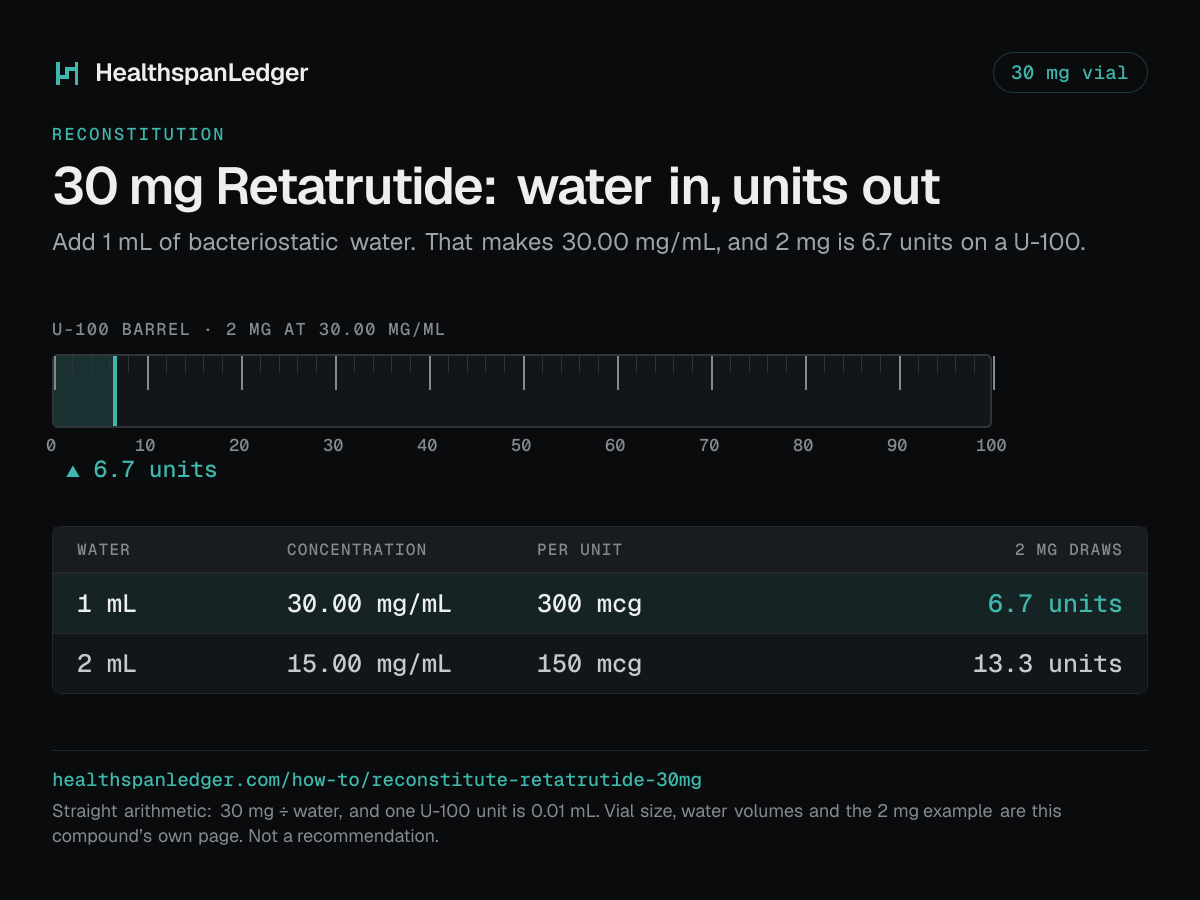
In this example, 1 mL of bacteriostatic water in a 30 mg Retatrutide vial gives 30.00 mg/mL. An example 2 mg amount is then 6.7 units on a U-100 syringe.
More water makes a weaker mix and a bigger draw. Less water makes a stronger mix and a smaller one. The amount of Retatrutide stays the same. Use the diluent and volume specified for your product; the arithmetic alone does not choose them.
What matters first
Example water volume
1 mL
Resulting strength
30.00 mg/mL
Example 2 mg dose
6.7 U-100 units
How much bacteriostatic water for a 30 mg Retatrutide vial?
◆ Unique to the 30 mg vialU-100 example draws
Water added
Concentration
Per U-100 unit
Example: 2 mg =
1 mL
30.00 mg/mL
300 mcg
6.7 units
2 mL
15.00 mg/mL
150 mcg
13.3 units
Straight arithmetic: concentration = 30 mg ÷ liquid volume, and 1 U-100 unit = 0.01 mL. The example column shows the math at 2 mg; it is not a dose recommendation.
The table compares possible concentrations; it does not establish which diluent or volume suits your product. Follow its dispensing instructions.
“Hard to measure” means the example draw is below two U-100 units. “Won’t fit” means it exceeds this syringe’s capacity.
The 30 mg vial at 1 mL on a U-100 barrel. 2 mg fills to 6.7 units, at 30.00 mg/mL.
Retatrutide is an experimental weekly injection being tested for weight loss. It acts on three hormone signals linked to appetite and metabolism.
How many units is a documented dose from this vial?
The table above uses one worked example. These are the published quantities, converted into marks on a U-100 barrel at each listed liquid volume for a 30 mg vial. Where a quantity was never studied by injection, the row says so.
1–12 mg — studied in a trial
1–12 mg once weekly, under the skin.
Water added
Concentration
Draw, low to high
1 mL
30.00 mg/mL
3.3 to 40.0 units
2 mL
15.00 mg/mL
6.7 to 80.0 units
Human trialJastreboff AM et al. Triple-Hormone-Receptor Agonist Retatrutide for Obesity — A Phase 2 Trial. N Engl J Med 2023;389:514-26 (PMID 37366315) · retrieved 2026-08-12
The only retatrutide vial where neither volume lands on a mark
The vial holds fifteen worked doses. Both water options put the draw between syringe lines, while the two smaller vial sizes land on whole units.
3Read the full vial record — 3 notes
Why this size reads awkwardly
The vial size and worked amount do not divide evenly with either water option. The exact draw falls between syringe lines in both cases.
The exact figure stays visible so you can compare it with the illustrated marks. A small fractional difference is still a difference in the represented dose; the table does not decide whether rounding is acceptable for a person or product.
Fifteen doses against no window
The vial divides into fifteen worked amounts, but no product-specific storage limit is assigned to this example. Fifteen doses does not establish fifteen weeks of use.
A storage limit would need to apply to the specific prepared product. The quantity remaining in a vial cannot show whether that product is still suitable to use, even if the calculation gives another complete dose.
The same vial at different study amounts
Inserting a higher amount from the listed trial rows reduces the portion count and increases the draw at the same concentration. The study rows keep those amounts attached to their trial context.
Inserting a lower amount does the reverse. Neither calculation establishes a storage duration or reproduces the trial product, and it cannot tell you which studied amount would be appropriate outside that trial.
How do you mix it, step by step?
Wipe both stoppers with an alcohol swab and let them dry.
Check the product’s mixing instructions for the correct diluent and volume before drawing it up.
Let the water run slowly down the inside wall of the Retatrutide vial, rather than jetting it onto the powder.
Follow the product’s instructions for mixing and checking the solution before use. Do not assume every powder uses the same method.
Store it as the dispensing label directs. What happens after mixing differs by product — some labels direct against refrigerating the mixed solution at all.
What if your water volume is not on the table?
The calculator lets you enter your product’s vial strength and mixing volume, then shows the arithmetic for your syringe.