
Page last checked

How-to · reconstitution

How to reconstitute Semaglutide 2 mg

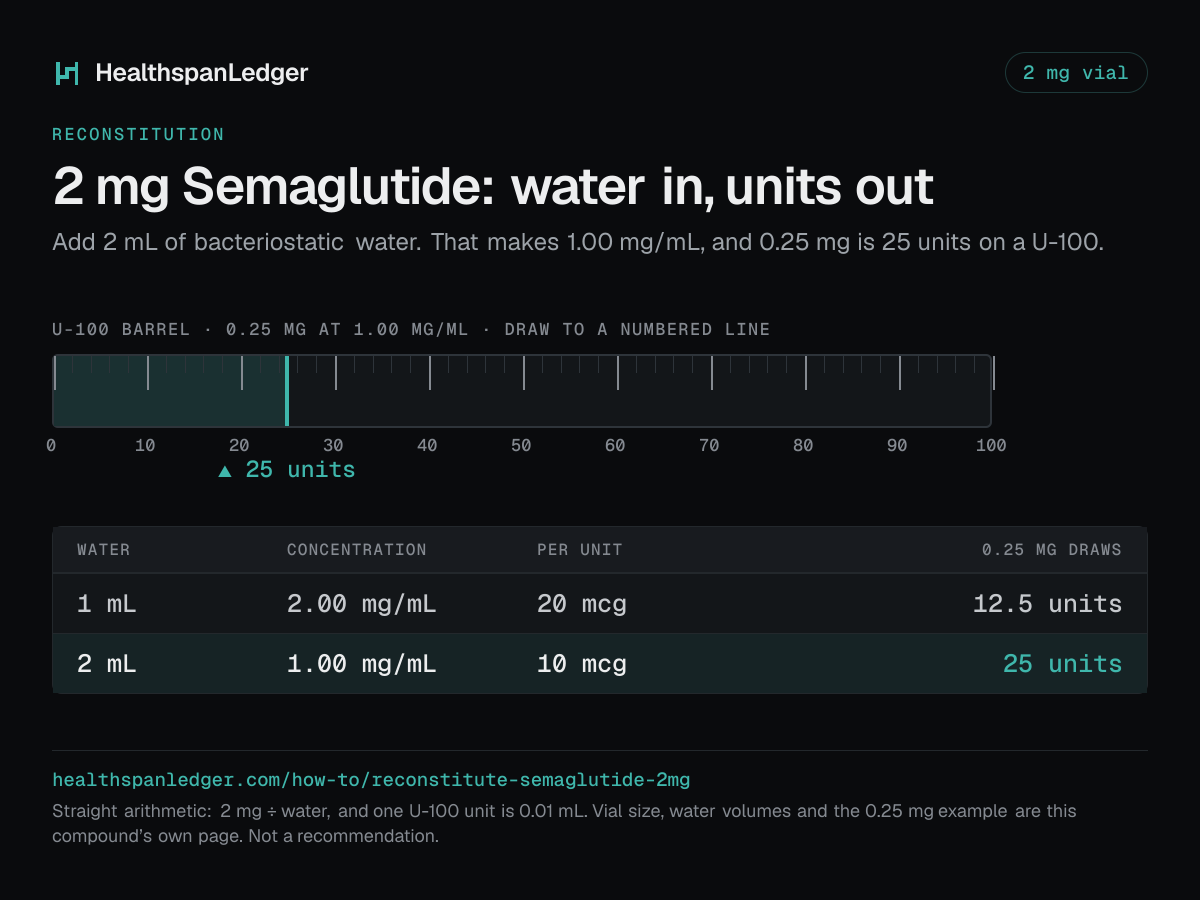
In this example, 2 mL of bacteriostatic water in a 2 mg Semaglutide vial gives 1.00 mg/mL. An example 0.25 mg amount is then 25.0 units on a U-100 syringe.

This example lands on a syringe line. More water makes a weaker mix and a bigger draw. Less water makes a stronger mix and a smaller one. The amount of Semaglutide stays the same. Use the diluent and volume specified for your product; the arithmetic alone does not choose them.

What matters first

Example water volume
2 mL
Resulting strength
1.00 mg/mL
Example 0.25 mg dose
25.0 U-100 units

How much bacteriostatic water for a 2 mg Semaglutide vial?

◆ Unique to the 2 mg vialU-100 example draws
Water addedConcentrationPer U-100 unitExample: 0.25 mg =
1 mL2.00 mg/mL20 mcg12.5 units
2 mL1.00 mg/mL10 mcg25.0 units

Straight arithmetic: concentration = 2 mg ÷ liquid volume, and 1 U-100 unit = 0.01 mL. The example column shows the math at 0.25 mg; it is not a dose recommendation.

The table compares possible concentrations; it does not establish which diluent or volume suits your product. Follow its dispensing instructions.

“Hard to measure” means the example draw is below two U-100 units. “Won’t fit” means it exceeds this syringe’s capacity.

Semaglutide 2 mg vial: example mixing volumes. Each row is what that amount draws on a U-100 syringe. 1 mL makes 2.00 mg/mL, or 20 mcg a unit, and 0.25 mg is 12.5 units. 2 mL makes 1.00 mg/mL, or 10 mcg a unit, and 0.25 mg is 25 units. The barrel drawn here is filled to 25 units, the draw at 2 mL. The sum is 2 mg divided by the liquid volume. One U-100 unit is 0.01 mL.
The 2 mg vial at 2 mL on a U-100 barrel. 0.25 mg fills to 25.0 units, at 1.00 mg/mL.

Medically reviewed by Kenneth Montecillo, MD2026-09-07open the primary sources

What is Semaglutide?

Semaglutide is the drug in Wegovy, Ozempic and Rybelsus. It copies a gut hormone called GLP-1, which helps control appetite and blood sugar.

How many units is a documented dose from this vial?

The table above uses one worked example. These are the published quantities, converted into marks on a U-100 barrel at each listed liquid volume for a 2 mg vial. Where a quantity was never studied by injection, the row says so.

0.25 mg — FDA-approved label

0.25 mg once weekly for 4 weeks, under the skin.

Water addedConcentrationDraw
1 mL2.00 mg/mL12.5 units
2 mL1.00 mg/mL25.0 units

FDA labelWegovy (semaglutide) — FDA-approved Prescribing Information (DailyMed) · retrieved 2026-08-20

1.7–2.4 mg — FDA-approved label

1.7–2.4 mg once weekly, under the skin.

Water addedConcentrationDraw, low to high
1 mL2.00 mg/mL85.0 to 120.0 unitswon’t fit
2 mL1.00 mg/mL170.0 to 240.0 unitswon’t fit

FDA labelWegovy (semaglutide) — FDA-approved Prescribing Information (DailyMed) · retrieved 2026-08-20

Eight example doses in the smallest semaglutide vial shown

The worked amount divides this vial into eight complete doses. Of the two water examples, the larger volume produces a whole-unit reading and the smaller one ends between whole-unit marks.

3Read the full vial record — 3 notes

Small vial, several example doses

The count depends on the dose as well as the vial strength. A small worked dose can divide even this vial into several portions. It does not mean that each portion can be stored and used over the following weeks.

The arithmetic assumes the full stated drug content and no loss during handling. It also does not check whether the supplied container is intended for one use or several.

The smaller water amount produces a fractional unit

That reading sits between whole-unit lines on the illustrated scale. Doubling the water doubles the liquid needed for the same amount of drug, which gives the whole-unit result in the other row.

This comparison explains the numbers; it is not a reason to dilute a dispensed product differently from its instructions. Check the actual syringe markings and ask the pharmacist about a draw that cannot be measured as written.

Match the instructions to the formulation

A semaglutide ingredient name does not identify the preparation or its storage requirements. Branded devices and pharmacy-prepared products can have different instructions, and a powder-mixing example does not replace those instructions.

No universal use-by period is attached to the eight-dose estimate. For an actual prescription, read the concentration, dose, preparation method and disposal date together. If any of those details is missing, the count in this table cannot supply it.
How do you mix it, step by step?

  1. Wipe both stoppers with an alcohol swab and let them dry.
  2. Check the product’s mixing instructions for the correct diluent and volume before drawing it up.
  3. Let the water run slowly down the inside wall of the Semaglutide vial, rather than jetting it onto the powder.
  4. Follow the product’s instructions for mixing and checking the solution before use. Do not assume every powder uses the same method.
  5. Store it as the dispensing label directs. What happens after mixing differs by product — some labels direct against refrigerating the mixed solution at all.

What if your water volume is not on the table?

The calculator lets you enter your product’s vial strength and mixing volume, then shows the arithmetic for your syringe.

Open the Semaglutide calculator →

Where to read next about Semaglutide

The arithmetic on this page is only half the question. These are the pages that carry the other half.

1primary source, each with the day we read it — open the documents used on this page