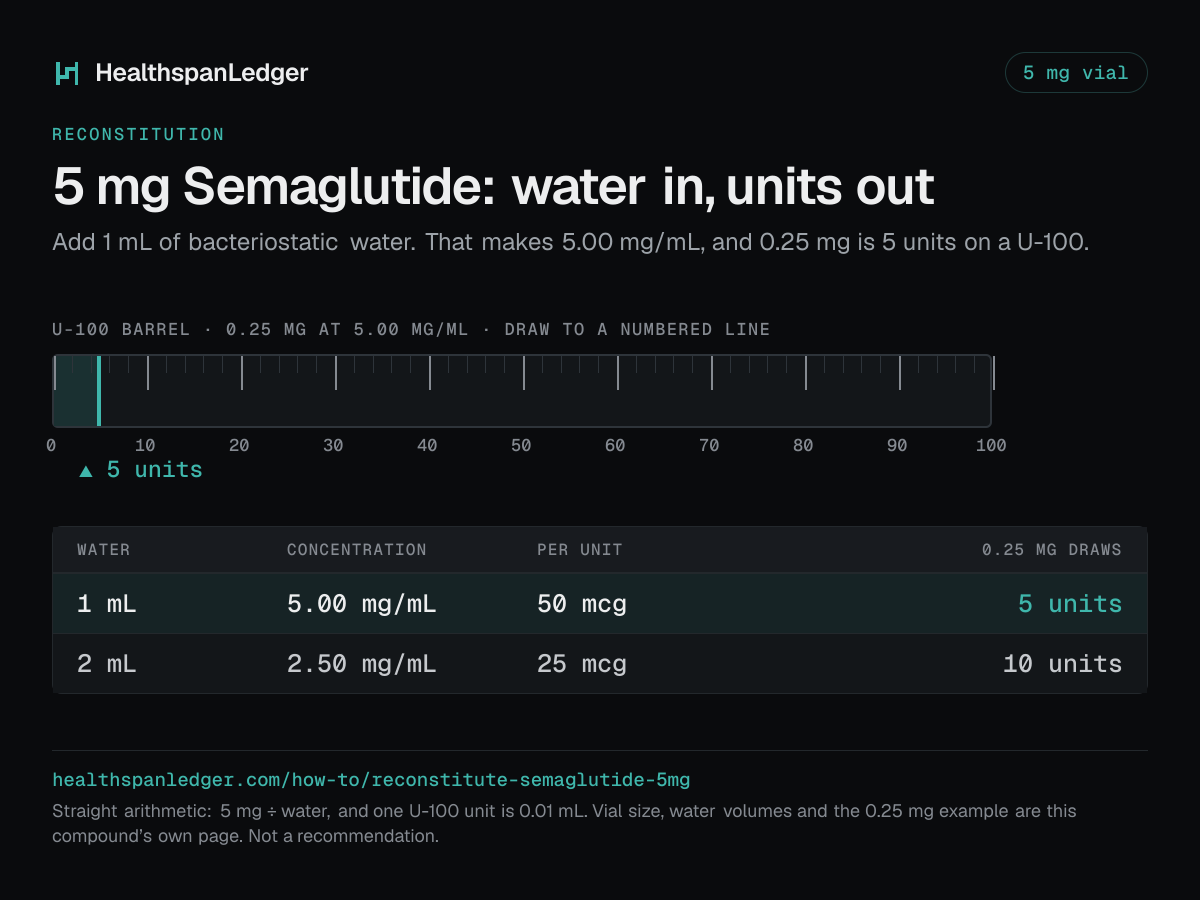
In this example, 1 mL of bacteriostatic water in a 5 mg Semaglutide vial gives 5.00 mg/mL. An example 0.25 mg amount is then 5.0 units on a U-100 syringe.
This example lands on a syringe line. More water makes a weaker mix and a bigger draw. Less water makes a stronger mix and a smaller one. The amount of Semaglutide stays the same. Use the diluent and volume specified for your product; the arithmetic alone does not choose them.
What matters first
Example water volume
1 mL
Resulting strength
5.00 mg/mL
Example 0.25 mg dose
5.0 U-100 units
How much bacteriostatic water for a 5 mg Semaglutide vial?
◆ Unique to the 5 mg vialU-100 example draws
Water added
Concentration
Per U-100 unit
Example: 0.25 mg =
1 mL
5.00 mg/mL
50 mcg
5.0 units
2 mL
2.50 mg/mL
25 mcg
10.0 units
Straight arithmetic: concentration = 5 mg ÷ liquid volume, and 1 U-100 unit = 0.01 mL. The example column shows the math at 0.25 mg; it is not a dose recommendation.
The table compares possible concentrations; it does not establish which diluent or volume suits your product. Follow its dispensing instructions.
“Hard to measure” means the example draw is below two U-100 units. “Won’t fit” means it exceeds this syringe’s capacity.
The 5 mg vial at 1 mL on a U-100 barrel. 0.25 mg fills to 5.0 units, at 5.00 mg/mL.
Semaglutide is the drug in Wegovy, Ozempic and Rybelsus. It copies a gut hormone called GLP-1, which helps control appetite and blood sugar.
How many units is a documented dose from this vial?
The table above uses one worked example. These are the published quantities, converted into marks on a U-100 barrel at each listed liquid volume for a 5 mg vial. Where a quantity was never studied by injection, the row says so.
0.25 mg — FDA-approved label
0.25 mg once weekly for 4 weeks, under the skin.
Water added
Concentration
Draw
1 mL
5.00 mg/mL
5.0 units
2 mL
2.50 mg/mL
10.0 units
FDA labelWegovy (semaglutide) — FDA-approved Prescribing Information (DailyMed) · retrieved 2026-08-20
1.7–2.4 mg — FDA-approved label
1.7–2.4 mg once weekly, under the skin.
Water added
Concentration
Draw, low to high
1 mL
5.00 mg/mL
34.0 to 48.0 units
2 mL
2.50 mg/mL
68.0 to 96.0 units
FDA labelWegovy (semaglutide) — FDA-approved Prescribing Information (DailyMed) · retrieved 2026-08-20
Twenty worked doses with two whole-unit draw examples
Both displayed water amounts give whole-unit syringe readings at the example dose. The vial divides into twenty doses before losses, but that count does not establish how long it can be used.
3Read the full vial record — 3 notes
Both results are whole numbers, with different volumes
The larger water amount spreads the same drug content through twice as much liquid. Each dose then needs twice the draw volume. Both results land on whole-unit lines in the illustration, with no rounding needed for these inputs.
The dose itself has not doubled. This distinction matters when comparing two labels or screenshots that show different unit readings for the same amount of medication.
A small whole number still needs the right scale
The smaller draw uses only a few units. A difference of one line can therefore represent a substantial fraction of that reading. Whole units make the calculation tidy, but they do not remove the need to check the syringe and concentration.
Use the scale printed on the supplied syringe. The U-100 drawing is not a generic measurement scale for every device, and the water examples do not override the mixing instructions.
Twenty portions is not twenty weeks of usable medicine
The dose count is obtained by division. It assumes the same dose each time and does not account for residual liquid, storage limits or restrictions on repeated use of the container.
A disposal date and the number of usable doses cannot be inferred from that count. Check the pharmacy label for the prepared product. A cost estimate based on all twenty portions needs those practical limits before it can describe the amount you could actually use.
How do you mix it, step by step?
Wipe both stoppers with an alcohol swab and let them dry.
Check the product’s mixing instructions for the correct diluent and volume before drawing it up.
Let the water run slowly down the inside wall of the Semaglutide vial, rather than jetting it onto the powder.
Follow the product’s instructions for mixing and checking the solution before use. Do not assume every powder uses the same method.
Store it as the dispensing label directs. What happens after mixing differs by product — some labels direct against refrigerating the mixed solution at all.
What if your water volume is not on the table?
The calculator lets you enter your product’s vial strength and mixing volume, then shows the arithmetic for your syringe.