Page last checked

How-to · reconstitution

How to reconstitute Tesamorelin 2 mg

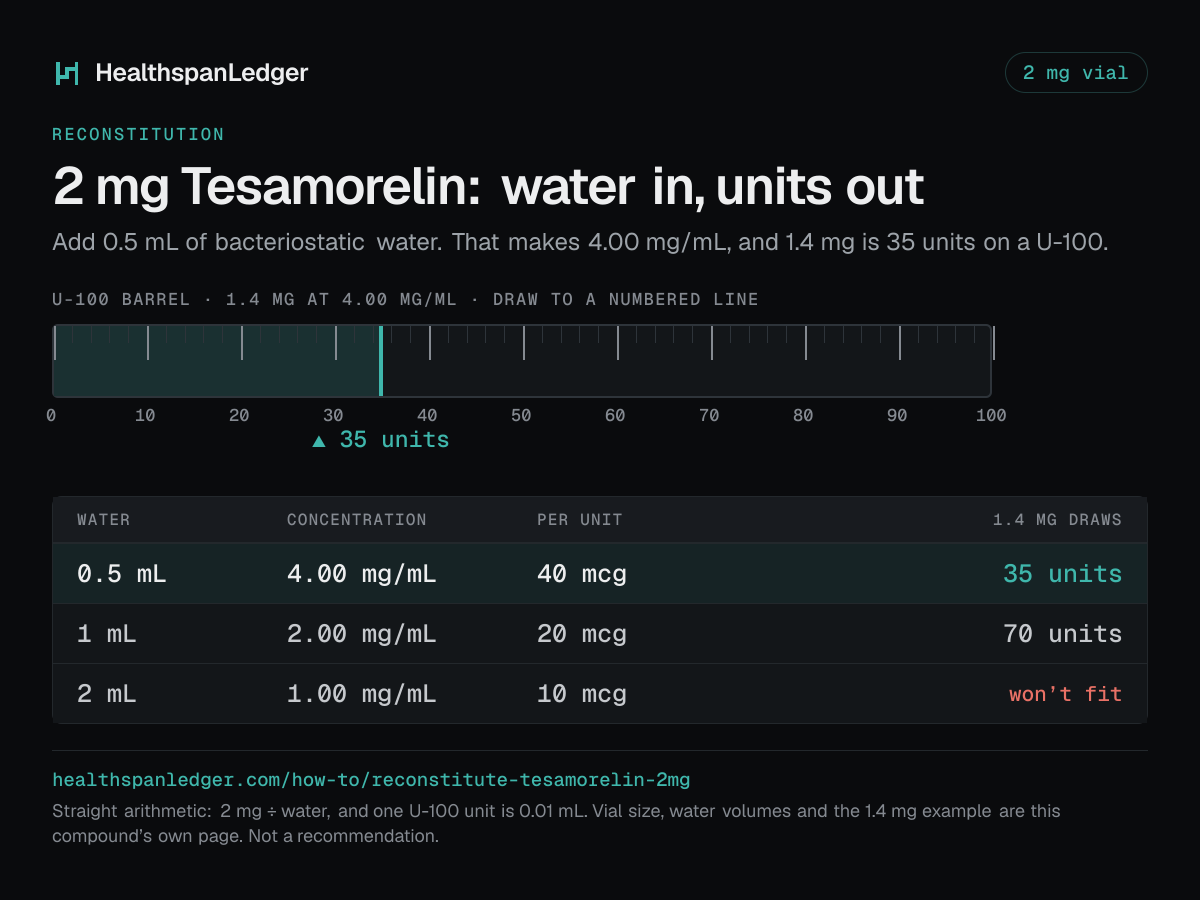
Put 0.5 mL of bacteriostatic water into the 2 mg Tesamorelin vial. That makes 4.00 mg/mL. A 1.4 mg dose is then 35.0 units on a U-100 syringe.

That volume is the one that lands the draw on a syringe line, so the reading can be checked by eye. More water makes a weaker mix and a bigger draw. Less water makes a stronger mix and a smaller one. The amount of Tesamorelin in the glass never changes. Only the number of marks it takes does.

What matters first

Water to add
0.5 mL
Resulting strength
4.00 mg/mL
Example 1.4 mg dose
35.0 U-100 units

What is Tesamorelin?

Tesamorelin is a prescription copy of the hormone that prompts growth hormone release, sold as Egrifta.

Medically reviewed by Jennifer Montecillo, MD · non-practicing medical reviewerReviewed 2026-08-12open the primary sources

How much bacteriostatic water for a 2 mg Tesamorelin vial?

◆ Unique to the 2 mg vialU-100 example draws
Water addedConcentrationPer U-100 unitExample: 1.4 mg =
0.5 mL4.00 mg/mL40 mcg35.0 units
1 mL2.00 mg/mL20 mcg70.0 units
2 mL1.00 mg/mL10 mcg140.0 unitswon’t fit

Straight arithmetic: concentration = 2 mg ÷ water, and 1 U-100 unit = 0.01 mL. The example column shows the math at 1.4 mg; it is not a dose recommendation.

Which volume to use is a practical choice rather than a dose. Pick the one that puts your draw somewhere you can actually read it on the syringe. The flags in the last column mark where that fails. “Hard to measure” means the draw is too small to judge by eye. “Won’t fit” means it is bigger than one U-100 syringe holds.

Tesamorelin 2 mg vial: how much water to add. Each row is what that amount draws on a U-100 syringe. 0.5 mL makes 4.00 mg/mL, or 40 mcg a unit, and 1.4 mg is 35 units. 1 mL makes 2.00 mg/mL, or 20 mcg a unit, and 1.4 mg is 70 units. 2 mL makes 1.00 mg/mL, or 10 mcg a unit, and 1.4 mg is more than one barrel holds. The barrel drawn here is filled to 35 units, the draw at 0.5 mL. The sum is 2 mg divided by the water. One U-100 unit is 0.01 mL.
The 2 mg vial at 0.5 mL on a U-100 barrel. 1.4 mg fills to 35.0 units, at 4.00 mg/mL.

How many units is a documented dose from this vial?

The table above uses one worked example. These are the published quantities, converted into marks on a U-100 barrel at each water volume for a 2 mg vial. Where a quantity was never studied by injection, the row says so.

1.4 mgFDA-approved label

1.4 mg once daily into the abdomen, under the skin. (Egrifta SV, the 2 mg-per-vial formulation).

Water addedConcentrationDraw
0.5 mL4.00 mg/mL35.0 units
1 mL2.00 mg/mL70.0 units
2 mL1.00 mg/mL140.0 unitswon’t fit

FDA labelEGRIFTA SV (tesamorelin) for injection — FDA-approved Prescribing Information (DailyMed SPL) · retrieved 2026-08-12

A single-dose vial mixed at a volume its own label chose

The labeled daily amount is most of what this vial holds, so it does not make a second dose. The smallest volume in the table below is unusual on this site. It is there because the approved product is made up at roughly that scale.

3Read the full vial record 3 notes

The remainder is not another dose

One draw empties the useful part of this vial. The remainder is real powder, and it will not stretch to a second dose. So the number worth knowing here is not how many doses you get. It is how much you throw out.

That is a different question from the one every other page here answers. It follows directly from the vial being close to the size of a single dose.

The largest listed volume cannot be drawn

Reach for the biggest volume out of habit and the daily amount runs past the end of a U-100 barrel. One injection becomes two.

On a research peptide that habit costs nothing. On a daily labeled medicine it turns a routine into an error, which is why the row carries a flag.

Two versions of the product exist and they differ

The approved medicine is sold in two formulations whose own labels state they are not interchangeable. Vial strength, daily amount, mixing liquid and storage all differ between them.

A figure carried across from the other one is not a close approximation. It describes a different container, and this page describes only the vial size in its title.

How do you mix it, step by step?

  1. Wipe both stoppers with an alcohol swab and let them dry.
  2. Draw up the water volume you picked from the table.
  3. Let the water run slowly down the inside wall of the Tesamorelin vial, rather than jetting it onto the powder.
  4. Swirl gently until it dissolves. Shaking damages peptides.
  5. Store it as the dispensing label directs. What happens after mixing differs by product — some labels direct against refrigerating the mixed solution at all.

What if your water volume is not on the table?

The table shows the offered water volumes. The calculator does the same arithmetic for any volume and any syringe, and shows its working line by line.

Open the Tesamorelin calculator →

Where to read next about Tesamorelin

The arithmetic on this page is only half the question. These are the pages that carry the other half.

1primary source, each with the day we read it — open the documents used on this page