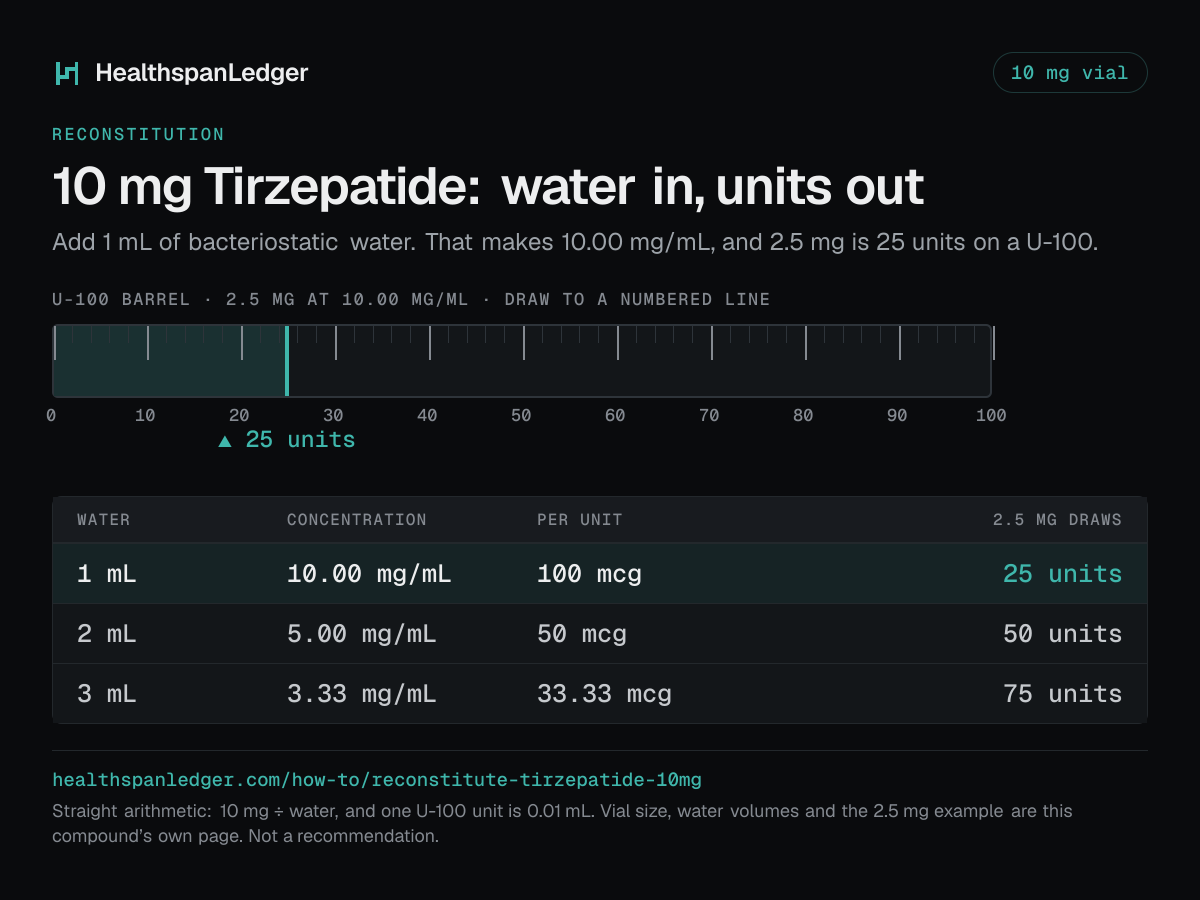
Put 1 mL of bacteriostatic water into the 10 mg Tirzepatide vial. That makes 10.00 mg/mL. A 2.5 mg dose is then 25.0 units on a U-100 syringe.
That volume is the one that lands the draw on a syringe line, so the reading can be checked by eye. More water makes a weaker mix and a bigger draw. Less water makes a stronger mix and a smaller one. The amount of Tirzepatide in the glass never changes. Only the number of marks it takes does.
What matters first
Water to add
1 mL
Resulting strength
10.00 mg/mL
Example 2.5 mg dose
25.0 U-100 units
What is Tirzepatide?
Tirzepatide is the drug in Zepbound and Mounjaro. It works on two gut hormone signals involved in appetite and blood sugar.
Medically reviewed by Jennifer Montecillo, MD · non-practicing medical reviewer·Reviewed 2026-07-22·open the primary sources
How much bacteriostatic water for a 10 mg Tirzepatide vial?
◆ Unique to the 10 mg vialU-100 example draws
Water added
Concentration
Per U-100 unit
Example: 2.5 mg =
1 mL
10.00 mg/mL
100 mcg
25.0 units
2 mL
5.00 mg/mL
50 mcg
50.0 units
3 mL
3.33 mg/mL
33.33 mcg
75.0 units
Straight arithmetic: concentration = 10 mg ÷ water, and 1 U-100 unit = 0.01 mL. The example column shows the math at 2.5 mg; it is not a dose recommendation.
Which volume to use is a practical choice rather than a dose. Pick the one that puts your draw somewhere you can actually read it on the syringe. The flags in the last column mark where that fails. “Hard to measure” means the draw is too small to judge by eye. “Won’t fit” means it is bigger than one U-100 syringe holds.
The 10 mg vial at 1 mL on a U-100 barrel. 2.5 mg fills to 25.0 units, at 10.00 mg/mL.
How many units is a documented dose from this vial?
The table above uses one worked example. These are the published quantities, converted into marks on a U-100 barrel at each water volume for a 10 mg vial. Where a quantity was never studied by injection, the row says so.
2.5 mg — FDA-approved label
2.5 mg once weekly for 4 weeks, under the skin.
Water added
Concentration
Draw
1 mL
10.00 mg/mL
25.0 units
2 mL
5.00 mg/mL
50.0 units
3 mL
3.33 mg/mL
75.0 units
FDA labelZepbound (tirzepatide) — FDA-approved Prescribing Information · retrieved 2026-07-22
5–15 mg — FDA-approved label
5–15 mg once weekly, under the skin. (5, 10, or 15 mg).
Water added
Concentration
Draw, low to high
1 mL
10.00 mg/mL
50.0 to 150.0 unitswon’t fit
2 mL
5.00 mg/mL
100.0 to 300.0 unitswon’t fit
3 mL
3.33 mg/mL
150.0 to 450.0 unitswon’t fit
FDA labelZepbound (tirzepatide) — FDA-approved Prescribing Information · retrieved 2026-07-22
The one vial where both clocks run out together
Four doses at the amount shown, and the cited storage window is also four weeks. This is the only tirzepatide size where the vial and storage window end at the same time.
3Read the full vial record — 3 notes
The last dose comes out as the window closes
On every larger vial in this family the mixed solution expires with powder still in it. On the smaller one the powder runs out early and the window never binds.
This size lands on the line. There is no wastage to price in and no half-used vial to decide about, which is a genuinely different situation from its neighbors.
All three volumes give whole numbers of units
Every listed water amount puts the worked dose exactly on a syringe line. The other tirzepatide vial sizes each have at least one combination that falls between lines.
It means the choice on this page is only about how much liquid goes under the skin, never about whether the reading can be trusted.
Why this size gets quoted so often
Mixing guides converge on this vial, and the arithmetic explains why rather than taste. A vial that empties exactly as its window shuts needs no wastage sum and forces no rounding compromise.
That is a property of this vial at this amount, though, not a property of the vial. Move up the schedule and the four doses become one.
How do you mix it, step by step?
Wipe both stoppers with an alcohol swab and let them dry.
Draw up the water volume you picked from the table.
Let the water run slowly down the inside wall of the Tirzepatide vial, rather than jetting it onto the powder.
Swirl gently until it dissolves. Shaking damages peptides.
Store it as the dispensing label directs, and discard after 28 days (USP <797> multi-dose vial).
What if your water volume is not on the table?
The table shows the offered water volumes. The calculator does the same arithmetic for any volume and any syringe, and shows its working line by line.
It is a middle step on the label’s own ladder rather than a large dose. That ladder opens at 2.5 mg weekly for four weeks, then climbs in 2.5 mg steps no faster than every four weeks. Its top maintenance dose is 15 mg weekly.
The 10 mg in this page title is a vial strength, though, and a vial strength is not a dose. A 10 mg vial holds four draws at the opening 2.5 mg.
How much bacteriostatic water to mix with 5mg of tirzepatide?
One of the three listed volumes will not fit the syringe on a 5 mg vial. At 3 mL the opening 2.5 mg needs 150 units, and a U-100 barrel holds 100.
One milliliter reads 50 units, and 2 mL reads exactly 100, filling the barrel to its top. On the small vial, adding water is the move that runs you out of syringe.
How do you reconstitute 10mg of tirzepatide?
Water in, powder dissolved, and the strength is 10 divided by the milliliters. That gives 10, 5 or 3.33 mg per mL across the three listed volumes. The opening 2.5 mg then reads 25, 50 or 75 units.
All three are whole numbers, which no other tirzepatide vial manages. This size also empties as its window shuts: four draws, and a mixed vial keeps 28 days.
How much reconstitution solution to add to tirzepatide?
The volume decides only how readable the draw is, because every one of them delivers the same milligrams. That is the whole trade-off on this vial.
At 1 mL the opening 2.5 mg fills a quarter of the barrel. At 3 mL it fills three quarters. The longer reading has more lines under it and costs a little more liquid.
Where to read next about Tirzepatide
The arithmetic on this page is only half the question. These are the pages that carry the other half.