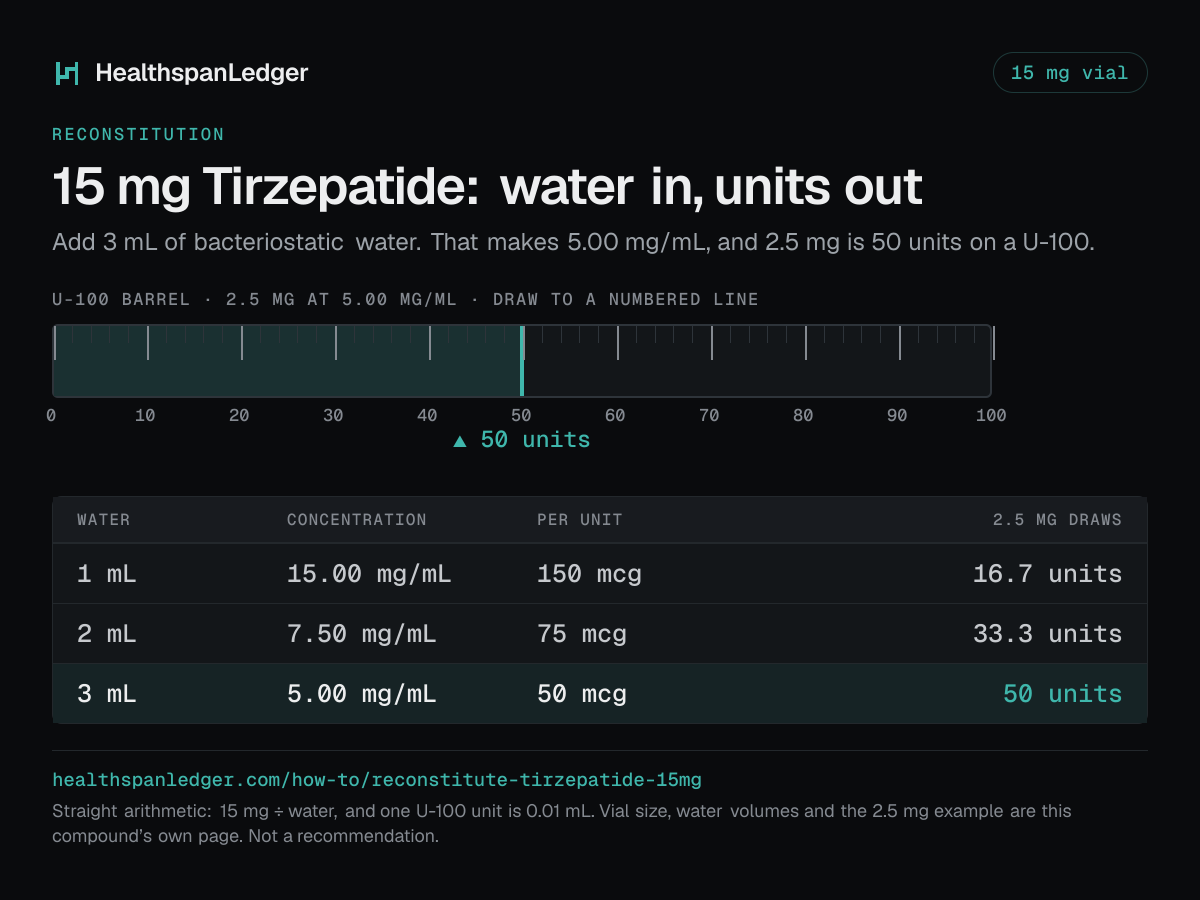
In this example, 3 mL of bacteriostatic water in a 15 mg Tirzepatide vial gives 5.00 mg/mL. An example 2.5 mg amount is then 50.0 units on a U-100 syringe.
This example lands on a syringe line. More water makes a weaker mix and a bigger draw. Less water makes a stronger mix and a smaller one. The amount of Tirzepatide stays the same. Use the diluent and volume specified for your product; the arithmetic alone does not choose them.
What matters first
Example water volume
3 mL
Resulting strength
5.00 mg/mL
Example 2.5 mg dose
50.0 U-100 units
How much bacteriostatic water for a 15 mg Tirzepatide vial?
◆ Unique to the 15 mg vialU-100 example draws
Water added
Concentration
Per U-100 unit
Example: 2.5 mg =
1 mL
15.00 mg/mL
150 mcg
16.7 units
2 mL
7.50 mg/mL
75 mcg
33.3 units
3 mL
5.00 mg/mL
50 mcg
50.0 units
Straight arithmetic: concentration = 15 mg ÷ liquid volume, and 1 U-100 unit = 0.01 mL. The example column shows the math at 2.5 mg; it is not a dose recommendation.
The table compares possible concentrations; it does not establish which diluent or volume suits your product. Follow its dispensing instructions.
“Hard to measure” means the example draw is below two U-100 units. “Won’t fit” means it exceeds this syringe’s capacity.
The 15 mg vial at 3 mL on a U-100 barrel. 2.5 mg fills to 50.0 units, at 5.00 mg/mL.
Tirzepatide is the drug in Zepbound and Mounjaro. It works on two gut hormone signals involved in appetite and blood sugar.
How many units is a documented dose from this vial?
The table above uses one worked example. These are the published quantities, converted into marks on a U-100 barrel at each listed liquid volume for a 15 mg vial. Where a quantity was never studied by injection, the row says so.
2.5 mg — FDA-approved label
2.5 mg once weekly for 4 weeks, under the skin.
Water added
Concentration
Draw
1 mL
15.00 mg/mL
16.7 units
2 mL
7.50 mg/mL
33.3 units
3 mL
5.00 mg/mL
50.0 units
FDA labelZepbound (tirzepatide) — FDA-approved Prescribing Information · retrieved 2026-09-19
5–15 mg — FDA-approved label
5–15 mg once weekly, under the skin. (5, 10, or 15 mg).
Water added
Concentration
Draw, low to high
1 mL
15.00 mg/mL
33.3 to 100.0 units
2 mL
7.50 mg/mL
66.7 to 200.0 unitswon’t fit
3 mL
5.00 mg/mL
100.0 to 300.0 unitswon’t fit
FDA labelZepbound (tirzepatide) — FDA-approved Prescribing Information · retrieved 2026-09-19
Six example doses, with two fractional syringe readings
At the displayed dose, this vial divides into six complete doses. Only the largest of the three water amounts gives a whole-unit draw on the illustrated syringe.
3Read the full vial record — 3 notes
Why two readings fall between lines
The first two water amounts produce fractional units because the entered dose does not divide evenly at those concentrations. The last row gives a whole number. These differences come from the ratio of drug to liquid, not from a change in the dose.
Keep the calculated fraction visible while checking the result. Rounding it without checking the syringe changes the amount of drug represented by the reading.
A line on this drawing is not every syringe
The diagram uses a U-100 scale with whole-unit marks. Actual syringes can have different capacities and spacing between their lines. A reading that fits this drawing may not have a matching line on the syringe you have.
The suitable diluent and volume come from the product instructions. Do not change the mixture just to make a decimal disappear; ask the dispensing pharmacist to resolve a draw you cannot measure.
Separate the six-dose count from the use-by date
Six is the result of vial content divided by the worked dose, before losses. It says nothing about how long the solution remains suitable for use or how often a particular container may be entered.
This guide therefore does not assign an expiry date or predict discarded doses from the ingredient name. The product label supplies those limits. If the prescribed dose changes, recalculate the draw and remaining quantity using that new amount.
How do you mix it, step by step?
Wipe both stoppers with an alcohol swab and let them dry.
Check the product’s mixing instructions for the correct diluent and volume before drawing it up.
Let the water run slowly down the inside wall of the Tirzepatide vial, rather than jetting it onto the powder.
Follow the product’s instructions for mixing and checking the solution before use. Do not assume every powder uses the same method.
Store it as the dispensing label directs. What happens after mixing differs by product — some labels direct against refrigerating the mixed solution at all.
What if your water volume is not on the table?
The calculator lets you enter your product’s vial strength and mixing volume, then shows the arithmetic for your syringe.