Page last checked
Research compound · not FDA-approved
Melanotan II
Melanotan II is a ring of seven amino acids. It copies a hormone the body already uses to tell skin cells to make more of the brown pigment that darkens a tan.
What matters first
- Why people look it up
- People take it to tan faster and darker, usually alongside sunbeds or sun. A second, unadvertised reason is that it causes erections, which is why some men take it too.
- What the evidence shows
- One human trial exists, from 1996, in three men. It reported darker skin in two of them. It was a safety study, not a tanning study, and nothing followed it. The erections were not a stray finding either. That trial reported them, and a different molecule was later built from this one for that use alone.
- Dose status
- Melanotan II is not FDA-approved, so no dosing label exists for it. The sections below explain what researchers tested and what remains unknown.
What is known about Melanotan II
Melanotan II is a ring of seven amino acids. It tells skin cells to make more of the pigment that darkens a tan. One human trial exists, in three men, in 1996. Its amounts are per kilogram of body weight. What matters more is the vial: two laboratories measured the product and found far less in it than the label claimed.
| Topic | Value |
|---|---|
| Strongest source | limited human data |
| FDA approval | Not FDA-approved |
| Studied dosing | 10–30 mcg per kilogram of body weight, on alternating days for two weeks in three male volunteers (published as 0.01 to 0.03 mg/kg; the trial started every subject at the bottom of that range and escalated in 0.005 mg/kg steps, and its own recommendation for the studies meant to follow it was 0.025 mg/kg a day) — from clinical trials |
| Typical vials | 10 mg |
Every row links back to a source listed below. These facts are for reference, not a personal recommendation.
What the evidence for Melanotan II is
People have received this compound in a documented setting, or it has approval outside the United States. The available human evidence is still too limited to show a clear dose-and-result pattern for US use.
- What it establishes
- What it does not establish
Check the country, study size and reason it was used. Do not treat limited human data as an FDA-approved schedule.
Evidence snapshot and shareable image
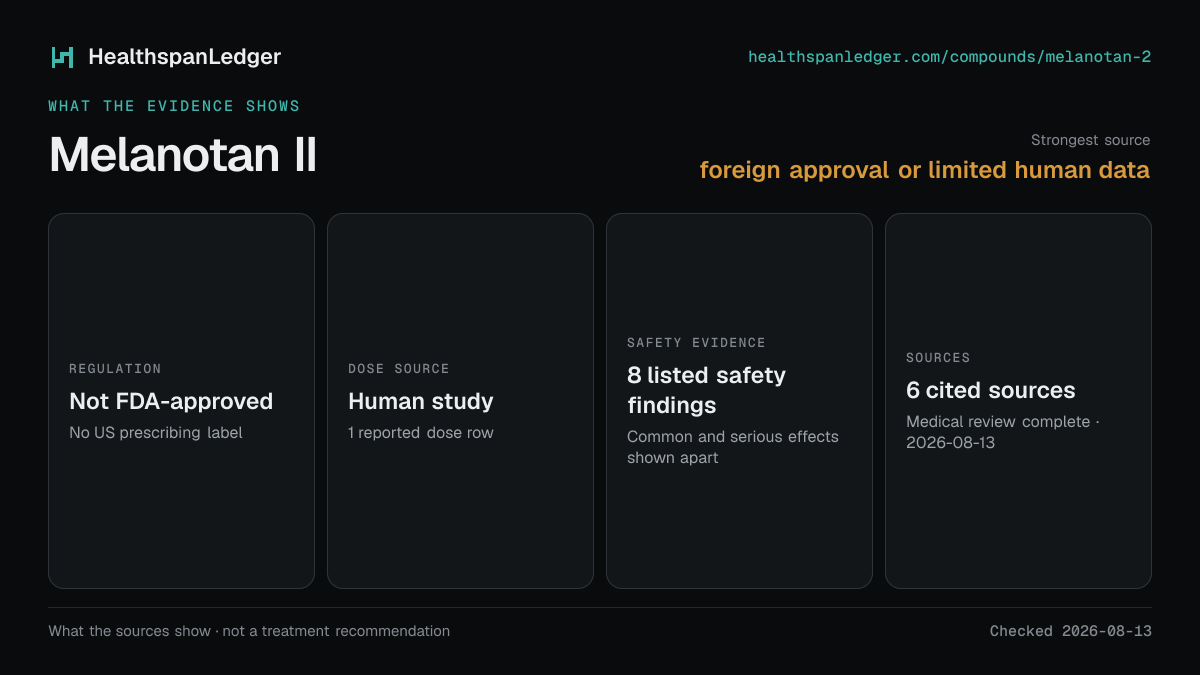
Evidence snapshot
Foreign approval or limited human data
- Regulation
- Dose source
- Safety evidence
- Sources
Where Melanotan II is in clinical trials
No trial of this compound is registered on ClinicalTrials.gov.
That is worth sitting with. Nobody has registered a study to find out whether Melanotan II works in people, so no result is coming and no date is worth waiting for. Sellers are not waiting for that work either.
We left one registration out of the count above. Registering a study does not prove it is running, and these did not hold up.
ClinicalTrials.gov · retrieved 2026-09-27
Regulatory status
No agency has approved melanotan II, and no company holds a license for it anywhere this site can attest.
It is sold online as a research chemical. A 2017 review reports that multiple national health organizations have issued safety warnings about it, and that is the review’s statement rather than ours — we could not reach any regulator’s own page on 13 August 2026, so this record names no country. A related but different molecule, afamelanotide, is approved for a small number of conditions.
It is not this one, and its trials are not this one’s.
Full regulatory tracker →Where to go next on Melanotan II
The related pages keep each topic with its evidence.
Why Melanotan II carries no boxed warning
Check a Melanotan II draw with the Melanotan II dosage calculator
The 10 mg Melanotan II vial: concentrations and example draws
Every calculator on this site, Melanotan II and the rest
Where Melanotan II sits among the dose schedules
Which compounds are still in trials besides Melanotan II
Melanotan II in the regulatory changelog
Uses and approval status for Melanotan II and other compounds
The sourcing rules behind every Melanotan II figure
Safety notes
Questions about Melanotan II
Is Melanotan II FDA-approved?
How is Melanotan II taken?
How does Melanotan II differ from the other compounds in this class?
What is not known about Melanotan II?
- Dorr RT, Lines R, Levine N, Brooks C, Xiang L. Evaluation of melanotan-II, a superpotent cyclic melanotropic peptide in a pilot phase-I clinical study. Life Sci. 1996;58(20):1777-84retrieved 2026-08-13limited human data
- Mallory CW, Lopategui DM, Cordon BH. Melanotan Tanning Injection: A Rare Cause of Priapism. Sex Med. 2021;9(1):100298retrieved 2026-08-13limited human data
- Nelson ME, Bryant SM, Aks SE. Melanotan II injection resulting in systemic toxicity and rhabdomyolysis. Clin Toxicol (Phila). 2012;50(10):1169-73retrieved 2026-08-13limited human data
- Peters B, Hadimeri H, Wahlberg R, Afghahi H. Melanotan II: a possible cause of renal infarction: review of the literature and case report. CEN Case Rep. 2020;9(3):219-222retrieved 2026-08-13limited human data
- Burian EA, Jemec GBE. Eruptive Melanocytic Nevi: A Review. Am J Clin Dermatol. 2019;20(5):669-682retrieved 2026-08-13limited human data
- Habbema L, Halk AB, Neumann M, Bergman W. Risks of unregulated use of alpha-melanocyte-stimulating hormone analogues: a review. Int J Dermatol. 2017;56(6):575-580retrieved 2026-08-13limited human data