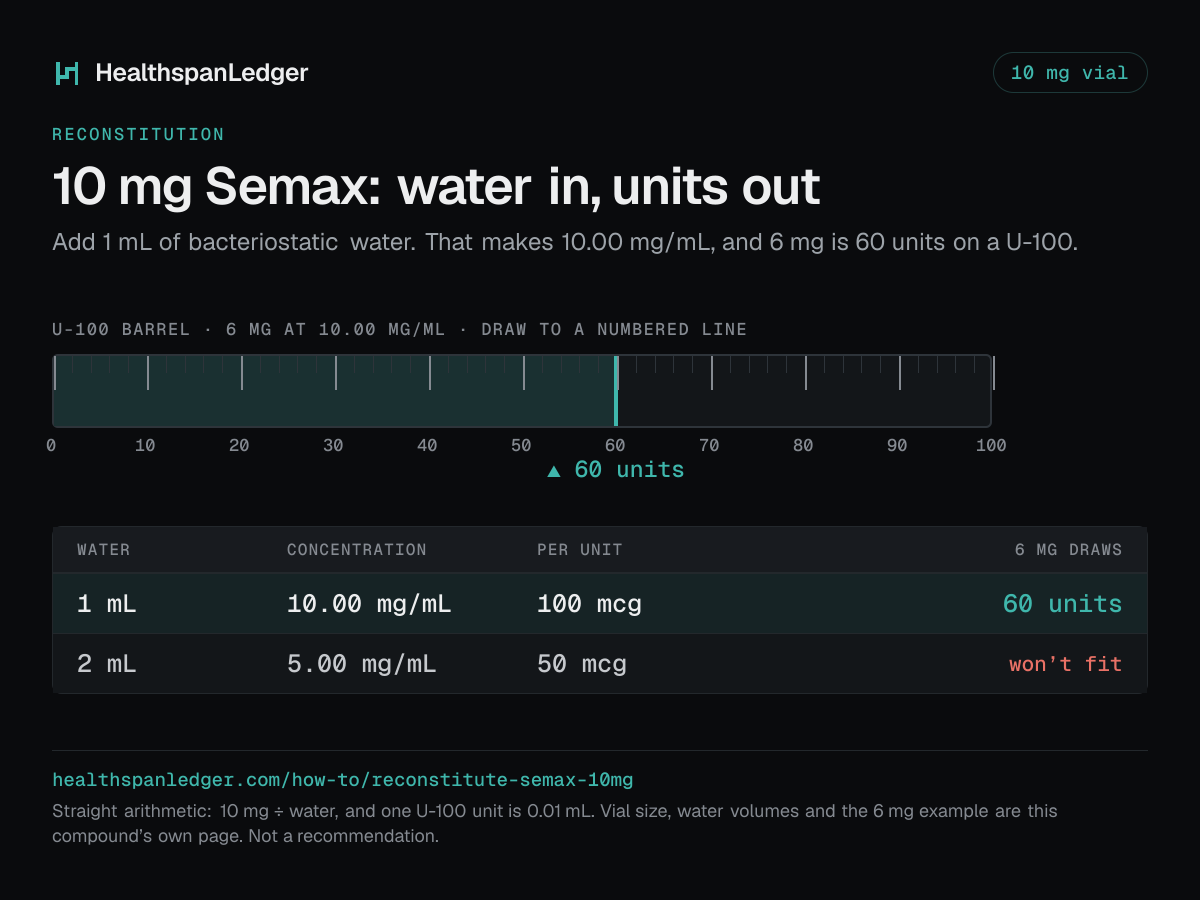
Why one of the two rows fails
The published worked amount is large relative to this vial. With more water, one draw exceeds the capacity of a U-100 syringe.
The more concentrated example fits the illustrated barrel. That comparison identifies a volume limit; it does not make either example an approved or tested preparation for injection.
One draw, against a course that ran for days
The study used the worked amount daily in two ten-day periods separated by a break. This vial contains one complete portion at that amount.
The portion count is much smaller than the number of administrations in that study. Matching the total mass would still not reproduce the studied preparation, its route or its delivery method.
It is also arithmetic about a product given as nasal drops from a licensed bottle, which this powder is not. The mass matches and nothing else about the two does.
A smaller powder example is still a different product
The vial example converts one stated drug mass into concentration and draw volume. It does not establish that the powder should be mixed, injected or used as a substitute for the studied nasal preparation.
Increasing the vial strength gives more theoretical portions but does not resolve the route difference. A larger quantity cannot supply the product instructions or clinical evidence needed to make that substitution.
Neither worked strength identifies the licensed nasal product used in the study. The figures depend on the stated inputs and do not independently confirm the identity, content or quality of another preparation.