Page last checked
Research compound · not FDA-approved
Semax
Semax is a peptide seven amino acids long, copied from a short stretch of a stress hormone. It carries none of that hormone’s own activity.
What matters first
- Why people look it up
- It is sold as a nootropic, for focus, memory and recovery after a stroke.
- What the evidence shows
- In Russia it is a registered prescription medicine given as nasal drops. Stroke patients there have received it for thirty years. That work is Russian-language, and none of it was ever registered as a trial. The clearest published result is a negative one, in 27 people with motor neuron disease.
- Dose status
- Semax is not FDA-approved, so no dosing label exists for it. The sections below explain what researchers tested and what remains unknown.
What is known about Semax
Semax is a seven-amino-acid peptide built from a short piece of adrenocorticotropic hormone with a three-residue tail added to stop the body breaking it down. It carries no hormone activity of its own. In Russia it is a registered prescription medicine, sold as nasal drops at two strengths, and it has been given to stroke patients there since the 1990s. Outside Russia it is approved nowhere, and no trial of it has ever been registered.
| Topic | Value |
|---|---|
| Strongest source | limited human data |
| FDA approval | Not FDA-approved |
| Studied dosing | 6 mg a day, in two courses of ten days separated by twenty days (110 patients at different stages after an ischemic stroke, mean age 58; the study also reported a brain-growth-factor marker in the blood rising alongside recovery scores) — from clinical trials |
| Studied dosing | 12 mg a day as a 1% solution, in two courses of ten days two weeks apart (27 patients; the report calls itself open-label. It states that Semax did not change the course of the disease, with a difference showing only on a quality-of-life total) — from clinical trials |
| Typical vials | 10 mg · 30 mg |
Every row links back to a source listed below. These facts are for reference, not a personal recommendation.
What the evidence for Semax is
People have received this compound in a documented setting, or it has approval outside the United States. The available human evidence is still too limited to show a clear dose-and-result pattern for US use.
- What it establishes
- What it does not establish
Check the country, study size and reason it was used. Do not treat limited human data as an FDA-approved schedule.
Evidence snapshot and shareable image
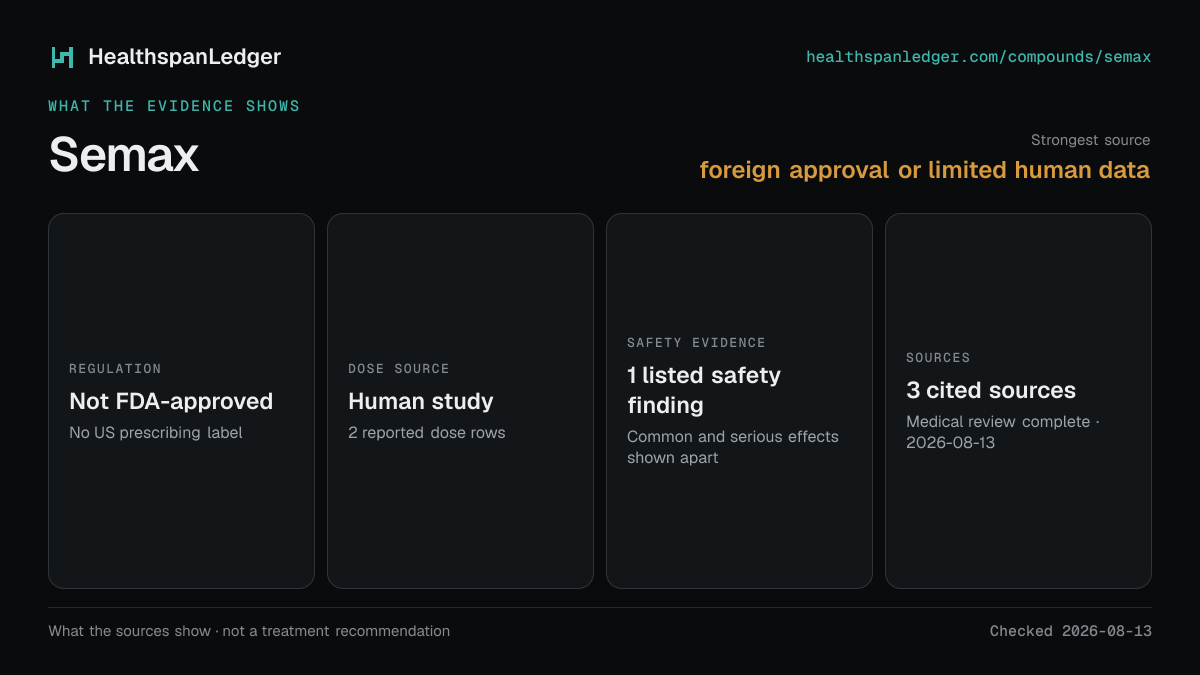
Evidence snapshot
Foreign approval or limited human data
- Regulation
- Dose source
- Safety evidence
- Sources
Where Semax is in clinical trials
No trial of this compound is registered on ClinicalTrials.gov.
That is worth sitting with. Nobody has registered a study to find out whether Semax works in people, so no result is coming and no date is worth waiting for. Sellers are not waiting for that work either.
ClinicalTrials.gov · retrieved 2026-09-27
Regulatory status
Russia’s State Register of Medicines lists two Semax registrations in force, both nasal drops in a 3 mL vial, one at 0.1% and one at 1%, and both prescription-only.
The line goes back to registrations first granted in December 2006. It is classed there as a nootropic. The vials sold elsewhere are a form that registration says nothing about.
FDA has approved nothing under this name. No Semax study appears on ClinicalTrials.gov, and the indexed literature holds no systematic review and no meta-analysis. The one paper indexed as a randomized trial describes itself as open-label.
Full regulatory tracker →Where to go next on Semax
The related pages keep each topic with its evidence.
Which semax reactions warrant medical attention
The semax reconstitution calculator for mixing math
Mixing a 10 mg semax vial, water volume by water volume
What each water volume does to the 30 mg semax vial
Where semax sits among the anxiety and depression compounds
Take the semax arithmetic to any other vial
Where semax sits among the dose schedules
Which compounds are still in trials besides semax
Semax in the regulatory changelog
Explore the research behind semax and other compounds
Safety notes
Questions about Semax
Is Semax FDA-approved?
How is Semax taken?
How does Semax differ from the other compounds in this class?
What is not known about Semax?
- Gusev EI, Martynov MY, Kostenko EV, Petrova LV, Bobyreva SN. [The efficacy of semax in the tretament of patients at different stages of ischemic stroke]. Zh Nevrol Psikhiatr Im S S Korsakova. 2018;118(3 Vyp 2):61-68 — 110 patients, two ten-day courses of 6000 mcg a day separated by twenty days. Russian; read here through the English abstract indexed in PubMedretrieved 2026-08-13limited human data
- Serdiuk AV, Levitskii GN, Miasoedov NF, Skvortsova VI. [The study of chronic partial denervation and quality of life in patients with motor neuron disease treated with semax]. Zh Nevrol Psikhiatr Im S S Korsakova. 2007;107(4):29-39 — 27 patients given 12 mg a day intranasally as a 1% solution in two ten-day courses. The abstract calls it open-label and reports that Semax did not influence the course of the disease. Russian; read through the indexed English abstractretrieved 2026-08-13limited human data
- Alekseeva GV, Bottaev NA, Goroshkova VV. [Use of semax at a follow-up of patients with posthypoxic encephalopathy]. Anesteziol Reanimatol. 1999;(1):40-3 — a follow-up of 73 patients recovering from oxygen starvation of the brain, fourteen of them in a persistent vegetative state. Reports paroxysmal activity on the electroencephalogram in some cases, and advises monitoring during the first injection. Russian; read through the indexed English abstractretrieved 2026-08-13limited human data