Page last checked
Growth hormone C-terminal fragment (research compound) · dosing
AOD-9604 dosage: the reported range, and what it rests on
People report taking AOD-9604 at 1–10 mg once daily over 12 weeks. That range is what circulates, not what a study found. No completed controlled human trial has shown which dose works for AOD-9604. The number shown here describes reported use, not a quantity established by a trial. Nothing here is a starting point, a schedule, or a recommendation.
Source for this answer
Source: Valentino MA, Lin JE, Waldman SA. Central and peripheral molecular targets for antiobesity pharmacotherapy. Clin Pharmacol Ther 2010;87(6):652-62 — reports the AOD-9604 12-week trial arms (1 mg/day and 10 mg/day) and the 536-subject 24-week trial that ended development
Source: Valentino MA, Lin JE, Waldman SA. Central and peripheral molecular targets for antiobesity pharmacotherapy. Clin Pharmacol Ther 2010;87(6):652-62 — reports the AOD-9604 12-week trial arms (1 mg/day and 10 mg/day) and the 536-subject 24-week trial that ended development
Key dose facts
What matters first
- Reported range
- 1–10 mg once daily over 12 weeks
- What that means
- A description of use, not a dose shown to work in a controlled trial.
- Approved schedule
- No FDA-approved AOD-9604 schedule exists.
What people report using, and what each figure rests on
Every published AOD-9604 quantity we found, in one table. The last column is the one that matters: it says what produced the number. The rows do not carry equal weight, and the table is built so you can see which is which without being told.
| Quantity | How often | Route | Where the figure came from |
|---|---|---|---|
| 1–10 mg | once daily over 12 weeks — the trials did not inject it, the 1 mg group lost 2.6 kg against 0.8 kg on placebo, the 10 mg group lost less than the 1 mg group, and the primary trial reports were never published | Swallowed | Reported use only |
| 250–500 mcg | a day, split over two or three injections under the skin | Under the skin | Reported use only |
Every row cites a source listed at the foot of this page. A row marked as reported is a description of what people do. It is not evidence that the quantity works, and it is not a dose this site suggests.
The reported rows above do not agree with each other, so averaging them would be misleading. They are shown separately because no human trial has established which amount is appropriate.
Where the AOD-9604 number came from
A range that circulates has a history, and the history is the part sellers leave out. This is what the source behind the row above actually says about its own figure.
- The 10 mg group lost less weight than the 1 mg group. The range on this record is not a ladder: more did not work better
This compound has an unusual regulatory footprint for a research peptide.
It failed as a drug candidate, then found a second life as a food and supplement ingredient. It later became publicly contentious in Australia, in a sports-supplements investigation. The question there was whether it counted as a prohibited substance.
Anti-doping authorities concluded that it was not. None of that shows it works: a substance can be legal, on sale and useless at once.
What this does and does not establish
For AOD-9604, this is the strongest evidence available. The two boxes separate what it can show from what it cannot show.
What it does establish
It shows that people have received it and that some human information exists.
What it does not
It does not prove that the same dose is appropriate in the United States or that uncommon and long-term risks are known.
Check the country, study size and reason it was used. Do not treat limited human data as an FDA-approved schedule.
3Reference details
Which syringe barrel the units are read on
A unit is not a unit. A U-100 and a U-50 barrel both print 0.01 mL per graduation; a U-40 barrel prints 0.025 mL. The same printed number therefore measures 2.5× the volume on a U-40. That is why every unit figure on this page names its barrel. It is also why a unit count copied from someone else’s syringe means nothing on its own.
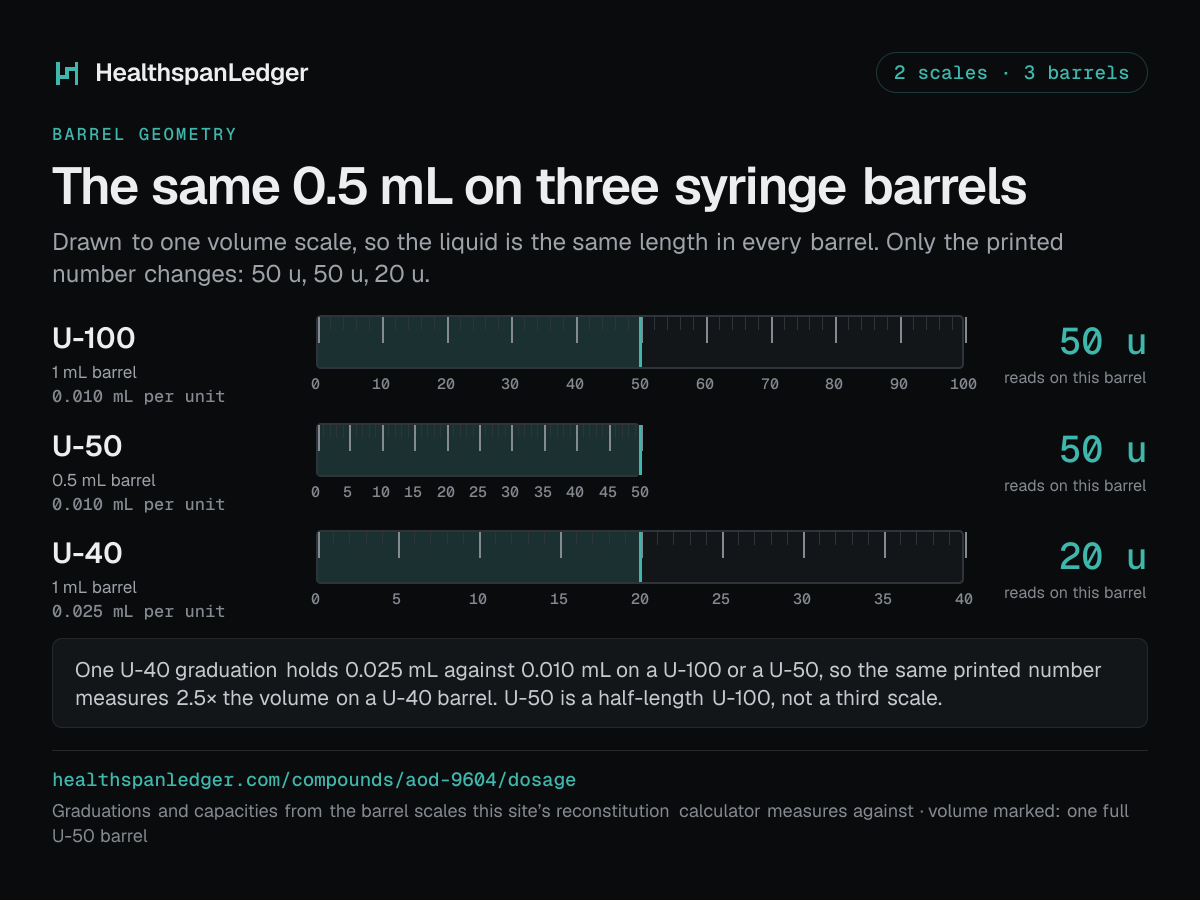
| Barrel | Capacity | One graduation | 0.5 mL reads as |
|---|---|---|---|
| U-100 insulin syringe · 1 mL · lines every 2 units | 1 mL | 0.010 mL | 50 units |
| U-100 insulin syringe · 0.5 mL · lines every 1 unit | 0.5 mL | 0.010 mL | 50 units |
| U-40 insulin syringe · 1 mL · lines every 1 unit | 1 mL | 0.025 mL | 20 units |
Barrel capacities and graduation spacing are the printed scales this site’s calculator measures against, not estimates. Three barrels carry only two scales: a U-50 is a half-length U-100, so it reads identically per unit and simply runs out sooner.
What one graduation is worth at each concentration
Reconstitution fixes a concentration, and the concentration fixes what a single graduation carries — before anyone decides what to draw. Below is every pairing of this page’s vial sizes and water volumes, as a concentration and as the mass one U-100 graduation holds at it. No dose is implied by any cell; it is division.
| Vial | + 2 mL water | + 3 mL water |
|---|---|---|
| 5 mg | 2.5 mg/mL25 mcg per unit | 1.67 mg/mL16.7 mcg per unit |
Vial strengths and water volumes are the AOD-9604 record’s own presets. One U-100 graduation is 0.01 mL, so the mass it carries is the concentration times that volume. That is the entire reason the same milligram figure produces a different unit count in every row.
How dosing works in this class
What a reported range is, and what it is not
A reported range tells you what some people say they use. It is not a dose that a human study found safe or effective, and it is not an approved schedule.
We include the range because readers will see the same numbers elsewhere. Here, the source and the type of evidence sit beside it so you can tell a reported amount from a studied dose.
Seeing the same number on several websites does not make it stronger evidence. Those sites may be repeating one source. Do not treat a reported range as a starting dose.
How these figures usually got their shape
Most reported ranges start in an animal study. The dose there is set per kilogram of body weight, so somebody divides and multiplies it up to a person. That step is arithmetic, and it is often done without the scaling method the field uses for it.
The arithmetic travels. The biology does not. How much a body absorbs, where it goes, how fast it clears and how the receptor answers all change between a mouse and a person. None of that is carried across by multiplying.
So a converted figure is a plausible place to start a study. It is not a result.
The other common origin is a round number. Vials are sold in whole milligrams. Quantities that divide a vial neatly spread faster than quantities that do not. That is a fact about packaging, not about the compound.
Concentration changes the units, not the dose
The dose and the syringe draw are two different things. The dose is a mass in milligrams. The draw is a volume in syringe units. It depends on the concentration after mixing. Adding more bacteriostatic water changes the unit reading, but not the dose.
This matters because a unit count copied from someone else’s vial means nothing without their concentration. That mismatch is the most common way a self-injected dose ends up ten times off. The arithmetic is fixed and safe to state as fact. The dose you apply it to is a clinical decision, and it is not.
Compounded vial?
No approved AOD-9604 product exists, so nothing here describes one. The calculator does arithmetic only: it converts a milligram figure and a reconstitution into a volume and a unit count, and it takes no position on which figure belongs in the box.
Open the AOD-9604 calculator →Questions about AOD-9604 dosing
What AOD-9604 dosage do people report using?
The range documented on this page is 1–10 mg once daily over 12 weeks. It describes reported use, not a dose established by a label or a controlled human trial, and it is not a starting point or recommendation.
Has a AOD-9604 dosage been established in a human trial?
No completed controlled human trial has shown which dose works for AOD-9604. The number shown here describes reported use, not a quantity established by a trial.
How many syringe units is the reported AOD-9604 range?
There is no unit answer without a concentration and a syringe scale. The worked draw table above converts the range only at the stated vial-and-water combinations; a different mix produces a different unit count for the same mass.
Does adding more water change the AOD-9604 dose?
No. It changes the concentration and therefore the volume and syringe units needed to draw a given mass. The milligram or microgram amount does not change merely because the vial contains more water.
Why is there no AOD-9604 dosage chart?
A chart would imply a sourced schedule. AOD-9604 has no approved label that sets one, and the reported range on this page did not come from a controlled human trial. The page therefore reports the range and its provenance without turning it into a ladder to follow.
Where to go next on AOD-9604
The AOD-9604 reactions reported most often
What backs the AOD-9604 numbers, and what backs the rest
Vial, water and dose for any peptide, with AOD-9604 as one example
What the FDA has published on AOD-9604
Explore the research behind AOD-9604 and other compounds
The sourcing rules behind every AOD-9604 figure
- Valentino MA, Lin JE, Waldman SA. Central and peripheral molecular targets for antiobesity pharmacotherapy. Clin Pharmacol Ther 2010;87(6):652-62 — reports the AOD-9604 12-week trial arms (1 mg/day and 10 mg/day) and the 536-subject 24-week trial that ended developmentretrieved 2026-08-12limited human data
- Dominikowski A, Rękoś Z, Olejarz M, Szczepanek-Parulska E, Domin R, Ruchała M. The emerging landscape of performance-enhancing peptides modulating GH-IGF1 axis: bridging the gap between clinical evidence and patient self-administration. Front Endocrinol 2026 — tabulates self-reported online dosing patterns beside the clinical doses, stating the reported values must not be read as clinically validated, regulatory-approved or saferetrieved 2026-08-12indirect evidence