Page last checked
Research compound · not FDA-approved
AOD-9604
AOD-9604 is the tail end of human growth hormone — residues 176 to 191, with one extra amino acid added on the front.
What matters first
- Why people look it up
- It is sold for fat loss, on the idea that this fragment carries the hormone’s fat-mobilizing part and leaves the rest behind.
- What the evidence shows
- That idea was tested properly and it did not hold. An Australian company ran controlled human obesity trials, the larger ones did not separate it from placebo on weight, and development stopped there. The 10 mg group lost less than the 1 mg group, and the doses were swallowed rather than injected.
- Dose status
- AOD-9604 is not FDA-approved, so no dosing label exists for it. The sections below explain what researchers tested and what remains unknown.
What is known about AOD-9604
AOD-9604 is the tail end of human growth hormone: residues 176 to 191, with a tyrosine added. Researchers cut it out on the theory that the fat-mobilizing activity sat in that fragment. The growth-promoting and glucose effects, they thought, belonged to the rest of the hormone. An Australian company developed it as an anti-obesity drug and ran controlled human trials. The larger trials did not separate it from placebo on weight, and development stopped.
| Topic | Value |
|---|---|
| Strongest source | limited human data |
| FDA approval | Not FDA-approved |
| Reported range | 1–10 mg once daily over 12 weeks — the trials did not inject it, the 1 mg group lost 2.6 kg against 0.8 kg on placebo, the 10 mg group lost less than the 1 mg group, and the primary trial reports were never published — reported in the literature |
| What people report using | 250–500 mcg a day, split over two or three injections under the skin; the human trials swallowed this compound rather than injecting it, and at roughly ten times the quantity — no trial has tested this quantity |
| Typical vials | 5 mg |
Every row links back to a source listed below. These facts are for reference, not a personal recommendation.
What the evidence for AOD-9604 is
People have received this compound in a documented setting, or it has approval outside the United States. The available human evidence is still too limited to show a clear dose-and-result pattern for US use.
- What it establishes
- What it does not establish
Check the country, study size and reason it was used. Do not treat limited human data as an FDA-approved schedule.
Evidence snapshot and shareable image
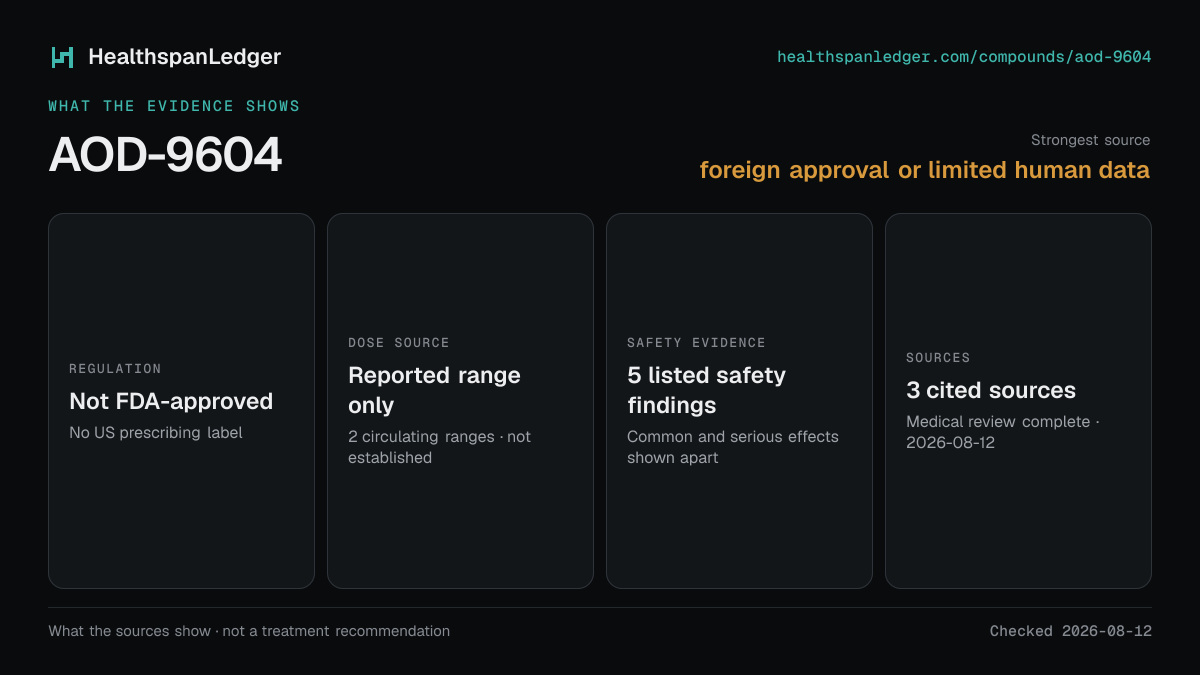
Evidence snapshot
Foreign approval or limited human data
- Regulation
- Dose source
- Safety evidence
- Sources
Where AOD-9604 is in clinical trials
No trial of this compound is registered on ClinicalTrials.gov.
That is worth sitting with. Nobody has registered a study to find out whether AOD-9604 works in people, so no result is coming and no date is worth waiting for. Sellers are not waiting for that work either.
ClinicalTrials.gov · retrieved 2026-09-27
Regulatory status
This compound has an unusual regulatory footprint for a research peptide.
It failed as a drug candidate, then found a second life as a food and supplement ingredient. It later became publicly contentious in Australia, in a sports-supplements investigation. The question there was whether it counted as a prohibited substance.
Anti-doping authorities concluded that it was not. None of that shows it works: a substance can be legal, on sale and useless at once.
Full regulatory tracker →Where to go next on AOD-9604
The related pages keep each topic with its evidence.
The AOD-9604 trial dosing program, arm by arm
Every reaction on the AOD-9604 page, with its frequency
Check an AOD-9604 draw with the AOD-9604 dosage calculator
The 5 mg AOD-9604 vial: concentrations and example draws
Where AOD-9604 sits among the weight loss compounds
Take the AOD-9604 arithmetic to any other vial
Which compounds are still in trials besides AOD-9604
The dated regulatory page for AOD-9604 and the rest
Uses and approval status for AOD-9604 and other compounds
How each AOD-9604 claim is checked
Safety notes
Questions about AOD-9604
Is AOD-9604 FDA-approved?
How is AOD-9604 taken?
How does AOD-9604 differ from the other compounds in this class?
What is not known about AOD-9604?
Is there a AOD-9604 dosing schedule on this site?
- Valentino MA, Lin JE, Waldman SA. Central and peripheral molecular targets for antiobesity pharmacotherapy. Clin Pharmacol Ther 2010;87(6):652-62 — reports the AOD-9604 12-week trial arms (1 mg/day and 10 mg/day) and the 536-subject 24-week trial that ended developmentretrieved 2026-08-12limited human data
- Dominikowski A, Rękoś Z, Olejarz M, Szczepanek-Parulska E, Domin R, Ruchała M. The emerging landscape of performance-enhancing peptides modulating GH-IGF1 axis: bridging the gap between clinical evidence and patient self-administration. Front Endocrinol 2026 — tabulates self-reported online dosing patterns beside the clinical doses, stating the reported values must not be read as clinically validated, regulatory-approved or saferetrieved 2026-08-12indirect evidence
- Dominikowski A, Rękoś Z, Olejarz M, Szczepanek-Parulska E, Domin R, Ruchała M. The emerging landscape of performance-enhancing peptides modulating GH-IGF1 axis: bridging the gap between clinical evidence and patient self-administration. Front Endocrinol 2026;17 — Table 1, AOD9604 safety-signal row, sourced there to Stier 2013retrieved 2026-08-12limited human data