Page last checked
Research compound · not FDA-approved
Hexarelin
Hexarelin is a peptide six amino acids long, built in the early 1990s to trigger a growth-hormone pulse.
What matters first
- Why people look it up
- Sellers pitch it as the hardest-hitting of the growth-hormone peptides, for muscle and recovery.
- What the evidence shows
- The pulse gets smaller as the doses repeat. On the only long course on record it had roughly halved by week 16, and came back only once the drug stopped. No trial turned that into a schedule, and none measured muscle.
- Dose status
- Hexarelin is not FDA-approved, so no dosing label exists for it. The sections below explain what researchers tested and what remains unknown.
What is known about Hexarelin
Hexarelin is a six-residue synthetic secretagogue, built in the early 1990s from the growth-hormone-releasing peptide series. It acts at the ghrelin receptor, and it also binds the scavenger receptor CD36 in heart tissue. Human pharmacology studies showed it provokes a pituitary growth-hormone pulse. The same studies showed something more awkward: repeated doses produce a smaller pulse. No trial turned that fading into a schedule, and none ever settled a dose that works.
| Topic | Value |
|---|---|
| Strongest source | limited human data |
| FDA approval | Not FDA-approved |
| Studied dosing | 1.5 mcg per kilogram of body weight, twice daily for 16 weeks in healthy elderly volunteers; the growth-hormone response fell from 19.1 to 10.5 mcg/L·h by week 16 and returned to 19.4 four weeks after stopping — from clinical trials |
| Studied dosing | 1.5 mcg per kilogram of body weight, two or three times in a day in six normal young men; both schedules raised 24-hour growth hormone by the same amount, and neither moved IGF-I — from clinical trials |
| Studied dosing | 0.125–1 mcg per kilogram of body weight, as a single dose in healthy adult men; the growth-hormone curve flattened at 1.0 mcg/kg, with half the maximum response at 0.48 mcg/kg — from clinical trials |
| What people report using | 100–200 mcg once or twice a day, continued for weeks at a time; the one study that dosed anyone for 16 weeks watched the growth-hormone response fall by nearly half over that period — no trial has tested this quantity |
| Typical vials | 2 mg · 5 mg |
Every row links back to a source listed below. These facts are for reference, not a personal recommendation.
What the evidence for Hexarelin is
People have received this compound in a documented setting, or it has approval outside the United States. The available human evidence is still too limited to show a clear dose-and-result pattern for US use.
- What it establishes
- What it does not establish
Check the country, study size and reason it was used. Do not treat limited human data as an FDA-approved schedule.
Evidence snapshot and shareable image
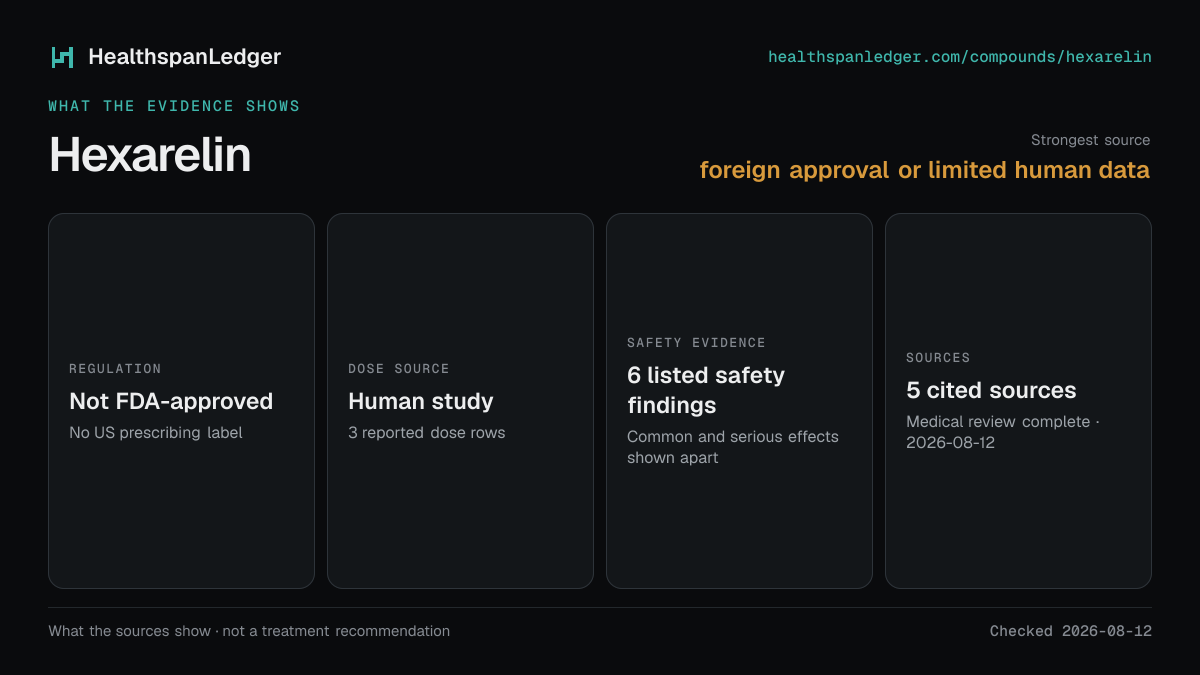
Evidence snapshot
Foreign approval or limited human data
- Regulation
- Dose source
- Safety evidence
- Sources
Where Hexarelin is in clinical trials
No trial of this compound is registered on ClinicalTrials.gov.
That is worth sitting with. Nobody has registered a study to find out whether Hexarelin works in people, so no result is coming and no date is worth waiting for. Sellers are not waiting for that work either.
ClinicalTrials.gov · retrieved 2026-09-27
Regulatory status
No sponsor holds an approval for hexarelin anywhere, and no trial program stands behind it.
In December 2025 FDA named the acetate salt in a warning letter to an ingredient broker. The letter listed the salt among substances FDA treats as off-limits for human drug compounding. So FDA has looked at the route by which this reaches pharmacies, rather than leaving it alone.
Anti-doping rules separately bar secretagogues as a class at all times.
Full regulatory tracker →Where to go next on Hexarelin
The related pages keep each topic with its evidence.
Which hexarelin reactions warrant medical attention
The hexarelin trial dosing program, arm by arm
Doses per 2 mg hexarelin vial in the hexarelin reconstitution calculator
Reconstituting hexarelin at 2 mg, step by step
What each water volume does to the 5 mg hexarelin vial
The muscle growth page hexarelin appears on
Mixing math for any vial, not just hexarelin
Where the hexarelin program has actually got to
Primary regulatory documents, including hexarelin
Explore the research behind hexarelin and other compounds
Safety notes
Questions about Hexarelin
Is Hexarelin FDA-approved?
How is Hexarelin taken?
How does Hexarelin differ from the other compounds in this class?
What is not known about Hexarelin?
Is there a Hexarelin dosing schedule on this site?
- Rahim A, O’Neill PA, Shalet SM. Growth hormone status during long-term hexarelin therapy. J Clin Endocrinol Metab 1998;83(5):1644-9retrieved 2026-08-12Human trial
- Maccario M, Veldhuis JD, Broglio F, Di Vito L, Arvat E, Deghenghi R, Ghigo E. Impact of two or three daily subcutaneous injections of hexarelin, a synthetic growth hormone (GH) secretagogue, on 24-h GH, prolactin, adrenocorticotropin and cortisol secretion in humans. Eur J Endocrinol 2002;146(3):310-8retrieved 2026-08-12Human trial
- Massoud AF, Hindmarsh PC, Brook CG. Hexarelin-induced growth hormone, cortisol, and prolactin release: a dose-response study. J Clin Endocrinol Metab 1996;81(12):4338-41retrieved 2026-08-12Human trial
- Dominikowski A, Rękoś Z, Olejarz M, Szczepanek-Parulska E, Domin R, Ruchała M. The emerging landscape of performance-enhancing peptides modulating GH-IGF1 axis: bridging the gap between clinical evidence and patient self-administration. Front Endocrinol 2026 — tabulates self-reported online dosing patterns beside the clinical doses, stating the reported values must not be read as clinically validated, regulatory-approved or saferetrieved 2026-08-12indirect evidence
- Dominikowski A, Rękoś Z, Olejarz M, Szczepanek-Parulska E, Domin R, Ruchała M. The emerging landscape of performance-enhancing peptides modulating GH-IGF1 axis: bridging the gap between clinical evidence and patient self-administration. Front Endocrinol 2026;17 — Table 1, hexarelin safety-signal rowretrieved 2026-08-12limited human data