Page last checked
Growth hormone secretagogue — selective pentapeptide (research compound) · dosing
Ipamorelin dosage: the reported range, and what it rests on
People report taking Ipamorelin at 200–300 mcg two or three times a day under the skin. That range is what circulates, not what a study found. Human studies of Ipamorelin do exist, and they used other quantities — those are further down this page. None of them produced this range. Nothing here is a starting point, a schedule, or a recommendation.
Source for this answer
Source: Dominikowski A, Rękoś Z, Olejarz M, Szczepanek-Parulska E, Domin R, Ruchała M. The emerging landscape of performance-enhancing peptides modulating GH-IGF1 axis: bridging the gap between clinical evidence and patient self-administration. Front Endocrinol 2026 — tabulates self-reported online dosing patterns beside the clinical doses, stating the reported values must not be read as clinically validated, regulatory-approved or safe
Source: Dominikowski A, Rękoś Z, Olejarz M, Szczepanek-Parulska E, Domin R, Ruchała M. The emerging landscape of performance-enhancing peptides modulating GH-IGF1 axis: bridging the gap between clinical evidence and patient self-administration. Front Endocrinol 2026 — tabulates self-reported online dosing patterns beside the clinical doses, stating the reported values must not be read as clinically validated, regulatory-approved or safe
Key dose facts
What matters first
- Reported range
- 200–300 mcg two or three times a day under the skin
- What that means
- A description of use, not a dose shown to work in a controlled trial.
- Approved schedule
- No FDA-approved Ipamorelin schedule exists.
What people report using, and what each figure rests on
Every published Ipamorelin quantity we found, in one table. The last column is the one that matters: it says what produced the number. The rows do not carry equal weight, and the table is built so you can see which is which without being told.
| Quantity | How often | Route | Where the figure came from |
|---|---|---|---|
| 0.03–0.06 mg | per kilogram of body weight, two or three times a day to 320 inpatients after bowel resection — the three arms of the dose-finding phase 2, none of them given under the skin | Into a vein | A trial in people |
| 0.03 mg | per kilogram of body weight, twice daily from the first postoperative day for up to a week | Into a vein | A trial in people |
| 200–300 mcg | two or three times a day under the skin, which is not how any of it was studied — every trial dose above went into a vein, in hospital, after bowel surgery | Under the skin | Reported use only |
Every row cites a source listed at the foot of this page. A row marked as reported is a description of what people do. It is not evidence that the quantity works, and it is not a dose this site suggests.
Why the reported range does not match the hospital studies
The human study doses were not home injections. Researchers gave ipamorelin into a vein in a hospital after bowel surgery. They adjusted the amount by body weight and gave it two or three times a day.
The reported 200–300 mcg range is a flat amount injected under the skin. The route, setting, people and purpose are all different. Those numbers cannot be joined into one schedule.
Where the Ipamorelin number came from
A range that circulates has a history, and the history is the part sellers leave out. This is what the source behind the row above actually says about its own figure.
- Every human dose on record is intravenous and per kilogram of body weight. No published trial injected it under the skin, and none used an absolute milligram quantity
Wellness clinics offer this peptide widely, in the words of prescribed medicine.
The law does not back that up. Ipamorelin is not a component of any approved drug product. FDA lists ipamorelin acetate twice on its compounding page.
It sits in category 2 under 503B, added 29 September 2023. It also sits under substances nominated but withdrawn, and FDA’s own note explains the double entry. The advisory committee took it up on 29 October 2024, for growth hormone deficiency and slow gut recovery after surgery.
A withdrawn nomination is not a finding against the drug.
What this does and does not establish
For Ipamorelin, this is the strongest evidence available. The two boxes separate what it can show from what it cannot show.
What it does establish
The study gave known doses to a defined group, monitored what happened and compared the results with another group.
What it does not
One trial cannot prove long-term safety or show that the result applies to everyone. The highest dose tested is a study dose, not a target for personal use.
Read each result with the study length, dose and number of participants. Results from separate trials are not a direct comparison because the people and study designs differ.
Ipamorelin dosage in units: 200–300 mcg on a syringe
A range in micrograms is not what anyone measures. Below is the same range as a volume and a unit count. Each available vial and water combination has its own row, so match the numbers to the vial in hand. The arithmetic is fixed. The reported range is not a prescription.
| Vial + water | Concentration | Volume | Draw on a U-100 syringe | Doses in the vial |
|---|---|---|---|---|
| 5 mg + 2 mL | 2.5 mg/mL | 0.08–0.12 mL | 8–12 units | 25 |
| 5 mg + 3 mL | 1.67 mg/mL | 0.12–0.18 mL | 12–18 units | 25 |
The vial sizes and water volumes are the Ipamorelin record’s own. The last column counts whole doses at the low end of the range. Every figure here is division applied to a quantity nobody has tested. The arithmetic being exact does not make the quantity right.
3Reference details
Which syringe barrel the units are read on
A unit is not a unit. A U-100 and a U-50 barrel both print 0.01 mL per graduation; a U-40 barrel prints 0.025 mL. The same printed number therefore measures 2.5× the volume on a U-40. That is why every unit figure on this page names its barrel. It is also why a unit count copied from someone else’s syringe means nothing on its own.
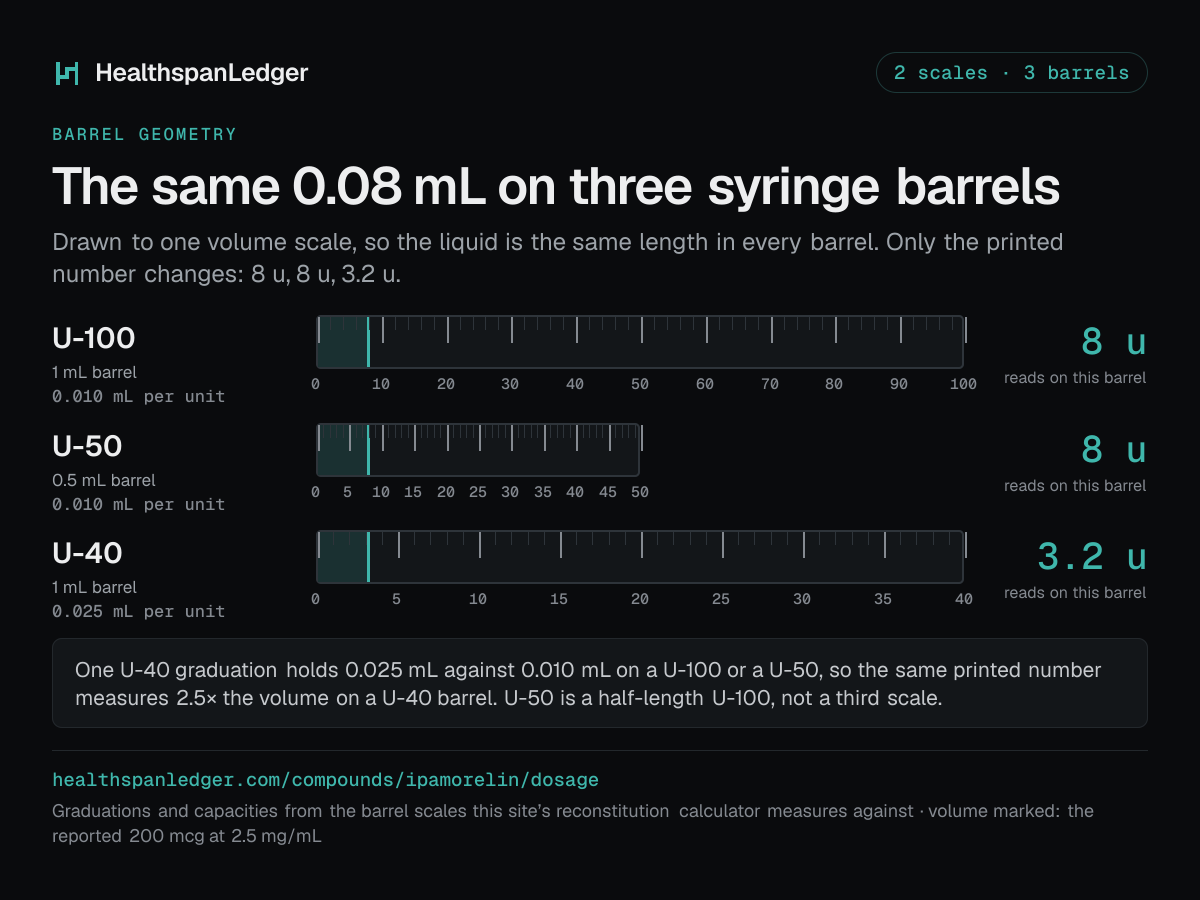
| Barrel | Capacity | One graduation | 0.08 mL reads as |
|---|---|---|---|
| U-100 insulin syringe · 1 mL · lines every 2 units | 1 mL | 0.010 mL | 8 units |
| U-100 insulin syringe · 0.5 mL · lines every 1 unit | 0.5 mL | 0.010 mL | 8 units |
| U-40 insulin syringe · 1 mL · lines every 1 unit | 1 mL | 0.025 mL | 3.2 units |
Barrel capacities and graduation spacing are the printed scales this site’s calculator measures against, not estimates. Three barrels carry only two scales: a U-50 is a half-length U-100, so it reads identically per unit and simply runs out sooner.
What one graduation is worth at each concentration
Reconstitution fixes a concentration, and the concentration fixes what a single graduation carries — before anyone decides what to draw. Below is every pairing of this page’s vial sizes and water volumes, as a concentration and as the mass one U-100 graduation holds at it. No dose is implied by any cell; it is division.
| Vial | + 2 mL water | + 3 mL water |
|---|---|---|
| 5 mg | 2.5 mg/mL25 mcg per unit | 1.67 mg/mL16.7 mcg per unit |
Vial strengths and water volumes are the Ipamorelin record’s own presets. One U-100 graduation is 0.01 mL, so the mass it carries is the concentration times that volume. That is the entire reason the same milligram figure produces a different unit count in every row.
How dosing works in this class
What a reported range is, and what it is not
A reported range tells you what some people say they use. It is not a dose that a human study found safe or effective, and it is not an approved schedule.
We include the range because readers will see the same numbers elsewhere. Here, the source and the type of evidence sit beside it so you can tell a reported amount from a studied dose.
Seeing the same number on several websites does not make it stronger evidence. Those sites may be repeating one source. Do not treat a reported range as a starting dose.
How these figures usually got their shape
Most reported ranges start in an animal study. The dose there is set per kilogram of body weight, so somebody divides and multiplies it up to a person. That step is arithmetic, and it is often done without the scaling method the field uses for it.
The arithmetic travels. The biology does not. How much a body absorbs, where it goes, how fast it clears and how the receptor answers all change between a mouse and a person. None of that is carried across by multiplying.
So a converted figure is a plausible place to start a study. It is not a result.
The other common origin is a round number. Vials are sold in whole milligrams. Quantities that divide a vial neatly spread faster than quantities that do not. That is a fact about packaging, not about the compound.
Concentration changes the units, not the dose
The dose and the syringe draw are two different things. The dose is a mass in milligrams. The draw is a volume in syringe units. It depends on the concentration after mixing. Adding more bacteriostatic water changes the unit reading, but not the dose.
This matters because a unit count copied from someone else’s vial means nothing without their concentration. That mismatch is the most common way a self-injected dose ends up ten times off. The arithmetic is fixed and safe to state as fact. The dose you apply it to is a clinical decision, and it is not.
Compounded vial?
No approved Ipamorelin product exists, so nothing here describes one. The calculator does arithmetic only: it converts a milligram figure and a reconstitution into a volume and a unit count, and it takes no position on which figure belongs in the box.
Open the Ipamorelin calculator →Questions about Ipamorelin dosing
What Ipamorelin dosage do people report using?
The range documented on this page is 200–300 mcg two or three times a day under the skin. It describes reported use, not a dose established by a label or a controlled human trial, and it is not a starting point or recommendation.
Has a Ipamorelin dosage been established in a human trial?
Human studies used the separate quantities listed in the evidence table above. None established the reported 200–300 mcg range as a schedule, effective dose, or maximum.
How many syringe units is the reported Ipamorelin range?
There is no unit answer without a concentration and a syringe scale. The worked draw table above converts the range only at the stated vial-and-water combinations; a different mix produces a different unit count for the same mass.
Does adding more water change the Ipamorelin dose?
No. It changes the concentration and therefore the volume and syringe units needed to draw a given mass. The milligram or microgram amount does not change merely because the vial contains more water.
Why is there no Ipamorelin dosage chart?
A chart would imply a sourced schedule. Ipamorelin has no approved label that sets one, and the reported range on this page did not come from a controlled human trial. The page therefore reports the range and its provenance without turning it into a ladder to follow.
Where to go next on Ipamorelin
- NCT01280344 — Phase II double-blind placebo-controlled dose-finding study of ipamorelin for recovery of gastrointestinal function after small or large bowel resection (Helsinn Therapeutics; 320 patients; arms 0.03 mg/kg BID, 0.06 mg/kg BID, 0.06 mg/kg TID, all intravenous)retrieved 2026-08-12Human trial
- Beck DE, Sweeney WB, McCarter MD; Ipamorelin 201 Study Group. Prospective, randomized, controlled, proof-of-concept study of the ghrelin mimetic ipamorelin for the management of postoperative ileus in bowel resection patients. Int J Colorectal Dis 2014;29(12):1527-34retrieved 2026-08-12Human trial
- Dominikowski A, Rękoś Z, Olejarz M, Szczepanek-Parulska E, Domin R, Ruchała M. The emerging landscape of performance-enhancing peptides modulating GH-IGF1 axis: bridging the gap between clinical evidence and patient self-administration. Front Endocrinol 2026 — tabulates self-reported online dosing patterns beside the clinical doses, stating the reported values must not be read as clinically validated, regulatory-approved or saferetrieved 2026-08-12indirect evidence