Page last checked
Research compound · not FDA-approved
Ipamorelin
Ipamorelin is a peptide five amino acids long. It makes the pituitary gland let out a pulse of growth hormone.
What matters first
- Why people look it up
- Clinics and sellers offer it for muscle gain, fat loss, deeper sleep and faster recovery — the things people expect of growth hormone.
- What the evidence shows
- The pulse itself is measured and real. What follows from the pulse is not. The two completed trials tested how quickly the gut restarted after bowel surgery, and neither one beat placebo. No trial has measured muscle, fat, sleep or aging.
- Dose status
- Ipamorelin is not FDA-approved, so no dosing label exists for it. The sections below explain what researchers tested and what remains unknown.
What is known about Ipamorelin
Ipamorelin is a five-residue secretagogue, designed at Novo Nordisk in the 1990s. Its designers wanted to fix a specific problem with the earlier growth-hormone-releasing peptides: those compounds also pushed up cortisol and prolactin. Ipamorelin provokes a pituitary growth-hormone pulse with far less of that spillover. That is a real achievement in drug design, and it is where the word selective comes from. No completed trial has shown that the pulse changes any outcome.
| Topic | Value |
|---|---|
| Strongest source | Human trial |
| FDA approval | Not FDA-approved |
| Studied dosing | 0.03–0.06 mg per kilogram of body weight, two or three times a day to 320 inpatients after bowel resection — the three arms of the dose-finding phase 2, none of them given under the skin — from clinical trials |
| Studied dosing | 0.03 mg per kilogram of body weight, twice daily from the first postoperative day for up to a week; median time until people could eat a meal without trouble was 25.3 hours against 32.6 on placebo, a difference that did not reach significance — from clinical trials |
| What people report using | 200–300 mcg two or three times a day under the skin, which is not how any of it was studied — every trial dose above went into a vein, in hospital, after bowel surgery — no trial has tested this quantity |
| Typical vials | 5 mg |
Every row links back to a source listed below. These facts are for reference, not a personal recommendation.
What the evidence for Ipamorelin is
These numbers come from a study in people that was published in a peer-reviewed journal. The drug or dose may still be experimental and may not have FDA approval.
- What it establishes
- What it does not establish
Read each result with the study length, dose and number of participants. Results from separate trials are not a direct comparison because the people and study designs differ.
Evidence snapshot and shareable image
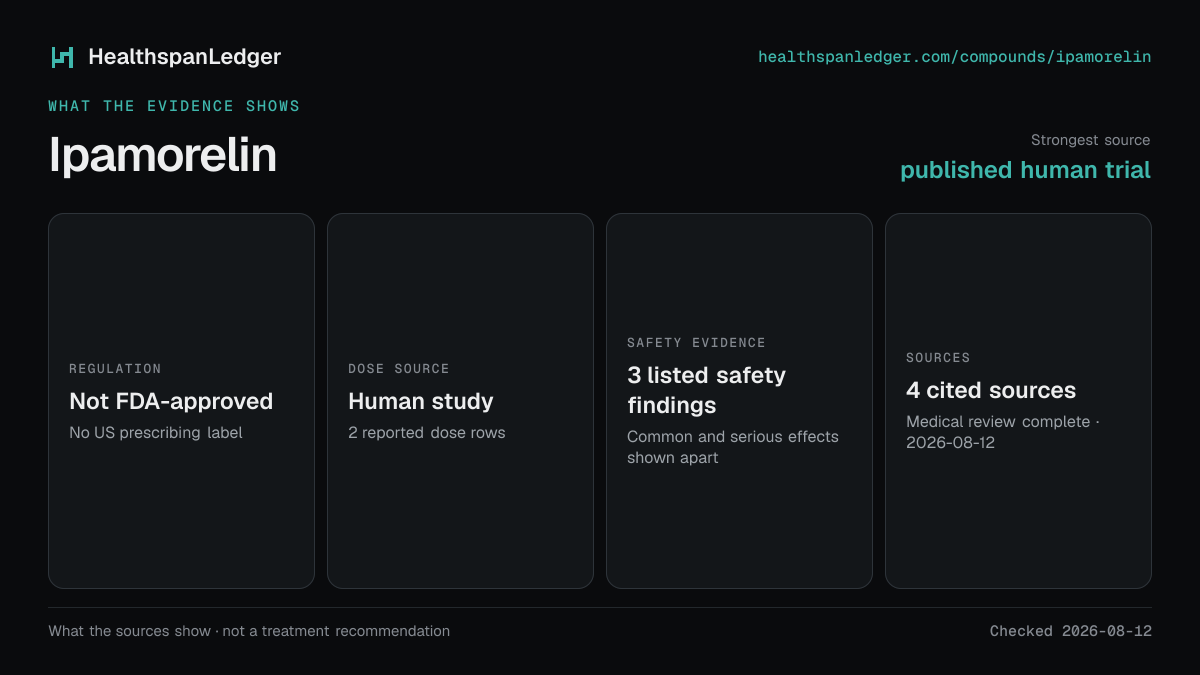
Evidence snapshot
Published human trial
- Regulation
- Dose source
- Safety evidence
- Sources
Where Ipamorelin is in clinical trials
2 registered studies; the program has reached phase 2. Nothing is currently open or enrolling.
- Phase 2Completed
- Phase 2Completed
ClinicalTrials.gov · retrieved 2026-09-27
Regulatory status
Wellness clinics offer this peptide widely, in the words of prescribed medicine.
The law does not back that up. Ipamorelin is not a component of any approved drug product. FDA lists ipamorelin acetate twice on its compounding page.
It sits in category 2 under 503B, added 29 September 2023. It also sits under substances nominated but withdrawn, and FDA’s own note explains the double entry. The advisory committee took it up on 29 October 2024, for growth hormone deficiency and slow gut recovery after surgery.
A withdrawn nomination is not a finding against the drug.
Full regulatory tracker →Where to go next on Ipamorelin
The related pages keep each topic with its evidence.
Every reaction on the ipamorelin page, with its frequency
The published ipamorelin page of what each amount did
Convert an ipamorelin amount to units with the ipamorelin reconstitution calculator
Choosing a water volume for a 5 mg ipamorelin vial
What changes in Canada for Peptide products after ipamorelin
The stack page ipamorelin belongs to
Has ipamorelin been tested alongside the other?
Where ipamorelin sits among the weight loss compounds
The sleep page ipamorelin appears on
Who else is sold for muscle growth besides ipamorelin
Safety notes
Questions about Ipamorelin
Is Ipamorelin FDA-approved?
How is Ipamorelin taken?
How does Ipamorelin differ from the other compounds in this class?
What is not known about Ipamorelin?
Is there a Ipamorelin dosing schedule on this site?
- NCT01280344 — Phase II double-blind placebo-controlled dose-finding study of ipamorelin for recovery of gastrointestinal function after small or large bowel resection (Helsinn Therapeutics; 320 patients; arms 0.03 mg/kg BID, 0.06 mg/kg BID, 0.06 mg/kg TID, all intravenous)retrieved 2026-08-12Human trial
- Beck DE, Sweeney WB, McCarter MD; Ipamorelin 201 Study Group. Prospective, randomized, controlled, proof-of-concept study of the ghrelin mimetic ipamorelin for the management of postoperative ileus in bowel resection patients. Int J Colorectal Dis 2014;29(12):1527-34retrieved 2026-08-12Human trial
- Dominikowski A, Rękoś Z, Olejarz M, Szczepanek-Parulska E, Domin R, Ruchała M. The emerging landscape of performance-enhancing peptides modulating GH-IGF1 axis: bridging the gap between clinical evidence and patient self-administration. Front Endocrinol 2026 — tabulates self-reported online dosing patterns beside the clinical doses, stating the reported values must not be read as clinically validated, regulatory-approved or saferetrieved 2026-08-12indirect evidence
- Dominikowski A, Rękoś Z, Olejarz M, Szczepanek-Parulska E, Domin R, Ruchała M. The emerging landscape of performance-enhancing peptides modulating GH-IGF1 axis: bridging the gap between clinical evidence and patient self-administration. Front Endocrinol 2026;17 — Table 1, ipamorelin safety-signal rowretrieved 2026-08-12limited human data