Page last checked
Research compound · not FDA-approved
Pinealon
Pinealon is a peptide three amino acids long, from the St Petersburg institute that also produced Epitalon. Papers abbreviate it EDR.
What matters first
- Why people look it up
- It is sold for memory, focus and mental sharpness in later life, as capsules or as powder for injection.
- What the evidence shows
- The memory claim rests on one sentence in one review. Following its three references leads to another review, a study in old rats, and a patent. People have taken it and the results were published, almost all in Russian. Two of those studies gave it alongside a second peptide, so neither separates the two. The one study that measured chemistry found two effects pointing the wrong way.
- Dose status
- Pinealon is not FDA-approved, so no dosing label exists for it. The sections below explain what researchers tested and what remains unknown.
What is known about Pinealon
Pinealon is three amino acids in a row: glutamic acid, aspartic acid, arginine, which the papers shorten to EDR. It was made at the St Petersburg institute that produced Epitalon, and it is sold for memory. People have taken it, and one paper says how much: railway crews swallowed 100 microgram capsules twice a day for two weeks. The memory claim it is known for is a different matter. Follow its references and they end at a review, a rat study and a patent.
| Topic | Value |
|---|---|
| Strongest source | limited human data |
| FDA approval | Not FDA-approved |
| Studied dosing | 100 mcg twice a day for two weeks (railway locomotive crews; the endpoints were biological-age indicators and measures of adaptive capacity, and the abstract describes no control group) — from clinical trials |
| Typical vials | 10 mg |
Every row links back to a source listed below. These facts are for reference, not a personal recommendation.
What the evidence for Pinealon is
People have received this compound in a documented setting, or it has approval outside the United States. The available human evidence is still too limited to show a clear dose-and-result pattern for US use.
- What it establishes
- What it does not establish
Check the country, study size and reason it was used. Do not treat limited human data as an FDA-approved schedule.
Evidence snapshot and shareable image
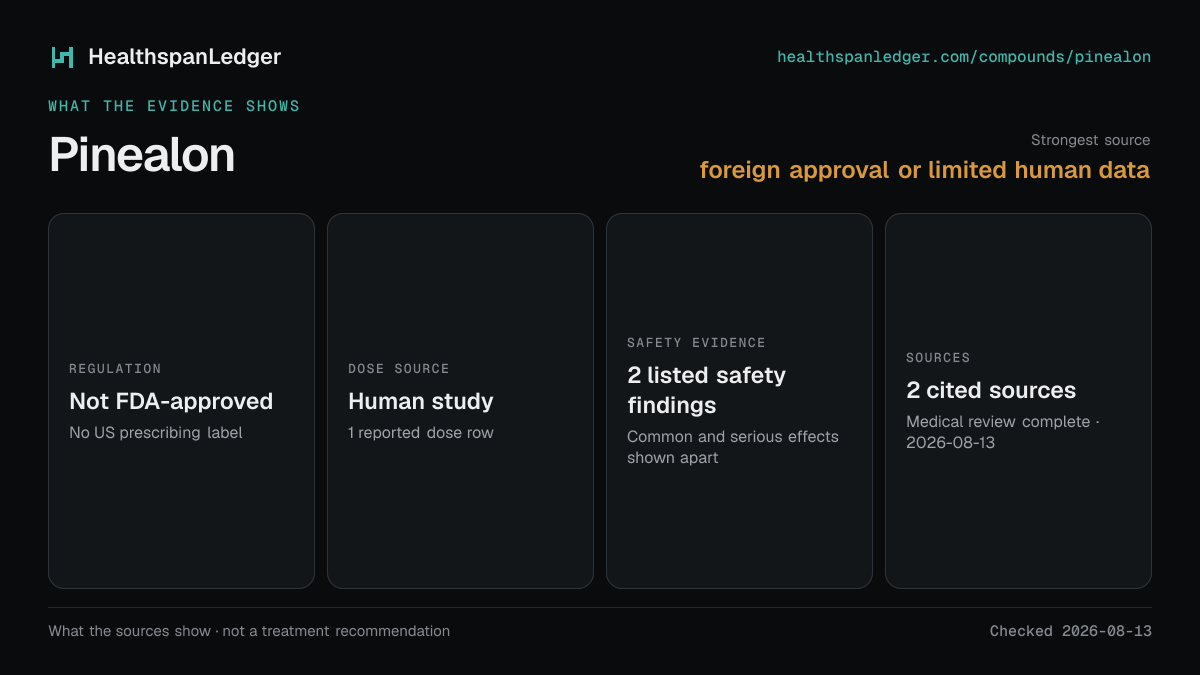
Evidence snapshot
Foreign approval or limited human data
- Regulation
- Dose source
- Safety evidence
- Sources
Where Pinealon is in clinical trials
No trial of this compound is registered on ClinicalTrials.gov.
That is worth sitting with. Nobody has registered a study to find out whether Pinealon works in people, so no result is coming and no date is worth waiting for. Sellers are not waiting for that work either.
ClinicalTrials.gov · retrieved 2026-09-27
Regulatory status
FDA has approved nothing under this name, and no Pinealon study appears on any trial registry anywhere.
Nearly the whole literature comes from one institute in St Petersburg and the journals around it. The same senior author runs through it, and the patents are in the same hands. That is not a language problem.
A finding nobody independent has repeated carries the weight of one lab’s claim. The one published human quantity was a capsule people swallowed, twice a day, so nothing stands behind putting this in a syringe.
Full regulatory tracker →Where to go next on Pinealon
The related pages keep each topic with its evidence.
Why pinealon carries no boxed warning
Pinealon vial and water in the pinealon dosage calculator
Reconstituting pinealon at 10 mg, step by step
Take the pinealon arithmetic to any other vial
Where pinealon sits among the dose schedules
Which compounds are still in trials besides pinealon
The dated regulatory page for pinealon and the rest
Uses and approval status for pinealon and other compounds
How each pinealon claim is checked
Safety notes
Questions about Pinealon
Is Pinealon FDA-approved?
How is Pinealon taken?
How does Pinealon differ from the other compounds in this class?
What is not known about Pinealon?
- Nazimko VA et al. [Analysis of some parameters of biological age and adaptation possibilities of workers of locomotive brigades]. Adv Gerontol 2012;25(1):57-62 — the only published source found that states a quantity of Pinealon given to people: one 100 microgram capsule twice a day for two weeks (PMID 22708445, in Russian)retrieved 2026-08-13limited human data
- Meshchaninov VN et al. [Effect of synthetic peptides on aging of patients with chronic polymorbidity and organic brain syndrome of the central nervous system in remission]. Adv Gerontol 2015;28(1):62-7 — 32 patients aged 41 to 83; reports prooxidant activity on chemiluminescence and a fall in CD34+ haematopoietic markers (PMID 26390612, in Russian)retrieved 2026-08-13limited human data