Page last checked
Growth hormone-releasing hormone fragment (compounded preparation) · dosing
Sermorelin dosage: the reported range, and what it rests on
People report taking Sermorelin at 200–300 mcg once daily, as a flat quantity. That range is what circulates, not what a study found. Human studies of Sermorelin do exist, and they used other quantities — those are further down this page. None of them produced this range. Nothing here is a starting point, a schedule, or a recommendation.
Source for this answer
Source: Dominikowski A, Rękoś Z, Olejarz M, Szczepanek-Parulska E, Domin R, Ruchała M. The emerging landscape of performance-enhancing peptides modulating GH-IGF1 axis: bridging the gap between clinical evidence and patient self-administration. Front Endocrinol 2026 — tabulates self-reported online dosing patterns beside the clinical doses, stating the reported values must not be read as clinically validated, regulatory-approved or safe
Source: Dominikowski A, Rękoś Z, Olejarz M, Szczepanek-Parulska E, Domin R, Ruchała M. The emerging landscape of performance-enhancing peptides modulating GH-IGF1 axis: bridging the gap between clinical evidence and patient self-administration. Front Endocrinol 2026 — tabulates self-reported online dosing patterns beside the clinical doses, stating the reported values must not be read as clinically validated, regulatory-approved or safe
Key dose facts
What matters first
- Reported range
- 200–300 mcg once daily, as a flat quantity
- What that means
- A description of use, not a dose shown to work in a controlled trial.
- Approved schedule
- No FDA-approved Sermorelin schedule exists.
What people report using, and what each figure rests on
Every published Sermorelin quantity we found, in one table. The last column is the one that matters: it says what produced the number. The rows do not carry equal weight, and the table is built so you can see which is which without being told.
| Quantity | How often | Route | Where the figure came from |
|---|---|---|---|
| 30 mcg | per kilogram of body weight, once daily at bedtime, in 110 previously untreated prepubertal growth-hormone-deficient children | Under the skin | A trial in people |
| 0.5–1 mg | twice daily for 14 days in healthy men of about 68 | Under the skin | A trial in people |
| 1 mcg | per kilogram of body weight, as one dose in a growth-hormone stimulation test — a diagnostic push given in a clinic, not a course of treatment | Into a vein | A trial in people |
| 200–300 mcg | once daily, as a flat quantity — where every clinical number above was set per kilogram of body weight, and the largest of those trials ran in children rather than in anyone choosing it | Under the skin | Reported use only |
Every row cites a source listed at the foot of this page. A row marked as reported is a description of what people do. It is not evidence that the quantity works, and it is not a dose this site suggests.
Why the reported range is not one of the study schedules
The human research asked three different questions. One trial treated children with growth hormone deficiency. Another tested a short course in older men. A third used one dose to test the pituitary gland.
The reported 200–300 mcg daily range does not match any of those study designs. It is a flat amount from reported practice. The study rows and the reported row are separate records, not stages of one schedule.
Where the Sermorelin number came from
A range that circulates has a history, and the history is the part sellers leave out. This is what the source behind the row above actually says about its own figure.
- Every quantity on this record comes from a published trial, not from a label; two of the three are per kilogram of body weight and do not convert to a vial without a weight
Today’s market came from the withdrawal of the branded product, not from any finding against it.
The branded medicine left the market, and its removal was not a safety action. A medicine pulled that way leaves a compounding pathway open. That is why this peptide sits on pharmacy formularies while its neighbors here do not.
The pathway governs how a pharmacy prepares it, not what it achieves. FDA has separately told a seller so in writing. Labeling stock for research use only does not change what a product is, where the surrounding site markets it for people.
What this does and does not establish
For Sermorelin, this is the strongest evidence available. The two boxes separate what it can show from what it cannot show.
What it does establish
It shows that people have received it and that some human information exists.
What it does not
It does not prove that the same dose is appropriate in the United States or that uncommon and long-term risks are known.
Check the country, study size and reason it was used. Do not treat limited human data as an FDA-approved schedule.
Sermorelin dosage in units: 200–300 mcg on a syringe
A range in micrograms is not what anyone measures. Below is the same range as a volume and a unit count. Each available vial and water combination has its own row, so match the numbers to the vial in hand. The arithmetic is fixed. The reported range is not a prescription.
| Vial + water | Concentration | Volume | Draw on a U-100 syringe | Doses in the vial |
|---|---|---|---|---|
| 5 mg + 2 mL | 2.5 mg/mL | 0.08–0.12 mL | 8–12 units | 25 |
| 5 mg + 3 mL | 1.67 mg/mL | 0.12–0.18 mL | 12–18 units | 25 |
| 6 mg + 2 mL | 3 mg/mL | 0.067–0.1 mL | 6.67–10 units | 30 |
| 6 mg + 3 mL | 2 mg/mL | 0.1–0.15 mL | 10–15 units | 30 |
| 9 mg + 2 mL | 4.5 mg/mL | 0.044–0.067 mL | 4.44–6.67 units | 45 |
| 9 mg + 3 mL | 3 mg/mL | 0.067–0.1 mL | 6.67–10 units | 45 |
| 15 mg + 2 mL | 7.5 mg/mL | 0.027–0.04 mL | 2.67–4 units | 75 |
| 15 mg + 3 mL | 5 mg/mL | 0.04–0.06 mL | 4–6 units | 75 |
The vial sizes and water volumes are the Sermorelin record’s own. The last column counts whole doses at the low end of the range. Every figure here is division applied to a quantity nobody has tested. The arithmetic being exact does not make the quantity right.
3Reference details
Which syringe barrel the units are read on
A unit is not a unit. A U-100 and a U-50 barrel both print 0.01 mL per graduation; a U-40 barrel prints 0.025 mL. The same printed number therefore measures 2.5× the volume on a U-40. That is why every unit figure on this page names its barrel. It is also why a unit count copied from someone else’s syringe means nothing on its own.
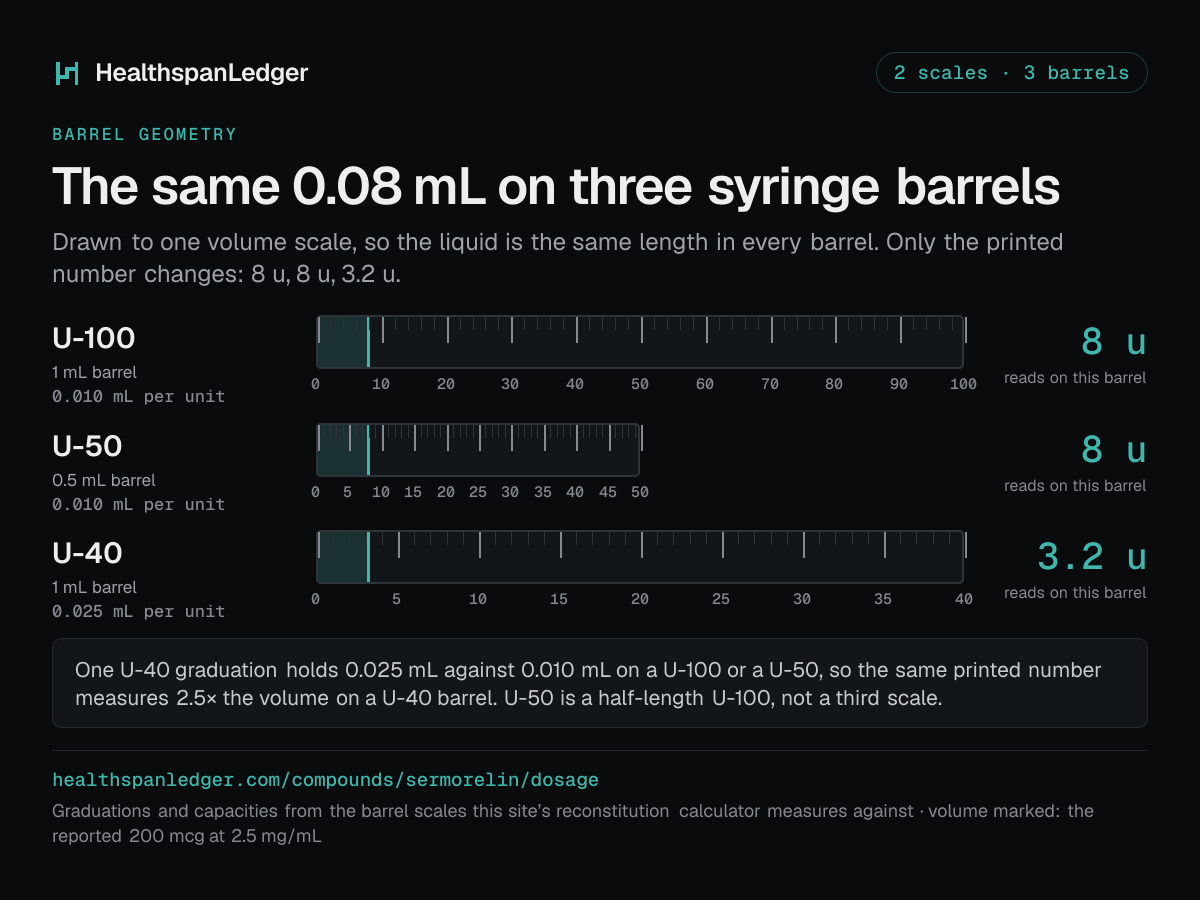
| Barrel | Capacity | One graduation | 0.08 mL reads as |
|---|---|---|---|
| U-100 insulin syringe · 1 mL · lines every 2 units | 1 mL | 0.010 mL | 8 units |
| U-100 insulin syringe · 0.5 mL · lines every 1 unit | 0.5 mL | 0.010 mL | 8 units |
| U-40 insulin syringe · 1 mL · lines every 1 unit | 1 mL | 0.025 mL | 3.2 units |
Barrel capacities and graduation spacing are the printed scales this site’s calculator measures against, not estimates. Three barrels carry only two scales: a U-50 is a half-length U-100, so it reads identically per unit and simply runs out sooner.
What one graduation is worth at each concentration
Reconstitution fixes a concentration, and the concentration fixes what a single graduation carries — before anyone decides what to draw. Below is every pairing of this page’s vial sizes and water volumes, as a concentration and as the mass one U-100 graduation holds at it. No dose is implied by any cell; it is division.
| Vial | + 2 mL water | + 3 mL water |
|---|---|---|
| 5 mg | 2.5 mg/mL25 mcg per unit | 1.67 mg/mL16.7 mcg per unit |
| 6 mg | 3 mg/mL30 mcg per unit | 2 mg/mL20 mcg per unit |
| 9 mg | 4.5 mg/mL45 mcg per unit | 3 mg/mL30 mcg per unit |
| 15 mg | 7.5 mg/mL75 mcg per unit | 5 mg/mL50 mcg per unit |
Vial strengths and water volumes are the Sermorelin record’s own presets. One U-100 graduation is 0.01 mL, so the mass it carries is the concentration times that volume. That is the entire reason the same milligram figure produces a different unit count in every row.
How dosing works in this class
What a reported range is, and what it is not
A reported range tells you what some people say they use. It is not a dose that a human study found safe or effective, and it is not an approved schedule.
We include the range because readers will see the same numbers elsewhere. Here, the source and the type of evidence sit beside it so you can tell a reported amount from a studied dose.
Seeing the same number on several websites does not make it stronger evidence. Those sites may be repeating one source. Do not treat a reported range as a starting dose.
How these figures usually got their shape
Most reported ranges start in an animal study. The dose there is set per kilogram of body weight, so somebody divides and multiplies it up to a person. That step is arithmetic, and it is often done without the scaling method the field uses for it.
The arithmetic travels. The biology does not. How much a body absorbs, where it goes, how fast it clears and how the receptor answers all change between a mouse and a person. None of that is carried across by multiplying.
So a converted figure is a plausible place to start a study. It is not a result.
The other common origin is a round number. Vials are sold in whole milligrams. Quantities that divide a vial neatly spread faster than quantities that do not. That is a fact about packaging, not about the compound.
Concentration changes the units, not the dose
The dose and the syringe draw are two different things. The dose is a mass in milligrams. The draw is a volume in syringe units. It depends on the concentration after mixing. Adding more bacteriostatic water changes the unit reading, but not the dose.
This matters because a unit count copied from someone else’s vial means nothing without their concentration. That mismatch is the most common way a self-injected dose ends up ten times off. The arithmetic is fixed and safe to state as fact. The dose you apply it to is a clinical decision, and it is not.
Compounded vial?
No approved Sermorelin product exists, so nothing here describes one. The calculator does arithmetic only: it converts a milligram figure and a reconstitution into a volume and a unit count, and it takes no position on which figure belongs in the box.
Open the Sermorelin calculator →Questions about Sermorelin dosing
What Sermorelin dosage do people report using?
The range documented on this page is 200–300 mcg once daily, as a flat quantity. It describes reported use, not a dose established by a label or a controlled human trial, and it is not a starting point or recommendation.
Has a Sermorelin dosage been established in a human trial?
Human studies used the separate quantities listed in the evidence table above. None established the reported 200–300 mcg range as a schedule, effective dose, or maximum.
How many syringe units is the reported Sermorelin range?
There is no unit answer without a concentration and a syringe scale. The worked draw table above converts the range only at the stated vial-and-water combinations; a different mix produces a different unit count for the same mass.
Does adding more water change the Sermorelin dose?
No. It changes the concentration and therefore the volume and syringe units needed to draw a given mass. The milligram or microgram amount does not change merely because the vial contains more water.
Why is there no Sermorelin dosage chart?
A chart would imply a sourced schedule. Sermorelin has no approved label that sets one, and the reported range on this page did not come from a controlled human trial. The page therefore reports the range and its provenance without turning it into a ladder to follow.
Where to go next on Sermorelin
Tesamorelin vs sermorelin, from the sermorelin side
The sermorelin reactions reported most often
Take the sermorelin arithmetic to any other vial
Where sermorelin sits among the dose schedules
The proceedings behind the sermorelin note on this page
Explore the research behind sermorelin and other compounds
- Thorner M, et al. Once daily subcutaneous growth hormone-releasing hormone therapy accelerates growth in growth hormone-deficient children during the first year of therapy (Geref International Study Group). J Clin Endocrinol Metab 1996;81(3):1189-96retrieved 2026-08-12Human trial
- Corpas E, Harman SM, Piñeyro MA, Roberson R, Blackman MR. Growth hormone (GH)-releasing hormone-(1-29) twice daily reverses the decreased GH and insulin-like growth factor-I levels in old men. J Clin Endocrinol Metab 1992;75(2):530-5retrieved 2026-08-12Human trial
- NCT00324064 — Sexually Dimorphic Effects of GHRH in Adult Growth Hormone Testing (protocol: GHRH [Geref] 1 mcg/kg intravenous push, followed by arginine)retrieved 2026-08-12Human trial
- Dominikowski A, Rękoś Z, Olejarz M, Szczepanek-Parulska E, Domin R, Ruchała M. The emerging landscape of performance-enhancing peptides modulating GH-IGF1 axis: bridging the gap between clinical evidence and patient self-administration. Front Endocrinol 2026 — tabulates self-reported online dosing patterns beside the clinical doses, stating the reported values must not be read as clinically validated, regulatory-approved or saferetrieved 2026-08-12indirect evidence