Page last checked
Research compound · not FDA-approved
Sermorelin
Sermorelin is the first 29 amino acids of the hormone that prompts growth hormone release. It is the shortest piece that still does the job at the pituitary.
What matters first
- Why people look it up
- Anti-aging and wellness clinics sell it for energy, body composition and sleep.
- What the evidence shows
- None of that is what it was approved for. As Geref it was an American medicine for testing pituitary function and for growth failure in children. That product was withdrawn. The one adult study on this page ran 14 days and measured hormone levels, not how anyone looked or felt.
- Dose status
- Sermorelin is not FDA-approved, so no dosing label exists for it. The sections below explain what researchers tested and what remains unknown.
What is known about Sermorelin
Sermorelin is the first 29 amino acids of growth hormone-releasing hormone — the shortest piece of the natural hormone that still does its job at the pituitary. Unlike most compounds in this registry it was once an approved American medicine, sold as Geref and used mainly as a diagnostic for pituitary function and in childhood growth failure. That product was taken off the market, and the adult anti-aging use it is now sold for was never the indication it was approved for.
| Topic | Value |
|---|---|
| Strongest source | limited human data |
| FDA approval | Not FDA-approved |
| Studied dosing | 30 mcg per kilogram of body weight, once daily at bedtime, in 110 previously untreated prepubertal growth-hormone-deficient children; mean height velocity rose from 4.1 cm/yr at baseline to 8.0 at six months and 7.2 at twelve, and 74% were rated good responders at six months — from clinical trials |
| Studied dosing | 0.5–1 mg twice daily for 14 days in healthy men of about 68; only the 1 mg arm raised 24-hour growth hormone and IGF-I significantly above the men’s own baseline — from clinical trials |
| Studied dosing | 1 mcg per kilogram of body weight, as one dose in a growth-hormone stimulation test — a diagnostic push given in a clinic, not a course of treatment — from clinical trials |
| What people report using | 200–300 mcg once daily, as a flat quantity — where every clinical number above was set per kilogram of body weight, and the largest of those trials ran in children rather than in anyone choosing it — no trial has tested this quantity |
| Typical vials | 5 mg · 6 mg · 9 mg · 15 mg |
Every row links back to a source listed below. These facts are for reference, not a personal recommendation.
What the evidence for Sermorelin is
People have received this compound in a documented setting, or it has approval outside the United States. The available human evidence is still too limited to show a clear dose-and-result pattern for US use.
- What it establishes
- What it does not establish
Check the country, study size and reason it was used. Do not treat limited human data as an FDA-approved schedule.
Evidence snapshot and shareable image
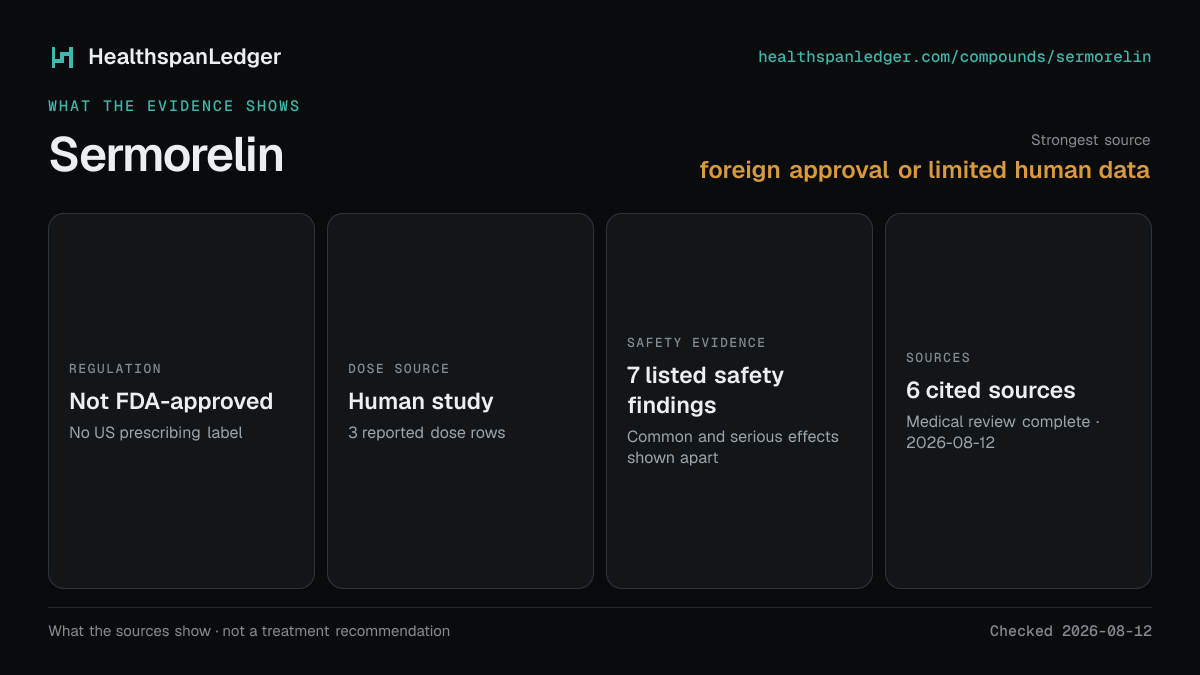
Evidence snapshot
Foreign approval or limited human data
- Regulation
- Dose source
- Safety evidence
- Sources
Where Sermorelin is in clinical trials
No trial of this compound is registered on ClinicalTrials.gov.
That is worth sitting with. Nobody has registered a study to find out whether Sermorelin works in people, so no result is coming and no date is worth waiting for. Sellers are not waiting for that work either.
ClinicalTrials.gov · retrieved 2026-09-27
Regulatory status
Today’s market came from the withdrawal of the branded product, not from any finding against it.
The branded medicine left the market, and its removal was not a safety action. A medicine pulled that way leaves a compounding pathway open. That is why this peptide sits on pharmacy formularies while its neighbors here do not.
The pathway governs how a pharmacy prepares it, not what it achieves. FDA has separately told a seller so in writing. Labeling stock for research use only does not change what a product is, where the surrounding site markets it for people.
Full regulatory tracker →How Sermorelin compares
Each page says which kind of comparison it is: one trial that tested both, or two separate trials read side by side — which is much weaker, however close the numbers look.
Where to go next on Sermorelin
The related pages keep each topic with its evidence.
The sermorelin trial dosing program, arm by arm
Every reaction on the sermorelin page, with its frequency
Convert a sermorelin amount to units with the sermorelin reconstitution calculator
Reconstituting sermorelin at 5 mg, step by step
Choosing a water volume for a 6 mg sermorelin vial
The testosterone page sermorelin appears on
Reconstituting sermorelin at 15 mg, step by step
What each water volume does to the 9 mg sermorelin vial
The sleep page sermorelin appears on
Who else is sold for longevity besides sermorelin
Safety notes
Questions about Sermorelin
Is Sermorelin FDA-approved?
How is Sermorelin taken?
How does Sermorelin differ from the other compounds in this class?
What is not known about Sermorelin?
Is there a Sermorelin dosing schedule on this site?
Questions readers ask
What are the downsides of taking sermorelin?
Is sermorelin like Ozempic?
What not to mix with sermorelin?
What does sermorelin really do?
- Thorner M, et al. Once daily subcutaneous growth hormone-releasing hormone therapy accelerates growth in growth hormone-deficient children during the first year of therapy (Geref International Study Group). J Clin Endocrinol Metab 1996;81(3):1189-96retrieved 2026-08-12Human trial
- Corpas E, Harman SM, Piñeyro MA, Roberson R, Blackman MR. Growth hormone (GH)-releasing hormone-(1-29) twice daily reverses the decreased GH and insulin-like growth factor-I levels in old men. J Clin Endocrinol Metab 1992;75(2):530-5retrieved 2026-08-12Human trial
- NCT00324064 — Sexually Dimorphic Effects of GHRH in Adult Growth Hormone Testing (protocol: GHRH [Geref] 1 mcg/kg intravenous push, followed by arginine)retrieved 2026-08-12Human trial
- Dominikowski A, Rękoś Z, Olejarz M, Szczepanek-Parulska E, Domin R, Ruchała M. The emerging landscape of performance-enhancing peptides modulating GH-IGF1 axis: bridging the gap between clinical evidence and patient self-administration. Front Endocrinol 2026 — tabulates self-reported online dosing patterns beside the clinical doses, stating the reported values must not be read as clinically validated, regulatory-approved or saferetrieved 2026-08-12indirect evidence
- Lanes R, Carrillo E; Venezuelan Collaborative Study Group. Long-term therapy with a single daily subcutaneous dose of growth hormone releasing hormone (1-29) in prepubertal growth hormone deficient children. J Pediatr Endocrinol 1994;7(4):303-8retrieved 2026-08-12Human trial
- Dominikowski A, Rękoś Z, Olejarz M, Szczepanek-Parulska E, Domin R, Ruchała M. The emerging landscape of performance-enhancing peptides modulating GH-IGF1 axis: bridging the gap between clinical evidence and patient self-administration. Front Endocrinol 2026;17 — Table 1, sermorelin safety-signal rowretrieved 2026-08-12limited human data