Page last checked

How-to · reconstitution

How to reconstitute AOD-9604 5 mg

Put 2 mL of bacteriostatic water into the 5 mg AOD-9604 vial. That makes 2.50 mg/mL. A 1 mg dose is then 40.0 units on a U-100 syringe.

That volume is the one that lands the draw on a syringe line, so the reading can be checked by eye. More water makes a weaker mix and a bigger draw. Less water makes a stronger mix and a smaller one. The amount of AOD-9604 in the glass never changes. Only the number of marks it takes does.

What matters first

Water to add
2 mL
Resulting strength
2.50 mg/mL
Example 1 mg dose
40.0 U-100 units

What is AOD-9604?

AOD-9604 is the tail end of human growth hormone — residues 176 to 191, with one extra amino acid added on the front.

Medically reviewed by Jennifer Montecillo, MD · non-practicing medical reviewerReviewed 2026-08-12open the primary sources

How much bacteriostatic water for a 5 mg AOD-9604 vial?

◆ Unique to the 5 mg vialU-100 example draws
Water addedConcentrationPer U-100 unitExample: 1 mg =
2 mL2.50 mg/mL25 mcg40.0 units
3 mL1.67 mg/mL16.67 mcg60.0 units

Straight arithmetic: concentration = 5 mg ÷ water, and 1 U-100 unit = 0.01 mL. The example column shows the math at 1 mg; it is not a dose recommendation.

Which volume to use is a practical choice rather than a dose. Pick the one that puts your draw somewhere you can actually read it on the syringe. The flags in the last column mark where that fails. “Hard to measure” means the draw is too small to judge by eye. “Won’t fit” means it is bigger than one U-100 syringe holds.

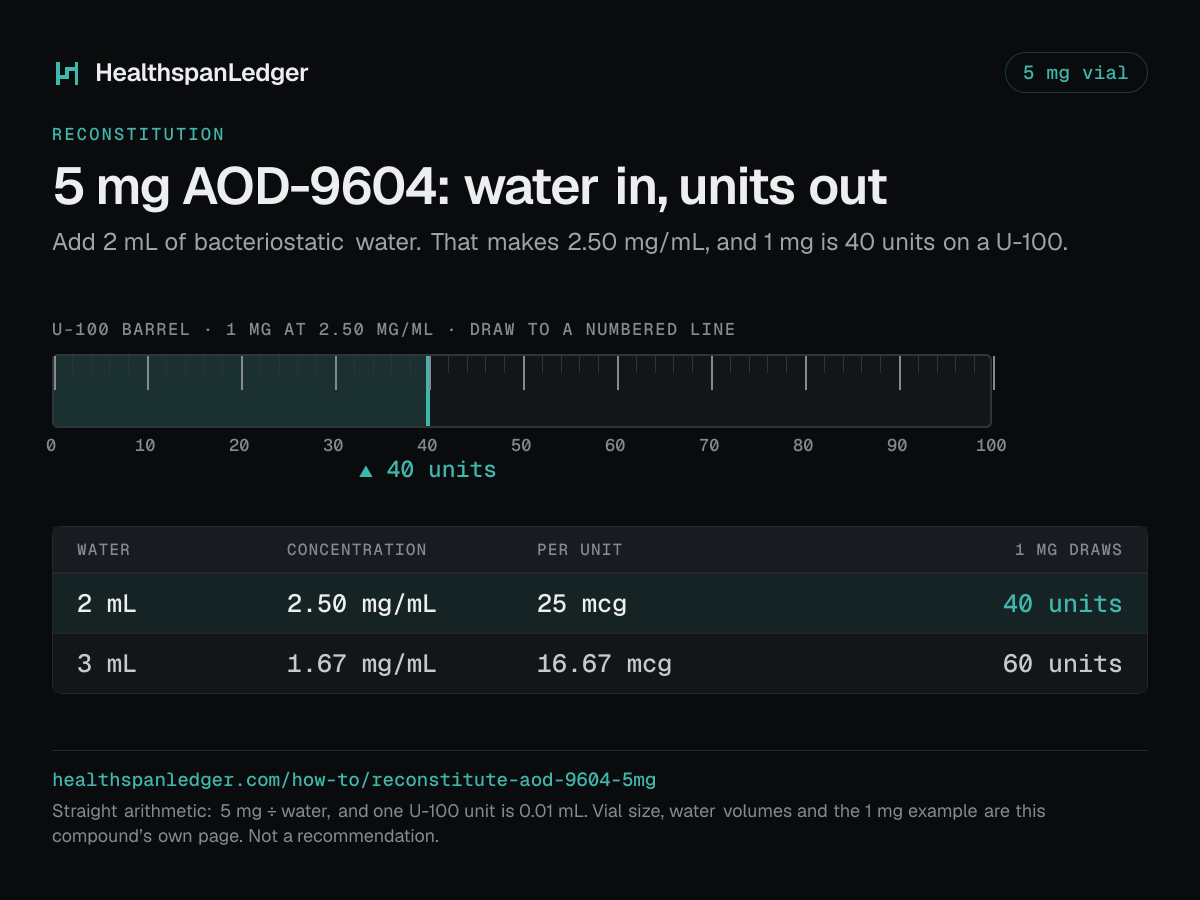
AOD-9604 5 mg vial: how much water to add. Each row is what that amount draws on a U-100 syringe. 2 mL makes 2.50 mg/mL, or 25 mcg a unit, and 1 mg is 40 units. 3 mL makes 1.67 mg/mL, or 16.67 mcg a unit, and 1 mg is 60 units. The barrel drawn here is filled to 40 units, the draw at 2 mL. The sum is 5 mg divided by the water. One U-100 unit is 0.01 mL.
The 5 mg vial at 2 mL on a U-100 barrel. 1 mg fills to 40.0 units, at 2.50 mg/mL.

How many units is a documented dose from this vial?

The table above uses one worked example. These are the published quantities, converted into marks on a U-100 barrel at each water volume for a 5 mg vial. Where a quantity was never studied by injection, the row says so.

1–10 mgreported, not studied

1–10 mg once daily over 12 weeks, swallowed. The trials did not inject it, the 1 mg group lost 2.6 kg against 0.8 kg on placebo, the 10 mg group lost less than the 1 mg group, and the primary trial reports were never published.

Water addedConcentrationDraw, low to high
2 mL2.50 mg/mL40.0 to 400.0 unitswon’t fit
3 mL1.67 mg/mL60.0 to 600.0 unitswon’t fit

limited human dataValentino MA, Lin JE, Waldman SA. Central and peripheral molecular targets for antiobesity pharmacotherapy. Clin Pharmacol Ther 2010;87(6):652-62 — reports the AOD-9604 12-week trial arms (1 mg/day and 10 mg/day) and the 536-subject 24-week trial that ended development · retrieved 2026-08-12

250–500 mcgreported, not studied

250–500 mcg a day, split over two or three injections under the skin. The human trials swallowed this compound rather than injecting it, and at roughly ten times the quantity.

Water addedConcentrationDraw, low to high
2 mL2.50 mg/mL10.0 to 20.0 units
3 mL1.67 mg/mL15.0 to 30.0 units

indirect evidenceDominikowski A, Rękoś Z, Olejarz M, Szczepanek-Parulska E, Domin R, Ruchała M. The emerging landscape of performance-enhancing peptides modulating GH-IGF1 axis: bridging the gap between clinical evidence and patient self-administration. Front Endocrinol 2026 — tabulates self-reported online dosing patterns beside the clinical doses, stating the reported values must not be read as clinically validated, regulatory-approved or safe · retrieved 2026-08-12

Five comfortable draws of something the trials swallowed

One vial size, two water volumes, and a milligram-scale reading that sits well up the syringe at either. The arithmetic is the least of this page’s problems.

3Read the full vial record 3 notes

Both volumes land on marks, high on the barrel

The worked amount is much larger than the figures on most peptide pages. The draw therefore covers more of the syringe and lands exactly on a line with either water option.

Rounding error genuinely does not arise here. It is one of the few pages in this family where the measurement is not the interesting part.

The human trials were taken by mouth

The controlled studies behind this fragment had participants swallow a daily amount for twelve weeks. Nothing published injected it.

A swallowed milligram and an injected milligram are not the same exposure, and no published work bridges them. The table converts the figure faithfully; the figure belongs to another route.

Five draws, and more was not better

The vial divides into five worked doses, but no published storage window is available for the mixed solution.

In the trials the larger group lost less weight than the smaller one. The bigger studies did not separate the fragment from placebo at all. Reading the top of the range as a target reads the evidence backwards.

Those trials were never published as primary papers either. The quantities on this page come from a peer-reviewed review of a company announcement, which is why the page calls them reported rather than studied.

How do you mix it, step by step?

  1. Wipe both stoppers with an alcohol swab and let them dry.
  2. Draw up the water volume you picked from the table.
  3. Let the water run slowly down the inside wall of the AOD-9604 vial, rather than jetting it onto the powder.
  4. Swirl gently until it dissolves. Shaking damages peptides.
  5. Store it as the dispensing label directs. What happens after mixing differs by product — some labels direct against refrigerating the mixed solution at all.

What if your water volume is not on the table?

The table shows the offered water volumes. The calculator does the same arithmetic for any volume and any syringe, and shows its working line by line.

Open the AOD-9604 calculator →

Questions readers ask

How much water to add to reconstitute peptides?

Use the amount printed on the pharmacy label. In the worked example, 1 mg draws 40 units with 2 mL of water or 60 units with 3 mL. Water changes the concentration, not the dose.

Both land on a printed line, and both sit high on the barrel. That comfort comes from a milligram-scale amount rather than from the compound.

How to reconstitute AOD-9604 pdf?

There is no PDF, and this site does not publish one. What it has instead is a print card built into the calculator.

The card prints the mix, the draw, a barrel drawn to scale with the draw marked, and a blank log grid. It leaves the reconstitution date as an empty line, because inventing a date would invent a discard date with it.

What to reconstitute aOD with?

Bacteriostatic water — every volume on this page is a volume of it, and the two listed are 2 mL and 3 mL.

No published source names another liquid for this fragment. The human trials used an oral form; nothing published describes injecting it.

Do you refrigerate AOD-9604?

Nobody has published a storage instruction this site can point to for AOD-9604. The storage records here cover four branded pens and nothing else.

This page also carries no beyond-use figure, so there is no sourced window for how long a mixed vial keeps. Borrowing a fridge rule from a different product would mean inventing one.

Where to read next about AOD-9604

The arithmetic on this page is only half the question. These are the pages that carry the other half.

2primary sources, each with the day we read it — open the documents used on this page