Page last checked

How-to · reconstitution

How to reconstitute DSIP 5 mg

Put 2 mL of bacteriostatic water into the 5 mg DSIP vial. That makes 2.50 mg/mL. A 250 mcg dose is then 10.0 units on a U-100 syringe.

That volume is the one that lands the draw on a syringe line, so the reading can be checked by eye. More water makes a weaker mix and a bigger draw. Less water makes a stronger mix and a smaller one. The amount of DSIP in the glass never changes. Only the number of marks it takes does.

What matters first

Water to add
2 mL
Resulting strength
2.50 mg/mL
Example 250 mcg dose
10.0 U-100 units

What is DSIP?

DSIP stands for delta sleep-inducing peptide. It is nine amino acids long, and it was recovered in 1977 from the blood of rabbits put into deep sleep electrically.

Medically reviewed by Jennifer Montecillo, MD · non-practicing medical reviewerReviewed 2026-08-12open the primary sources

How much bacteriostatic water for a 5 mg DSIP vial?

◆ Unique to the 5 mg vialU-100 example draws
Water addedConcentrationPer U-100 unitExample: 250 mcg =
2 mL2.50 mg/mL25 mcg10.0 units
3 mL1.67 mg/mL16.67 mcg15.0 units

Straight arithmetic: concentration = 5 mg ÷ water, and 1 U-100 unit = 0.01 mL. The example column shows the math at 250 mcg; it is not a dose recommendation.

Which volume to use is a practical choice rather than a dose. Pick the one that puts your draw somewhere you can actually read it on the syringe. The flags in the last column mark where that fails. “Hard to measure” means the draw is too small to judge by eye. “Won’t fit” means it is bigger than one U-100 syringe holds.

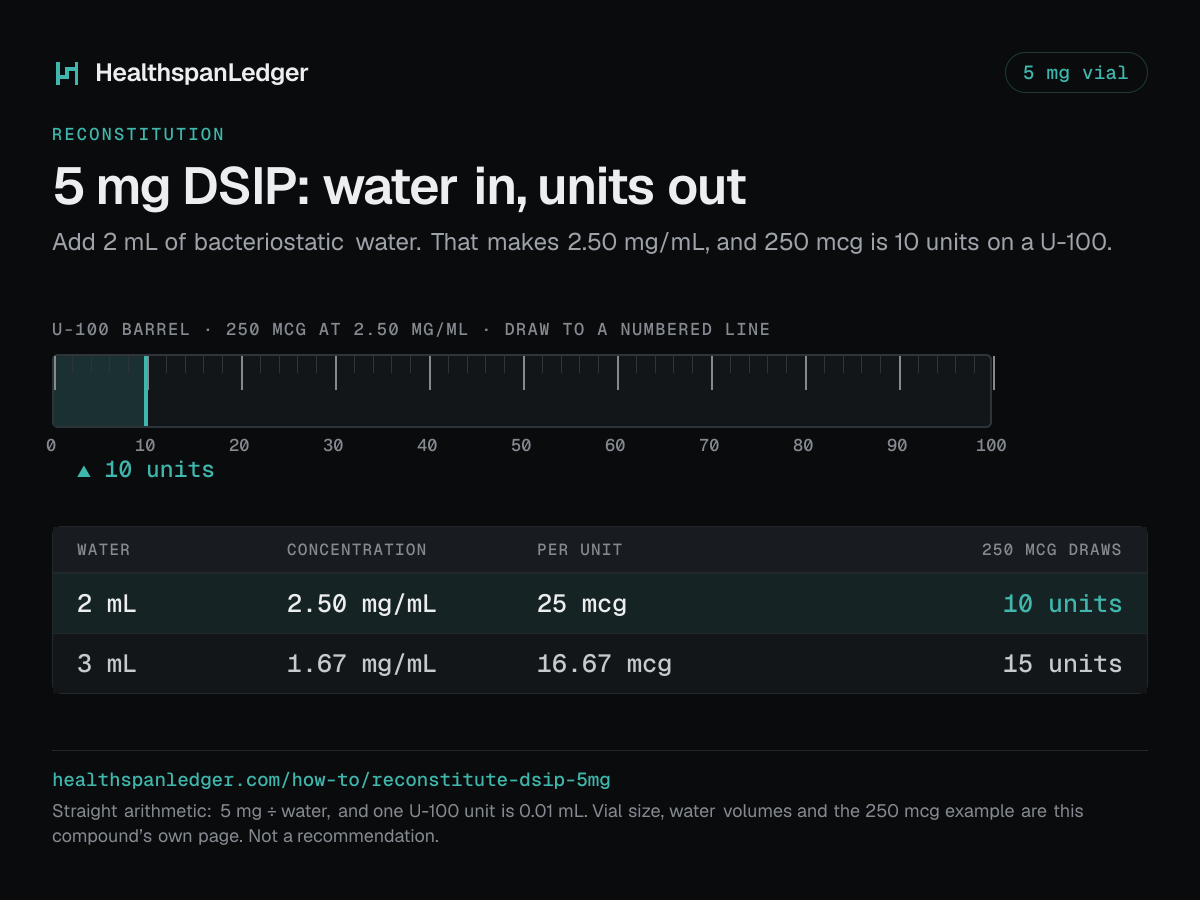
DSIP 5 mg vial: how much water to add. Each row is what that amount draws on a U-100 syringe. 2 mL makes 2.50 mg/mL, or 25 mcg a unit, and 250 mcg is 10 units. 3 mL makes 1.67 mg/mL, or 16.67 mcg a unit, and 250 mcg is 15 units. The barrel drawn here is filled to 10 units, the draw at 2 mL. The sum is 5 mg divided by the water. One U-100 unit is 0.01 mL.
The 5 mg vial at 2 mL on a U-100 barrel. 250 mcg fills to 10.0 units, at 2.50 mg/mL.

The smaller DSIP vial is the one that reads

The vial contains twenty worked doses. Both water options land exactly on syringe lines and sit above the crowded bottom of the syringe.

3Read the full vial record 3 notes

The vial size moves the reading further than the water does

Between this page’s two water volumes the draw changes by half again. Between its two vial sizes it doubles.

That makes the purchase the bigger decision and the mixing the smaller one, which is the reverse of most pages in this family. Choosing this size is what buys the legible reading.

Twenty draws, both of them on marks

Each listed volume gives a whole number of units here. The water choice therefore comes down to how much liquid goes under the skin, and how long the vial covers.

No published source gives a storage window for the mixed vial. Twenty is a dose count, not twenty weeks of use.

The strength on the glass is a seller’s claim

Material under this name ships for laboratory research, with no enforced standard governing vial contents. The number printed on the label is an assertion by whoever filled it.

Every figure on this page inherits that assertion. The arithmetic cannot be more reliable than the quantity it starts from.

No regulator anywhere has licensed this peptide and it appears in no pharmacopeia, so nothing independent checks what a vial holds. That is a different situation from a medicine whose contents an agency enforces.

How do you mix it, step by step?

  1. Wipe both stoppers with an alcohol swab and let them dry.
  2. Draw up the water volume you picked from the table.
  3. Let the water run slowly down the inside wall of the DSIP vial, rather than jetting it onto the powder.
  4. Swirl gently until it dissolves. Shaking damages peptides.
  5. Store it as the dispensing label directs. What happens after mixing differs by product — some labels direct against refrigerating the mixed solution at all.

What if your water volume is not on the table?

The table shows the offered water volumes. The calculator does the same arithmetic for any volume and any syringe, and shows its working line by line.

Open the DSIP calculator →

Where to read next about DSIP

The arithmetic on this page is only half the question. These are the pages that carry the other half.

2primary sources, each with the day we read it — open the documents used on this page