Page last checked
Research compound · not FDA-approved
DSIP
DSIP stands for delta sleep-inducing peptide. It is nine amino acids long, and it was recovered in 1977 from the blood of rabbits put into deep sleep electrically.
What matters first
- Why people look it up
- It is sold for insomnia and for deeper sleep.
- What the evidence shows
- It has more human research than many peptides sold this way, but the evidence is still thin. European groups gave it during the 1980s to people with insomnia and to people in alcohol and opiate withdrawal, and reported improved sleep. The studies were small, mostly open label, used intravenous dosing and never led to an approval.
- Dose status
- DSIP is not FDA-approved, so no dosing label exists for it. The sections below explain what researchers tested and what remains unknown.
What is known about DSIP
DSIP, delta sleep-inducing peptide, is a nine-amino-acid sequence recovered in 1977 from the cerebral venous blood of rabbits during electrically induced slow-wave sleep. European groups injected it into people with insomnia and into people in alcohol and opiate withdrawal through the 1980s, at doses of 25 to 30 nanomoles per kilogram, and reported sleep normalizing. Those human studies are small, largely uncontrolled, forty years old and never led to an approval.
| Topic | Value |
|---|---|
| Strongest source | limited human data |
| FDA approval | Not FDA-approved |
| Studied dosing | 21.2 mcg as a single dose before sleep, per kilogram of body weight (published as 25 nmol/kg; two small insomnia studies reported improved sleep on it) — from clinical trials |
| Studied dosing | 25.5 mcg per kilogram of body weight, six doses across one week (published as 30 nmol/kg; a sleep-laboratory study of 18 chronic insomniacs aged 29 to 83, with the effect tracked for a further week afterwards) — from clinical trials |
| Typical vials | 5 mg · 10 mg |
Every row links back to a source listed below. These facts are for reference, not a personal recommendation.
DSIP dosage chart: what the human studies used
The human DSIP literature stated amounts in nanomoles per kilogram. The mass conversions below keep that per-kilogram basis and do not assume a body weight.
| Study record | Published amount | Mass conversion | Route and schedule | Who was studied |
|---|---|---|---|---|
| 1984 insomnia investigations | 25 nmol/kg | 21.2 mcg/kg | Intravenous single injection before sleep | Two small insomnia studies summarized together; the PubMed abstract does not state a participant count |
| 1986 sleep-laboratory study | 30 nmol/kg | 25.5 mcg/kg | Intravenous; six doses across one week | 18 chronic insomniacs, ages 29–83, followed for one further week |
Each row keeps the units and study description used in the cited PubMed article. Read the sources.
What the evidence for DSIP is
People have received this compound in a documented setting, or it has approval outside the United States. The available human evidence is still too limited to show a clear dose-and-result pattern for US use.
- What it establishes
- What it does not establish
Check the country, study size and reason it was used. Do not treat limited human data as an FDA-approved schedule.
Evidence snapshot and shareable image
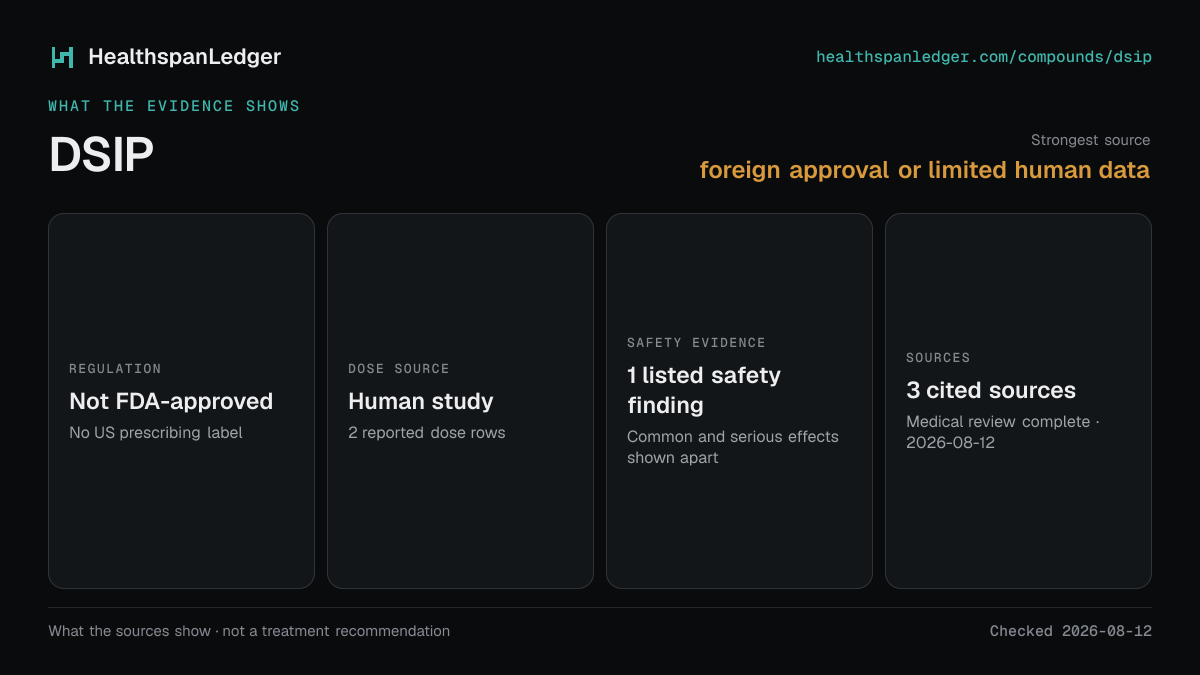
Evidence snapshot
Foreign approval or limited human data
- Regulation
- Dose source
- Safety evidence
- Sources
Where DSIP is in clinical trials
No trial of this compound is registered on ClinicalTrials.gov.
That is worth sitting with. Nobody has registered a study to find out whether DSIP works in people, so no result is coming and no date is worth waiting for. Sellers are not waiting for that work either.
ClinicalTrials.gov · retrieved 2026-09-27
Regulatory status
DSIP has an international generic name, emideltide.
FDA listed it for a compounding-committee review on 24 July 2026. It went up as a candidate for the section 503A bulk drug substances list. The uses under review were opioid withdrawal, chronic insomnia and narcolepsy.
Those are the three the 1980s papers examined. That review asks whether pharmacists may compound it at all. It is not an approval.
No company has filed to market it anywhere. Material sold under this name ships for lab research. So what is in the vial rests on a seller’s certificate, not on a standard anyone enforces.
Full regulatory tracker →Where to go next on DSIP
The related pages keep each topic with its evidence.
Why DSIP carries no boxed warning
Check a DSIP draw with the DSIP reconstitution calculator
Reconstituting DSIP at 10 mg, step by step
Mixing a 5 mg DSIP vial, water volume by water volume
What backs the DSIP numbers, and what backs the rest
Who else is sold for sleep besides DSIP
Every calculator on this site, DSIP and the rest
Where the DSIP program has actually got to
Primary regulatory documents, including DSIP
Uses and approval status for DSIP and other compounds
Safety notes
Questions about DSIP
Is DSIP FDA-approved?
How is DSIP taken?
How does DSIP differ from the other compounds in this class?
What is not known about DSIP?
Questions readers ask
What are the benefits of taking DSIP peptide?
How long does it take for DSIP to kick in?
What are the side effects of DSIP?
Where do you inject DSIP peptide?
- Schneider-Helmert D. DSIP in insomnia. Eur Neurol. 1984;23(5):358-63retrieved 2026-08-12limited human data
- Schneider-Helmert D. Efficacy of DSIP to normalize sleep in middle-aged and elderly chronic insomniacs. Eur Neurol. 1986;25(6):448-53retrieved 2026-08-12limited human data
- Dick P, Costa C, Fayolle K, et al. DSIP in the treatment of withdrawal syndromes from alcohol and opiates. Eur Neurol. 1984;23(3):188-93retrieved 2026-08-12limited human data