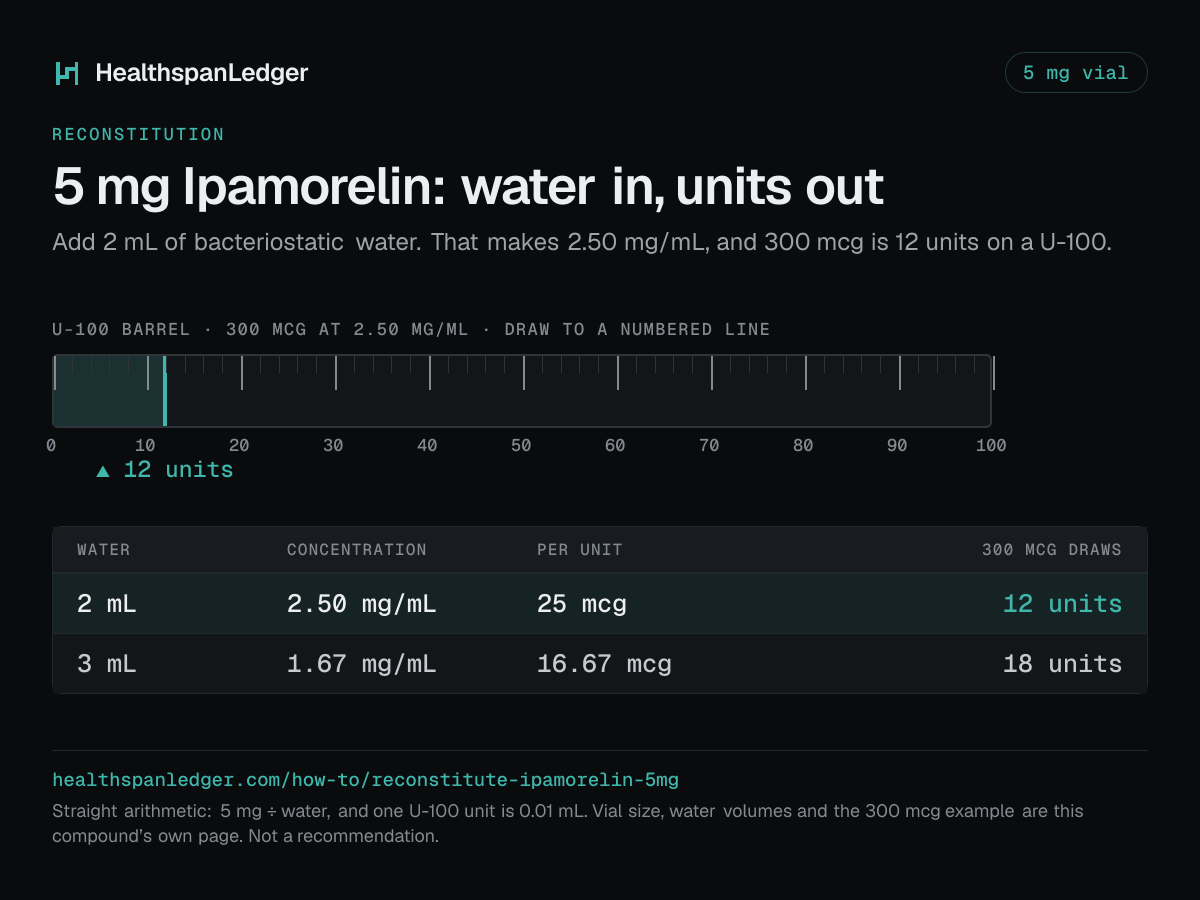
In this example, 2 mL of bacteriostatic water in a 5 mg Ipamorelin vial gives 2.50 mg/mL. An example 300 mcg amount is then 12.0 units on a U-100 syringe.
This example lands on a syringe line. More water makes a weaker mix and a bigger draw. Less water makes a stronger mix and a smaller one. The amount of Ipamorelin stays the same. Use the diluent and volume specified for your product; the arithmetic alone does not choose them.
What matters first
Example water volume
2 mL
Resulting strength
2.50 mg/mL
Example 300 mcg dose
12.0 U-100 units
How much bacteriostatic water for a 5 mg Ipamorelin vial?
◆ Unique to the 5 mg vialU-100 example draws
Water added
Concentration
Per U-100 unit
Example: 300 mcg =
2 mL
2.50 mg/mL
25 mcg
12.0 units
3 mL
1.67 mg/mL
16.67 mcg
18.0 units
Straight arithmetic: concentration = 5 mg ÷ liquid volume, and 1 U-100 unit = 0.01 mL. The example column shows the math at 300 mcg; it is not a dose recommendation.
The table compares possible concentrations; it does not establish which diluent or volume suits your product. Follow its dispensing instructions.
“Hard to measure” means the example draw is below two U-100 units. “Won’t fit” means it exceeds this syringe’s capacity.
The 5 mg vial at 2 mL on a U-100 barrel. 300 mcg fills to 12.0 units, at 2.50 mg/mL.
Ipamorelin is a peptide five amino acids long. It makes the pituitary gland let out a pulse of growth hormone.
How many units is a documented dose from this vial?
The table above uses one worked example. These are the published quantities, converted into marks on a U-100 barrel at each listed liquid volume for a 5 mg vial. Where a quantity was never studied by injection, the row says so.
200–300 mcg — reported, not studied
200–300 mcg two or three times a day under the skin, which is not how any of it was studied. Every trial dose above went into a vein, in hospital, after bowel surgery.
Water added
Concentration
Draw, low to high
2 mL
2.50 mg/mL
8.0 to 12.0 units
3 mL
1.67 mg/mL
12.0 to 18.0 units
indirect evidenceDominikowski A, Rękoś Z, Olejarz M, Szczepanek-Parulska E, Domin R, Ruchała M. The emerging landscape of performance-enhancing peptides modulating GH-IGF1 axis: bridging the gap between clinical evidence and patient self-administration. Front Endocrinol 2026 — tabulates self-reported online dosing patterns beside the clinical doses, stating the reported values must not be read as clinically validated, regulatory-approved or safe · retrieved 2026-08-12
Sixteen doses, none of them matching how it was studied
This vial divides into sixteen draws at the worked amount. The human study amounts listed here were weight-based and given into a vein, so this fixed-mass example does not reproduce their dosing method.
3Read the full vial record — 3 notes
A worked amount is not the trial’s dosing method
The result follows from the entered vial content, liquid volume and dose. Those calculations cannot validate the choice of dose or establish that the same amount would be appropriate by a different route.
The published trials used hospital infusions after bowel surgery and adjusted the amount to each patient’s weight. The flat worked amount comes from reported practice instead.
Both illustrated draws land on whole units
Both listed volumes put the reading on a syringe line, and both land well clear of the crowded bottom of the barrel. Being one mark out costs a small fraction of the draw.
That avoids rounding a fractional unit in these two examples. It does not establish that a preparation is suitable or that a one-line difference would be clinically unimportant.
A long supply with no window against it
Sixteen draws could keep a mixed vial in use for a long time, but the example supplies no applicable stability result.
So the count stands alone. It says how the powder divides and nothing at all about how long the solution stays what it was.
How do you mix it, step by step?
Wipe both stoppers with an alcohol swab and let them dry.
Check the product’s mixing instructions for the correct diluent and volume before drawing it up.
Let the water run slowly down the inside wall of the Ipamorelin vial, rather than jetting it onto the powder.
Follow the product’s instructions for mixing and checking the solution before use. Do not assume every powder uses the same method.
Store it as the dispensing label directs. What happens after mixing differs by product — some labels direct against refrigerating the mixed solution at all.
What if your water volume is not on the table?
The calculator lets you enter your product’s vial strength and mixing volume, then shows the arithmetic for your syringe.
With the offered 2 mL or 3 mL mixes, 300 micrograms equals 12 units or 18 units on a U-100 syringe.
Both are whole numbers, so neither reading needs rounding. The choice comes down to which of the two you can see clearly on the barrel. The milligrams that end up under the skin are identical either way.
How to reconstitute CJC-1295 ipamorelin 5mg?
A 5/5 blend contains 5 mg of each peptide in one vial. Adding 2 mL, 3 mL or 5 mL of water changes the concentration of both peptides together.
At 2 mL each peptide sits at 2.5 mg per mL, so one unit carries 25 micrograms of each. Moving the plunger moves both, and no trial has ever given this pair to a person together.
How much bacteriostatic water for 5mg of peptides?
The 5 mg printed on the vial is not enough to calculate units; the dose is also required. Worked amounts for 5 mg vials range from 200 micrograms to several milligrams.
Adding 2 mL to any 5 mg vial makes a 2.5 mg/mL solution. The unit count still changes with the dose: one worked example draws 12 units and another draws 40.
How long will a 5mg vial of ipamorelin last?
At the 300 microgram worked amount, the vial contains sixteen draws. No published source says how long the mixed vial keeps.
The pattern a review writes down is two or three injections a day. At three a day, sixteen draws is under a week. Every dose in the actual trials went into a vein instead, set per kilogram of body weight.
Where to read next about Ipamorelin
The arithmetic on this page is only half the question. These are the pages that carry the other half.