
Page last checked

How-to · reconstitution

How to reconstitute Kisspeptin-10 5 mg

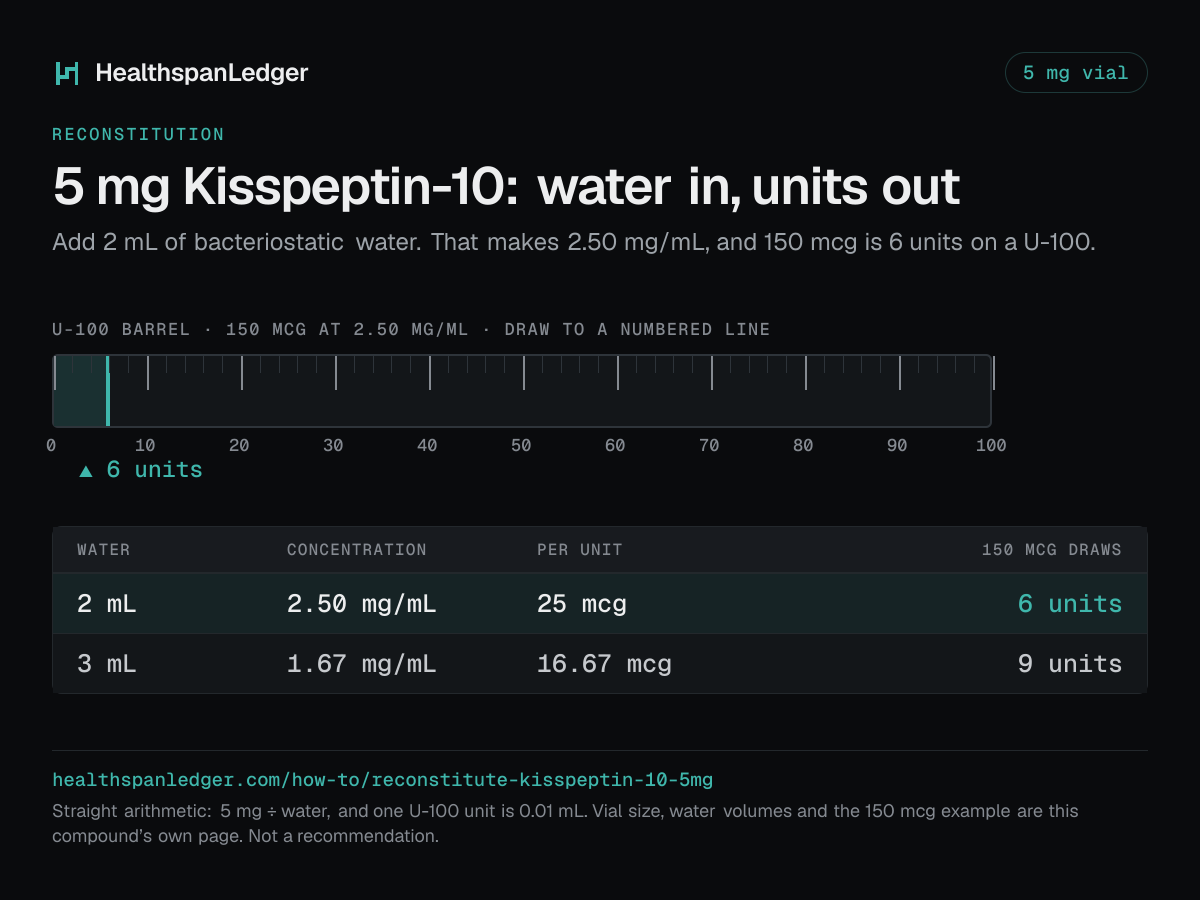
In this example, 2 mL of bacteriostatic water in a 5 mg Kisspeptin-10 vial gives 2.50 mg/mL. An example 150 mcg amount is then 6.0 units on a U-100 syringe.

This example lands on a syringe line. More water makes a weaker mix and a bigger draw. Less water makes a stronger mix and a smaller one. The amount of Kisspeptin-10 stays the same. Use the diluent and volume specified for your product; the arithmetic alone does not choose them.

What matters first

Example water volume
2 mL
Resulting strength
2.50 mg/mL
Example 150 mcg dose
6.0 U-100 units

How much bacteriostatic water for a 5 mg Kisspeptin-10 vial?

◆ Unique to the 5 mg vialU-100 example draws
Water addedConcentrationPer U-100 unitExample: 150 mcg =
2 mL2.50 mg/mL25 mcg6.0 units
3 mL1.67 mg/mL16.67 mcg9.0 units

Straight arithmetic: concentration = 5 mg ÷ liquid volume, and 1 U-100 unit = 0.01 mL. The example column shows the math at 150 mcg; it is not a dose recommendation.

The table compares possible concentrations; it does not establish which diluent or volume suits your product. Follow its dispensing instructions.

“Hard to measure” means the example draw is below two U-100 units. “Won’t fit” means it exceeds this syringe’s capacity.

Kisspeptin-10 5 mg vial: example mixing volumes. Each row is what that amount draws on a U-100 syringe. 2 mL makes 2.50 mg/mL, or 25 mcg a unit, and 150 mcg is 6 units. 3 mL makes 1.67 mg/mL, or 16.67 mcg a unit, and 150 mcg is 9 units. The barrel drawn here is filled to 6 units, the draw at 2 mL. The sum is 5 mg divided by the liquid volume. One U-100 unit is 0.01 mL.
The 5 mg vial at 2 mL on a U-100 barrel. 150 mcg fills to 6.0 units, at 2.50 mg/mL.

Medically reviewed by Kenneth Montecillo, MD2026-09-07open the primary sources

What is Kisspeptin-10?

Kisspeptin-10 is the ten-amino-acid working core of kisspeptin, the signal sitting at the very top of the reproductive hormone chain.

Thirty-three draws, and both volumes read as whole numbers

At the worked amount, the smaller kisspeptin vial contains thirty-three complete portions before drawing losses. Each water option lands exactly on a syringe line.

3Read the full vial record — 3 notes

A long count with nothing to check it against

The vial divides into thirty-three worked amounts. No storage limit is assigned here, so that count should not be read as a schedule.

The arithmetic does not estimate a use-by date or how much would remain at that date. That requires information about the particular formulation, storage conditions and permitted container use.

Small readings, but at least they land

Both listed volumes give whole numbers of units, though both sit low on the barrel. The larger volume produces a larger reading for the same drug amount, which changes how much of the draw a single unit represents.

On the larger vial in this family neither of those things holds, which makes this the more measurable of the two sizes despite holding less.

The route this table models is the one that did least

Human responses to this peptide came from injections into a vein. Under the skin, the largest amount studied moved neither of the hormones being measured.

So the conversion below is exact and its subject is the route with the weakest evidence behind it. That is worth knowing before the count of draws feels like a plan.
How do you mix it, step by step?

  1. Wipe both stoppers with an alcohol swab and let them dry.
  2. Check the product’s mixing instructions for the correct diluent and volume before drawing it up.
  3. Let the water run slowly down the inside wall of the Kisspeptin-10 vial, rather than jetting it onto the powder.
  4. Follow the product’s instructions for mixing and checking the solution before use. Do not assume every powder uses the same method.
  5. Store it as the dispensing label directs. What happens after mixing differs by product — some labels direct against refrigerating the mixed solution at all.

What if your water volume is not on the table?

The calculator lets you enter your product’s vial strength and mixing volume, then shows the arithmetic for your syringe.

Open the Kisspeptin-10 calculator →

Where to read next about Kisspeptin-10

The arithmetic on this page is only half the question. These are the pages that carry the other half.

2primary sources, each with the day we read it — open the documents used on this page