Page last checked
Research compound · not FDA-approved
Kisspeptin-10
Kisspeptin-10 is the ten-amino-acid working core of kisspeptin, the signal sitting at the very top of the reproductive hormone chain.
What matters first
- Why people look it up
- It is sold for libido, for fertility, and for raising testosterone.
- What the evidence shows
- The human work is physiology research in groups of four to six people, run to map the circuit rather than to treat anyone. Given into a vein it lifted luteinising hormone in men within half an hour. Given under the skin — the route these vials are sold for — it moved neither hormone in the women studied.
- Dose status
- Kisspeptin-10 is not FDA-approved, so no dosing label exists for it. The sections below explain what researchers tested and what remains unknown.
What is known about Kisspeptin-10
Kisspeptin-10 is the ten-amino-acid core of kisspeptin, which starts a hormone signal in the reproductive system. Researchers gave it to healthy volunteers to study that signal, not to treat a condition. A dose into a vein raised luteinizing hormone in men within 30 minutes. Under-the-skin injection did not raise LH or FSH in women in the follicular phase of their cycle. Responses varied by sex and cycle phase, so these groups do not isolate the effect of route.
| Topic | Value |
|---|---|
| Strongest source | limited human data |
| FDA approval | Not FDA-approved |
| Studied dosing | 41.7 mcg once per kilogram of body weight (published as 32 nmol/kg; the largest under-the-skin dose in the study did not raise either measured hormone in women sampled during the follicular phase) — from clinical trials |
| Studied dosing | 0.01–3 mcg once per kilogram of body weight (in healthy men, luteinizing hormone peaked at 1 mcg/kg; 3 mcg/kg produced a smaller response) — from clinical trials |
| Studied dosing | 1.5–4 mcg per kilogram per hour, infused for up to 22.5 hours in healthy men (the lower rate raised LH pulse frequency; the higher rate raised testosterone) — from clinical trials |
| Typical vials | 5 mg · 10 mg |
Every row links back to a source listed below. These facts are for reference, not a personal recommendation.
What the evidence for Kisspeptin-10 is
People have received this compound in a documented setting, or it has approval outside the United States. The available human evidence is still too limited to show a clear dose-and-result pattern for US use.
- What it establishes
- What it does not establish
Check the country, study size and reason it was used. Do not treat limited human data as an FDA-approved schedule.
Evidence snapshot and shareable image
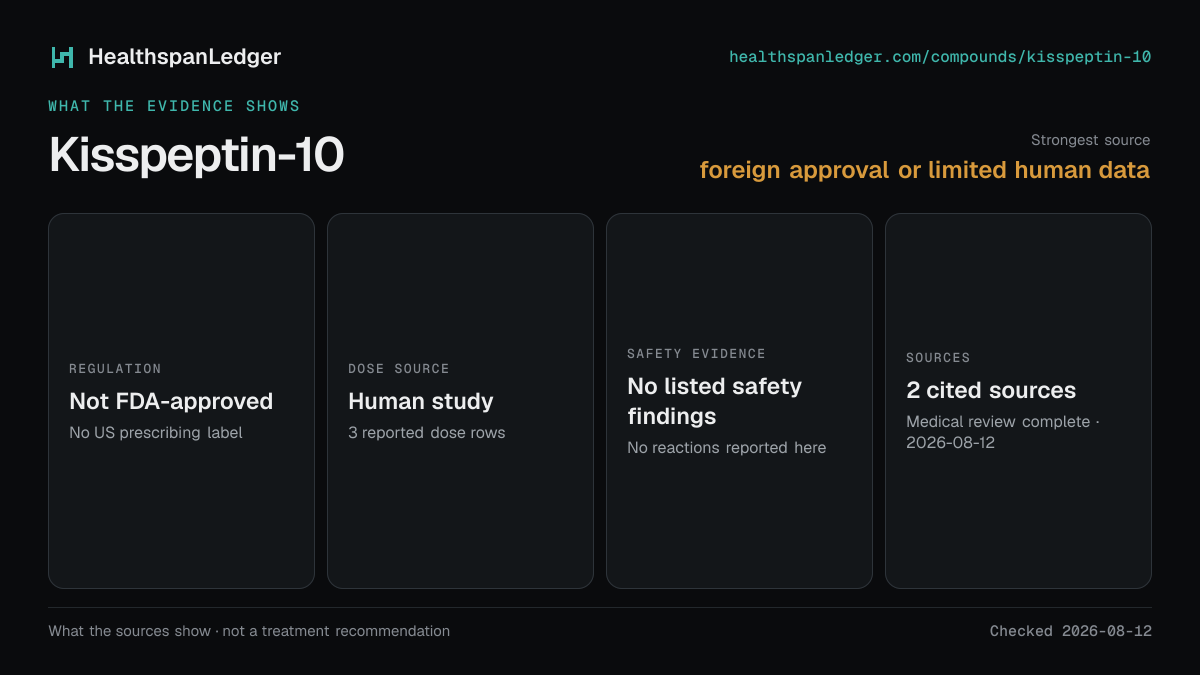
Evidence snapshot
Foreign approval or limited human data
- Regulation
- Dose source
- Safety evidence
- Sources
Where Kisspeptin-10 is in clinical trials
5 registered studies; the program has reached phase 3. Nothing is currently open or enrolling.
- Phase 3Completed
- Phase 3Completed
- Phase 3Completed
ClinicalTrials.gov · retrieved 2026-09-27
Regulatory status
University studies have given kisspeptin-10 to people under ethics review.
Their doses were scaled to body weight and used to map hormones, not to set a treatment dose. FDA placed it in category 2 of its interim 503A compounding policy on September 29, 2023. It is not on the withdrawn list.
An FDA committee reviewed it for low hormone function in men on October 29, 2024, but a review is not an approval.
Full regulatory tracker →Where to go next on Kisspeptin-10
The related pages keep each topic with its evidence.
Why no Kisspeptin-10 reaction profile can be published
Doses per 5 mg Kisspeptin-10 vial in the Kisspeptin-10 reconstitution calculator
What each water volume does to the 10 mg Kisspeptin-10 vial
Reconstituting Kisspeptin-10 at 5 mg, step by step
Who else is sold for testosterone besides Kisspeptin-10
The sexual function page Kisspeptin-10 appears on
Every calculator on this site, Kisspeptin-10 and the rest
What backs the Kisspeptin-10 numbers, and what backs the rest
Which compounds are still in trials besides Kisspeptin-10
Kisspeptin-10 in the regulatory changelog
Safety notes
Questions about Kisspeptin-10
Is Kisspeptin-10 FDA-approved?
How is Kisspeptin-10 taken?
How does Kisspeptin-10 differ from the other compounds in this class?
What is not known about Kisspeptin-10?
- Jayasena CN, Nijher GM, Comninos AN, et al. The effects of kisspeptin-10 on reproductive hormone release show sexual dimorphism in humans. J Clin Endocrinol Metab. 2011;96(12):E1963-72retrieved 2026-08-12limited human data
- George JT, Veldhuis JD, Roseweir AK, et al. Kisspeptin-10 is a potent stimulator of LH and increases pulse frequency in men. J Clin Endocrinol Metab. 2011;96(8):E1228-36retrieved 2026-08-12limited human data