Page last checked

How-to · reconstitution

How to reconstitute LL-37 5 mg

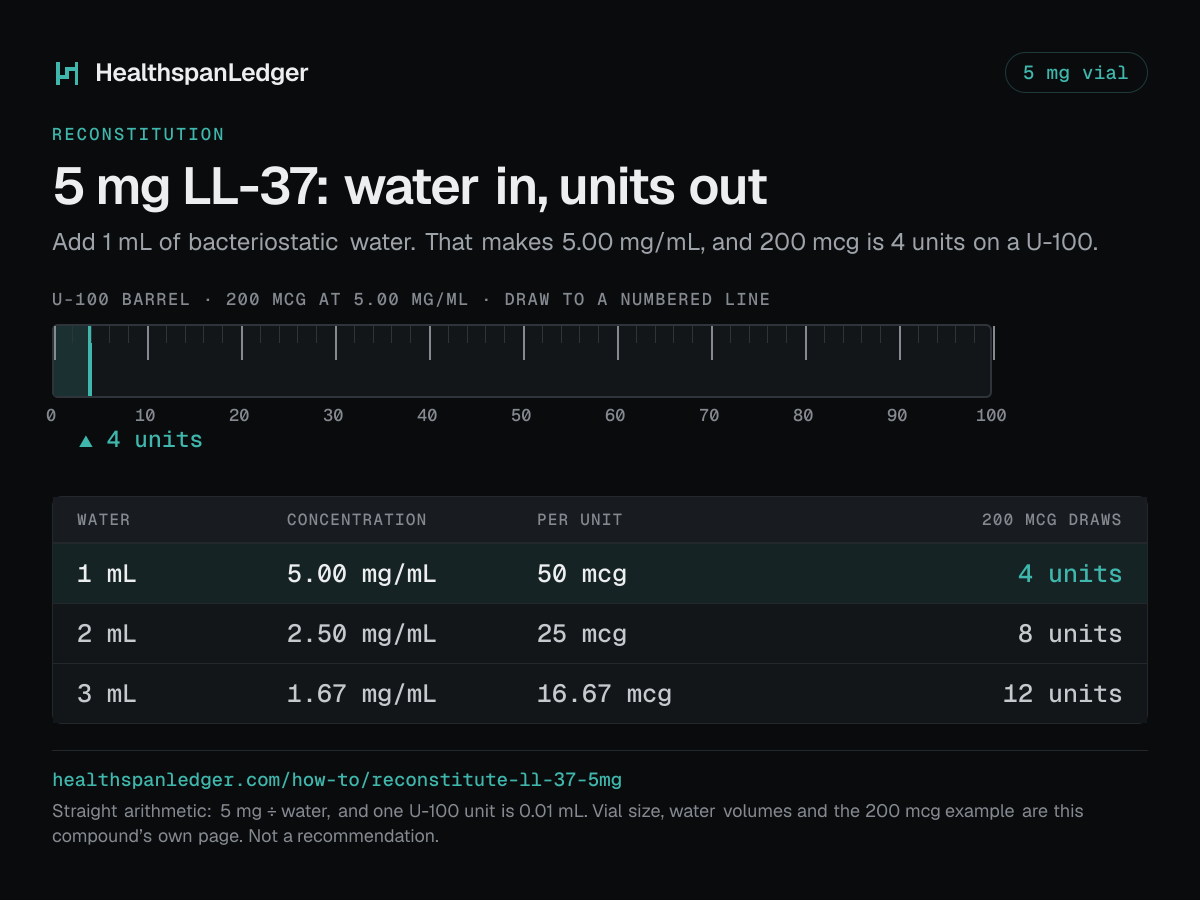
Put 1 mL of bacteriostatic water into the 5 mg LL-37 vial. That makes 5.00 mg/mL. A 200 mcg dose is then 4.0 units on a U-100 syringe.

That volume is the one that lands the draw on a syringe line, so the reading can be checked by eye. More water makes a weaker mix and a bigger draw. Less water makes a stronger mix and a smaller one. The amount of LL-37 in the glass never changes. Only the number of marks it takes does.

What matters first

Water to add
1 mL
Resulting strength
5.00 mg/mL
Example 200 mcg dose
4.0 U-100 units

What is LL-37?

LL-37 is a peptide 37 amino acids long that your own white blood cells make. It kills bacteria by breaking open their outer membrane.

Medically reviewed by Jennifer Montecillo, MD · non-practicing medical reviewerReviewed 2026-08-12open the primary sources

How much bacteriostatic water for a 5 mg LL-37 vial?

◆ Unique to the 5 mg vialU-100 example draws
Water addedConcentrationPer U-100 unitExample: 200 mcg =
1 mL5.00 mg/mL50 mcg4.0 units
2 mL2.50 mg/mL25 mcg8.0 units
3 mL1.67 mg/mL16.67 mcg12.0 units

Straight arithmetic: concentration = 5 mg ÷ water, and 1 U-100 unit = 0.01 mL. The example column shows the math at 200 mcg; it is not a dose recommendation.

Which volume to use is a practical choice rather than a dose. Pick the one that puts your draw somewhere you can actually read it on the syringe. The flags in the last column mark where that fails. “Hard to measure” means the draw is too small to judge by eye. “Won’t fit” means it is bigger than one U-100 syringe holds.

LL-37 5 mg vial: how much water to add. Each row is what that amount draws on a U-100 syringe. 1 mL makes 5.00 mg/mL, or 50 mcg a unit, and 200 mcg is 4 units. 2 mL makes 2.50 mg/mL, or 25 mcg a unit, and 200 mcg is 8 units. 3 mL makes 1.67 mg/mL, or 16.67 mcg a unit, and 200 mcg is 12 units. The barrel drawn here is filled to 4 units, the draw at 1 mL. The sum is 5 mg divided by the water. One U-100 unit is 0.01 mL.
The 5 mg vial at 1 mL on a U-100 barrel. 200 mcg fills to 4.0 units, at 5.00 mg/mL.

How many units is a documented dose from this vial?

The table above uses one worked example. These are the published quantities, converted into marks on a U-100 barrel at each water volume for a 5 mg vial. Where a quantity was never studied by injection, the row says so.

250–500 mcgstudied in a trial

250–500 mcg once every 7 days for up to 8 weeks, injected into a cutaneous or subcutaneous melanoma deposit, under the skin. (2 participants at 250 mcg, 1 at 500 mcg — 3 treated in all).

Water addedConcentrationDraw, low to high
1 mL5.00 mg/mL5.0 to 10.0 units
2 mL2.50 mg/mL10.0 to 20.0 units
3 mL1.67 mg/mL15.0 to 30.0 units

Human trialInduction of Antitumor Response in Melanoma Patients Using the Antimicrobial Peptide LL37 (NCT02225366) — MD Anderson Cancer Center, phase 1/2, completed, results posted · retrieved 2026-08-12

Three volumes, three clean readings, three people in the evidence

Every documented water option produces a whole-number syringe reading. It is the only guide in this group with three usable volumes that all land exactly on syringe lines. The reported human evidence involves three people.

3Read the full vial record 3 notes

Every row lands on a graduation

Three listed volumes, three whole numbers of units. The spread is wide enough that the smallest reading is single figures and the largest is not.

The choice on this page is therefore purely about legibility. The largest volume gives the reading with most marks under it, and costs nothing but a little more liquid.

The dose in the table came from injections into tumors

The only registered trial to give this peptide to people injected it directly into melanoma deposits, in three participants at two dose levels. A skin cancer was recorded among them.

Injecting into a tumor puts a peptide somewhere entirely unlike fat, and three people is not a group anyone can generalize an amount from.

Both human studies point away from more

In the larger trial, on leg ulcers, the two lower strengths improved healing and the highest did not differ from placebo.

That is the second piece of human evidence for this peptide and it runs the same direction as the first. Twenty-five draws in a vial is not an argument for using them.

How do you mix it, step by step?

  1. Wipe both stoppers with an alcohol swab and let them dry.
  2. Draw up the water volume you picked from the table.
  3. Let the water run slowly down the inside wall of the LL-37 vial, rather than jetting it onto the powder.
  4. Swirl gently until it dissolves. Shaking damages peptides.
  5. Store it as the dispensing label directs. What happens after mixing differs by product — some labels direct against refrigerating the mixed solution at all.

What if your water volume is not on the table?

The table shows the offered water volumes. The calculator does the same arithmetic for any volume and any syringe, and shows its working line by line.

Open the LL-37 calculator →

Where to read next about LL-37

The arithmetic on this page is only half the question. These are the pages that carry the other half.

1primary source, each with the day we read it — open the documents used on this page