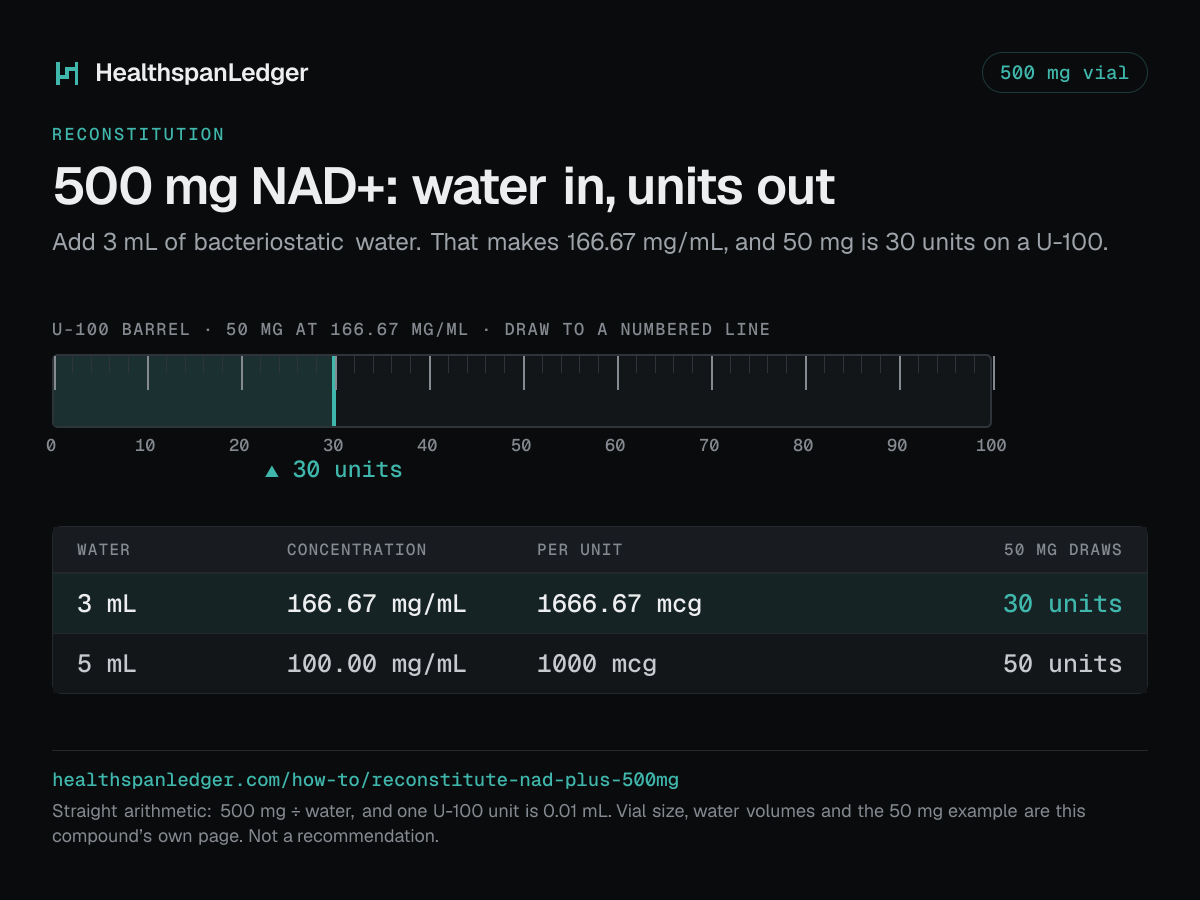
In this example, 3 mL of bacteriostatic water in a 500 mg NAD+ vial gives 166.67 mg/mL. An example 50 mg amount is then 30.0 units on a U-100 syringe.
This example lands on a syringe line. More water makes a weaker mix and a bigger draw. Less water makes a stronger mix and a smaller one. The amount of NAD+ stays the same. Use the diluent and volume specified for your product; the arithmetic alone does not choose them.
What matters first
Example water volume
3 mL
Resulting strength
166.67 mg/mL
Example 50 mg dose
30.0 U-100 units
How much bacteriostatic water for a 500 mg NAD+ vial?
◆ Unique to the 500 mg vialU-100 example draws
Water added
Concentration
Per U-100 unit
Example: 50 mg =
3 mL
166.67 mg/mL
1666.67 mcg
30.0 units
5 mL
100.00 mg/mL
1000 mcg
50.0 units
Straight arithmetic: concentration = 500 mg ÷ liquid volume, and 1 U-100 unit = 0.01 mL. The example column shows the math at 50 mg; it is not a dose recommendation.
The table compares possible concentrations; it does not establish which diluent or volume suits your product. Follow its dispensing instructions.
“Hard to measure” means the example draw is below two U-100 units. “Won’t fit” means it exceeds this syringe’s capacity.
The 500 mg vial at 3 mL on a U-100 barrel. 50 mg fills to 30.0 units, at 166.67 mg/mL.
NAD+ is a substance every cell uses to turn food into energy and carry out repair work. It is a coenzyme, not a peptide.
How many units is a documented dose from this vial?
The table above uses one worked example. These are the published quantities, converted into marks on a U-100 barrel at each listed liquid volume for a 500 mg vial. Where a quantity was never studied by injection, the row says so.
10–50 mg — studied in a trial
10–50 mg once daily for 21 days, into a vein. The three escalating groups (10 mg, then 20 mg, then 50 mg) of a 12-participant phase 1 safety study.
Water added
Concentration
Draw, low to high
3 mL
166.67 mg/mL
6.0 to 30.0 units
5 mL
100.00 mg/mL
10.0 to 50.0 units
Human trialNCT06558253 — Phase 1 safety and efficacy study of Coenzyme I (nicotinamide adenine dinucleotide) for injection after single umbilical cord blood transplantation, with 10 mg, 20 mg and 50 mg daily dose groups · retrieved 2026-08-12
100 mg — studied in a trial
100 mg once daily for one week, in a phase 1/2 study in immune thrombocytopenia, into a vein.
Water added
Concentration
Draw
3 mL
166.67 mg/mL
60.0 units
5 mL
100.00 mg/mL
100.0 units
Human trialNCT06776510 — A clinical study of intravenous nicotinamide adenine dinucleotide (Coenzyme I for Injection) in the treatment of immune thrombocytopenia, 100 mg/day for one week · retrieved 2026-08-12
500 mg — studied in a trial
500 mg diluted in 500 mL of saline, in a 53-participant comparison against intravenous nicotinamide riboside, into a vein.
Water added
Concentration
Draw
3 mL
166.67 mg/mL
300.0 unitswon’t fit
5 mL
100.00 mg/mL
500.0 unitswon’t fit
Human trialNCT06382688 — IV administration of nicotinamide riboside as compared to NAD+: 500 mg of nicotinamide adenine dinucleotide in 500 mL of saline, 53 participants enrolled · retrieved 2026-08-12
Check the final liquid volume for this larger drug amount
This NAD+ example uses more drug than the peptide examples. The result assumes the stated liquid volume. It does not measure how much liquid is in a real mix.
3Read the full vial record — 3 notes
What the volume calculation assumes
Concentration is the drug amount divided by the final liquid volume. Divide by the shown liquid volume to check the result. Actual mixing instructions may give one volume of water to add and a different final volume.
This example does not measure how the powder changes the final volume. No adjustment is guessed. Use the final strength on the label or the product’s mixing instructions; the powder’s mass alone cannot tell you how much room it takes up.
Ten draws, in tens of milligrams
The vial divides into ten worked doses, and both water options land exactly on syringe lines.
Everything on this page is an order of magnitude heavier than its neighbors. A decimal point in the wrong place therefore moves the amount much further than it would on a peptide vial. The mass column is the one to read.
The cited NAD+ studies used intravenous administration
The listed human studies gave NAD+ into a vein under supervision. That route uses different equipment and conditions from an injection under the skin. Their amounts stay tied to those studies.
Those rows do not establish how much to give under the skin or how to mix it for that use. A correct sum cannot fill that gap or prove that either route helps a person.
How do you mix it, step by step?
Wipe both stoppers with an alcohol swab and let them dry.
Check the product’s mixing instructions for the correct diluent and volume before drawing it up.
Let the water run slowly down the inside wall of the NAD+ vial, rather than jetting it onto the powder.
Follow the product’s instructions for mixing and checking the solution before use. Do not assume every powder uses the same method.
Store it as the dispensing label directs. What happens after mixing differs by product — some labels direct against refrigerating the mixed solution at all.
What if your water volume is not on the table?
The calculator lets you enter your product’s vial strength and mixing volume, then shows the arithmetic for your syringe.