NAD+ is a substance every cell uses to turn food into energy and carry out repair work. It is a coenzyme, not a peptide.
What matters first
Why people look it up
Clinics promote NAD+ IV drips and injections for energy, focus, recovery, hangovers, addiction recovery and healthy aging.
What the evidence shows
The human studies on NAD+ itself are small and used IV infusions. They have not shown that NAD+ injections improve those goals. The clearest finding so far is discomfort during the drip, including stomach symptoms, a faster heartbeat and chest pressure.
Dose status
NAD+ is not FDA-approved, so no dosing label exists for it. The sections below explain what researchers tested and what remains unknown.
Read the label first
NAD+, NR and NMN are not the same thing
“NAD supplement” can describe different ingredients and ways of taking them. Check the ingredient and form on the label first. What researchers learned about one form does not automatically apply to the others.
IV NAD+
What it is
NAD+ itself
How it is taken
A drip into a vein
What to know
The human studies we found gave NAD+ through an IV.
NAD+ injection
What it is
NAD+ itself
How it is taken
A compounded injection
What to know
We did not find a human study of NAD+ injections under the skin.
NR or NMN supplement
What it is
A substance the body can use to make NAD+
How it is taken
Usually swallowed
What to know
It is not the same ingredient or route as an NAD+ infusion.
The same rule applies to patches, nasal sprays and liposomal products. Check the ingredient and how the product is meant to be taken before comparing claims.
NAD+ helps cells turn food into usable energy and take part in repair work. Levels tend to fall with age, which is one reason clinics promote NAD+ drips and injections. The human research on NAD+ itself is still small. Studies have tested IV amounts from 10 to 500 mg, but they have not shown that NAD+ injections improve energy, focus, recovery or healthy aging.
NAD+ research and regulatory details: evidence quality, approval status, doses, handling, and presentation.
Topic
Value
Strongest source
limited human data
FDA approval
Not FDA-approved
Studied dosing
10–50 mg once daily for 21 days — the three escalating groups (10 mg, then 20 mg, then 50 mg) of a 12-participant phase 1 safety study— from clinical trials
Studied dosing
100 mg once daily for one week, in a phase 1/2 study in immune thrombocytopenia— from clinical trials
Studied dosing
500 mg diluted in 500 mL of saline, in a 53-participant comparison against intravenous nicotinamide riboside— from clinical trials
Typical vials
500 mg
Every row links back to a source listed below. These facts are for reference, not a personal recommendation.
What the evidence for NAD+ is
People have received this compound in a documented setting, or it has approval outside the United States. The available human evidence is still too limited to show a clear dose-and-result pattern for US use.
limited human data
What it establishes
It shows that people have received it and that some human information exists.
What it does not establish
It does not prove that the same dose is appropriate in the United States or that uncommon and long-term risks are known.
Check the country, study size and reason it was used. Do not treat limited human data as an FDA-approved schedule.
Evidence snapshot and shareable image
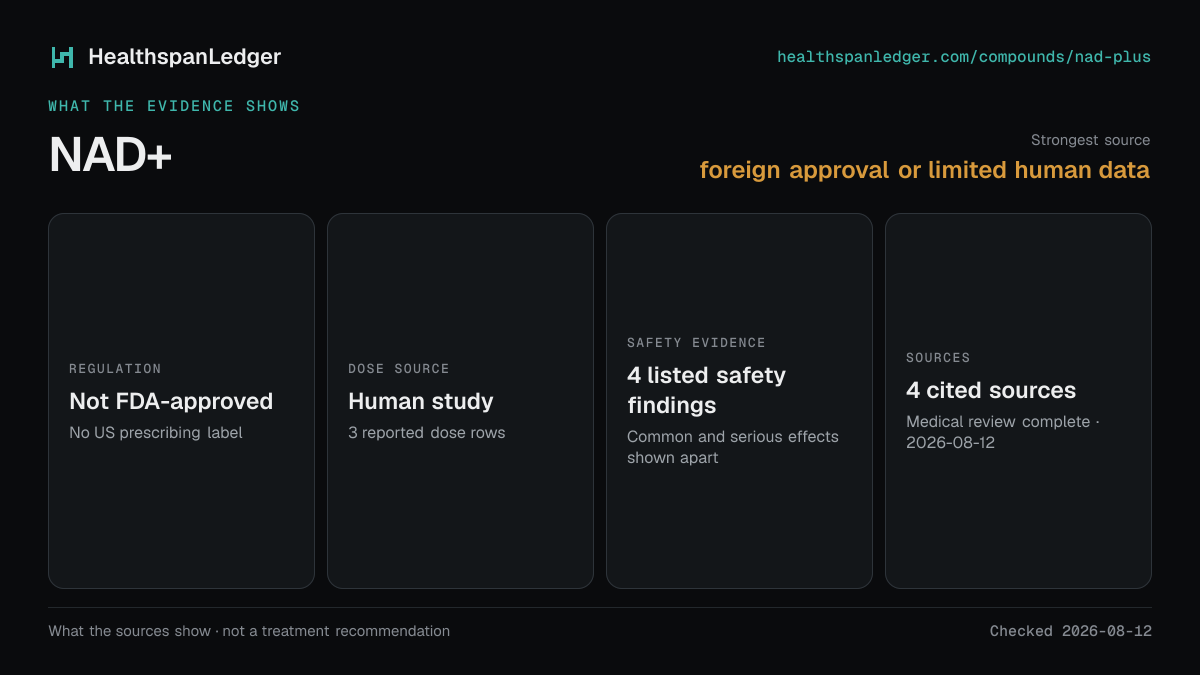
NAD+ at a glance: foreign approval or limited human data, dosing basis, regulatory status, safety coverage, and cited-source count. These details summarize the available sources; they are not treatment recommendations.
Evidence snapshot
Foreign approval or limited human data
The fastest way to see what kind of evidence this page is built on.
Regulation
Not FDA-approvedNo US prescribing label
Dose source
Human study3 reported dose rows
Safety evidence
4 listed safety findingsCommon and serious effects shown apart
NAD+ at a glance: foreign approval or limited human data, dosing basis, regulatory status, safety coverage, and cited-source count. These details summarize the available sources; they are not treatment recommendations.
Where NAD+ is in clinical trials
6 registered studies; the program has reached phase 3, and one is still enrolling.
The soonest a running study expects to finish measuring people is April 2028. That is when the sponsor expects to finish collecting the main measurement. It is not a results date, and not a date anything goes on sale.
Phase 3Running, closed to new participants
Combination Gerotherapeutic Interventions for Healthspan Improvement
AgelessRx · Healthspan Improvement, Aging · 30 participants planned · started July 2025
Main measurement due April 2026 (sponsor estimate)
Searched under the name nicotinamide adenine dinucleotide, which is how the registry files it.
A registered study means a sponsor filed a plan and started enrolling. It is not evidence the drug works, and most drugs tested in people never reach a pharmacy. Sponsors write and update these sources themselves; the National Library of Medicine publishes them without checking them.
A compounding pharmacy can prepare them, but that does not mean FDA reviewed the finished product for safety, effectiveness or quality before it was sold. The human studies in this record used IV infusions under supervision. They do not establish how an injection under the skin should be used.
No trial has established that raising this coenzyme by injection changes a clinical outcome — the human studies are early safety work that records how people handled the infusion
Every human dose on record was infused into a vein under supervision; nothing published describes injecting it under the skin, which is how the powder sold under this name is used
Registered daily quantities span 10 mg to 500 mg — a fiftyfold spread, which means there is no consensus figure to copy
Discomfort during the infusion is the consistent finding: stomach and gut symptoms, a faster heartbeat and chest pressure. It was severe enough that infusions ran at roughly a third of the comparison group’s speed
Most human NAD+ research studies the oral precursors NR and NMN instead; those are different substances and their milligram figures do not describe this one
Sold both as a ready-mixed solution and as a powder — only the powder involves any reconstitution arithmetic
Quantities here are in milligrams rather than micrograms, so a misplaced decimal moves further than it would on a peptide vial
Questions about NAD+
Is NAD+ FDA-approved?
No. There is no prescribing label for it, so no approved dose exists — the regulatory status section above has the detail.
How is NAD+ taken?
By a drip or injection into a vein, once a day.
How does NAD+ differ from the other compounds in this class?
NAD+ has been studied in people, but it works through a different system from GLP-1 and amylin drugs. Its doses and results are not directly comparable with theirs.
What is not known about NAD+?
It does not prove that the same dose is appropriate in the United States or that uncommon and long-term risks are known.
Questions readers ask
What happens if you take NAD every day?
Daily dosing is exactly what the registered studies did, and every one of them went into a vein. A 12-participant phase 1 study ran 10 mg, then 20 mg, then 50 mg daily for 21 days.
A phase 1/2 study in immune thrombocytopenia gave 100 mg daily for one week. Those are early safety studies, and neither established that raising this coenzyme changes a clinical outcome.
What is NAD plus peptide good for?
NAD+ is not a peptide. It is a coenzyme that helps cells turn food into energy and carry out repair work.
Clinics promote it for energy, focus, recovery and healthy aging. Human studies of NAD+ itself are small and have not shown that injections improve those goals.
What is the downside of taking NAD+?
NAD+ injections are not FDA-approved. Compounded versions are not reviewed by FDA for safety, effectiveness or quality before sale.
There is no established dose either. Registered studies used very different IV amounts, from 10 to 500 mg, and did not determine a best amount for routine use.
Is NAD like Adderall?
No. NAD+ is a coenzyme the body already uses, while Adderall is a prescription stimulant. No study has compared the two.
The NAD+ studies in this record looked at IV infusions and early safety. They did not test whether NAD+ improves attention, alertness or mood.
4primary sources, each with the day we read it — open the documents used on this page