Page last checked

How-to · reconstitution

How to reconstitute Sermorelin 6 mg

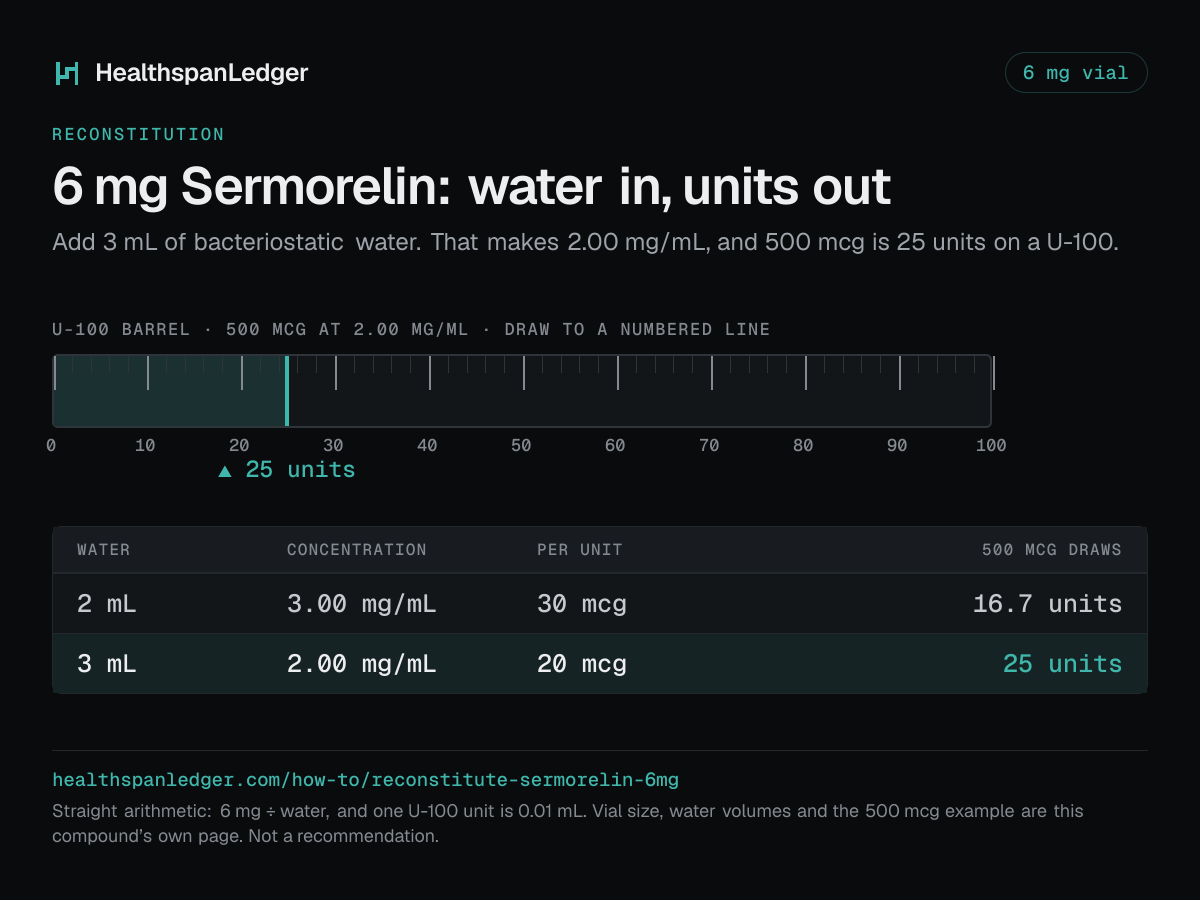
In this example, 3 mL of bacteriostatic water in a 6 mg Sermorelin vial gives 2.00 mg/mL. An example 500 mcg amount is then 25.0 units on a U-100 syringe.

This example lands on a syringe line. More water makes a weaker mix and a bigger draw. Less water makes a stronger mix and a smaller one. The amount of Sermorelin stays the same. Use the diluent and volume specified for your product; the arithmetic alone does not choose them.

What matters first

Example water volume
3 mL
Resulting strength
2.00 mg/mL
Example 500 mcg dose
25.0 U-100 units

How much bacteriostatic water for a 6 mg Sermorelin vial?

◆ Unique to the 6 mg vialU-100 example draws
Water addedConcentrationPer U-100 unitExample: 500 mcg =
2 mL3.00 mg/mL30 mcg16.7 units
3 mL2.00 mg/mL20 mcg25.0 units

Straight arithmetic: concentration = 6 mg ÷ liquid volume, and 1 U-100 unit = 0.01 mL. The example column shows the math at 500 mcg; it is not a dose recommendation.

The table compares possible concentrations; it does not establish which diluent or volume suits your product. Follow its dispensing instructions.

“Hard to measure” means the example draw is below two U-100 units. “Won’t fit” means it exceeds this syringe’s capacity.

Sermorelin 6 mg vial: example mixing volumes. Each row is what that amount draws on a U-100 syringe. 2 mL makes 3.00 mg/mL, or 30 mcg a unit, and 500 mcg is 16.7 units. 3 mL makes 2.00 mg/mL, or 20 mcg a unit, and 500 mcg is 25 units. The barrel drawn here is filled to 25 units, the draw at 3 mL. The sum is 6 mg divided by the liquid volume. One U-100 unit is 0.01 mL.
The 6 mg vial at 3 mL on a U-100 barrel. 500 mcg fills to 25.0 units, at 2.00 mg/mL.

Medically reviewed by Kenneth Montecillo, MD2026-09-07open the primary sources

What is Sermorelin?

Sermorelin is the first 29 amino acids of the hormone that prompts growth hormone release. It is the shortest piece that still does the job at the pituitary.

How many units is a documented dose from this vial?

The table above uses one worked example. These are the published quantities, converted into marks on a U-100 barrel at each listed liquid volume for a 6 mg vial. Where a quantity was never studied by injection, the row says so.

0.5–1 mg — studied in a trial

0.5–1 mg twice daily for 14 days in healthy men of about 68, under the skin. Only the 1 mg arm raised 24-hour growth hormone and IGF-I significantly above the men’s own baseline.

Water addedConcentrationDraw, low to high
2 mL3.00 mg/mL16.7 to 33.3 units
3 mL2.00 mg/mL25.0 to 50.0 units

Human trialCorpas E, Harman SM, Piñeyro MA, Roberson R, Blackman MR. Growth hormone (GH)-releasing hormone-(1-29) twice daily reverses the decreased GH and insulin-like growth factor-I levels in old men. J Clin Endocrinol Metab 1992;75(2):530-5 · retrieved 2026-08-12

200–300 mcg — reported, not studied

200–300 mcg once daily, as a flat quantity, under the skin. Where every clinical number above was set per kilogram of body weight, and the largest of those trials ran in children rather than in anyone choosing it.

Water addedConcentrationDraw, low to high
2 mL3.00 mg/mL6.7 to 10.0 units
3 mL2.00 mg/mL10.0 to 15.0 units

indirect evidenceDominikowski A, Rękoś Z, Olejarz M, Szczepanek-Parulska E, Domin R, Ruchała M. The emerging landscape of performance-enhancing peptides modulating GH-IGF1 axis: bridging the gap between clinical evidence and patient self-administration. Front Endocrinol 2026 — tabulates self-reported online dosing patterns beside the clinical doses, stating the reported values must not be read as clinically validated, regulatory-approved or safe · retrieved 2026-08-12

Twelve example doses, with one whole-unit result

This vial example contains twelve worked doses. Only the larger water option produces a whole-number syringe reading.

3Read the full vial record — 3 notes

A fifth more powder is enough to break a whole number

Against the smallest vial in this family the difference is slight. It is still enough to move the draw off a syringe line at the smaller volume.

That is the practical consequence of odd fill sizes. They do not make a vial worse; they make the reading land where no line is printed.

Twelve portions, with one whole-unit illustration

Only the larger listed volume puts the reading on a graduation here. The smaller one leaves the plunger between two, at a draw where a mark is a small share of the dose.

Both exact figures stay visible so the difference between the two options is easy to compare. A whole unit avoids rounding in the illustration; it does not establish the right mixing volume for a dispensed product.

No window figure to set against twelve

No storage limit is assigned to this worked preparation. Twelve is a dose count, not twelve weeks of use.

That is a long time for a compounded solution to sit. No cited source confirms that the mixture remains usable for the full calculated period.

How do you mix it, step by step?

  1. Wipe both stoppers with an alcohol swab and let them dry.
  2. Check the product’s mixing instructions for the correct diluent and volume before drawing it up.
  3. Let the water run slowly down the inside wall of the Sermorelin vial, rather than jetting it onto the powder.
  4. Follow the product’s instructions for mixing and checking the solution before use. Do not assume every powder uses the same method.
  5. Store it as the dispensing label directs. What happens after mixing differs by product — some labels direct against refrigerating the mixed solution at all.

What if your water volume is not on the table?

The calculator lets you enter your product’s vial strength and mixing volume, then shows the arithmetic for your syringe.

Open the Sermorelin calculator →

Where to read next about Sermorelin

The arithmetic on this page is only half the question. These are the pages that carry the other half.

4primary sources, each with the day we read it — open the documents used on this page