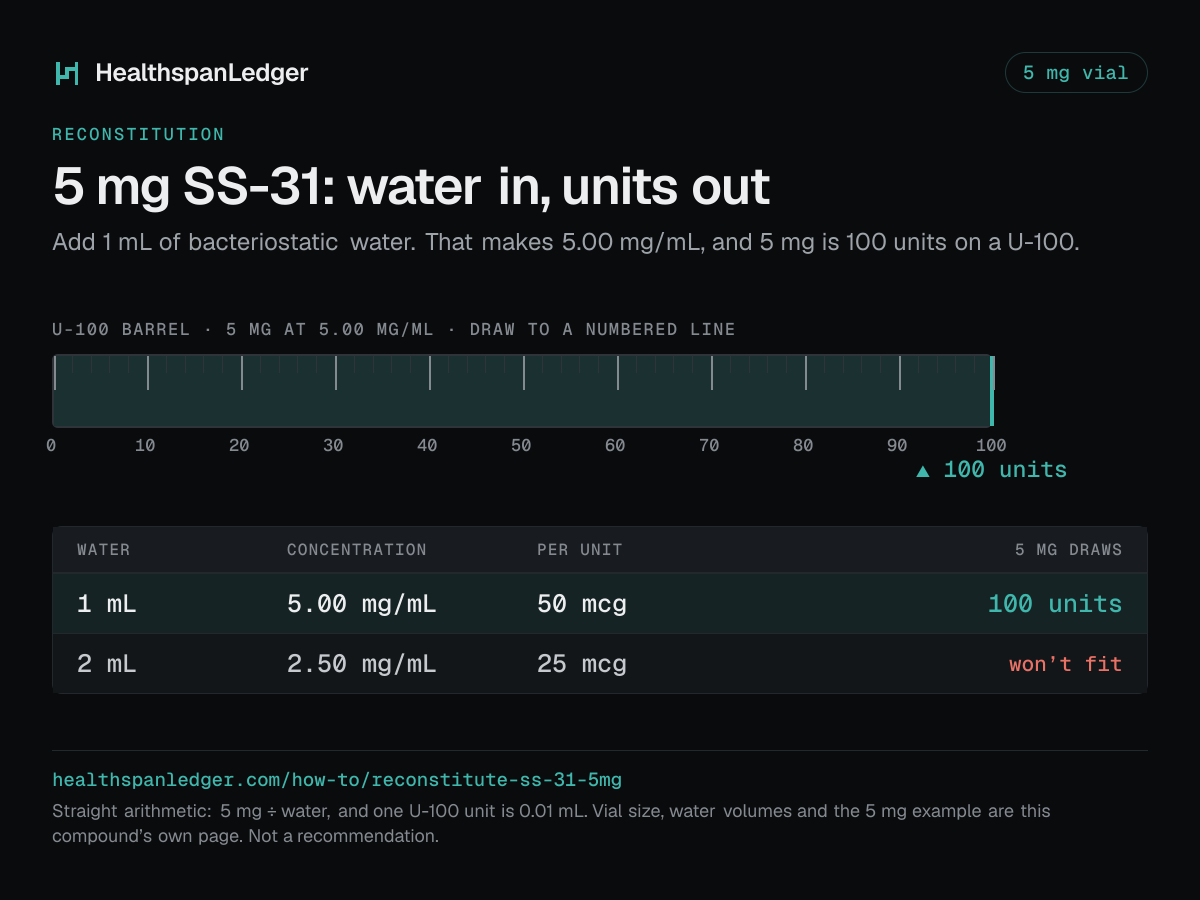
In this example, 1 mL of bacteriostatic water in a 5 mg SS-31 vial gives 5.00 mg/mL. An example 5 mg amount is then 100.0 units on a U-100 syringe.
This example lands on a syringe line. More water makes a weaker mix and a bigger draw. Less water makes a stronger mix and a smaller one. The amount of SS-31 stays the same. Use the diluent and volume specified for your product; the arithmetic alone does not choose them.
What matters first
Example water volume
1 mL
Resulting strength
5.00 mg/mL
Example 5 mg dose
100.0 U-100 units
How much bacteriostatic water for a 5 mg SS-31 vial?
◆ Unique to the 5 mg vialU-100 example draws
Water added
Concentration
Per U-100 unit
Example: 5 mg =
1 mL
5.00 mg/mL
50 mcg
100.0 units
2 mL
2.50 mg/mL
25 mcg
200.0 unitswon’t fit
Straight arithmetic: concentration = 5 mg ÷ liquid volume, and 1 U-100 unit = 0.01 mL. The example column shows the math at 5 mg; it is not a dose recommendation.
The table compares possible concentrations; it does not establish which diluent or volume suits your product. Follow its dispensing instructions.
“Hard to measure” means the example draw is below two U-100 units. “Won’t fit” means it exceeds this syringe’s capacity.
The 5 mg vial at 1 mL on a U-100 barrel. 5 mg fills to 100.0 units, at 5.00 mg/mL.
SS-31 is a peptide four amino acids long. It gathers inside mitochondria, the parts of a cell that make energy, and sticks to a fat there.
How many units is a documented dose from this vial?
The table above uses one worked example. These are the published quantities, converted into marks on a U-100 barrel at each listed liquid volume for a 5 mg vial. Where a quantity was never studied by injection, the row says so.
40 mg — FDA-approved label
40 mg once a day, for people with Barth syndrome weighing at least 30 kg, under the skin. The label gives a separate reduction for adults with severe renal impairment who are not on dialysis.
Water added
Concentration
Draw
1 mL
5.00 mg/mL
800.0 unitswon’t fit
2 mL
2.50 mg/mL
1600.0 unitswon’t fit
FDA labelFORZINITY (elamipretide) injection, for subcutaneous use — FDA prescribing information, Stealth BioTherapeutics Inc., initial U.S. approval 2025 (NDA 215244). Source for the accelerated approval, the Barth syndrome indication, the 40 mg once-daily dose, the 20 mg renal reduction, the 280 mg/3.5 mL solution, and the reaction rates against placebo · retrieved 2026-08-13
20 mg — FDA-approved label
20 mg once a day, where kidney filtration is under 30 mL per minute and the person is not on dialysis, under the skin. It is the only reduction the label describes.
Water added
Concentration
Draw
1 mL
5.00 mg/mL
400.0 unitswon’t fit
2 mL
2.50 mg/mL
800.0 unitswon’t fit
FDA labelFORZINITY (elamipretide) injection, for subcutaneous use — FDA prescribing information, Stealth BioTherapeutics Inc., initial U.S. approval 2025 (NDA 215244). Source for the accelerated approval, the Barth syndrome indication, the 40 mg once-daily dose, the 20 mg renal reduction, the 280 mg/3.5 mL solution, and the reaction rates against placebo · retrieved 2026-08-13
One worked portion, separate from the approved SS-31 product
The single powder-vial example contains less drug than the approved product’s listed daily amount. Its worked conversion does not reproduce the approved product’s concentration, delivery instructions or labeled dose.
3Read the full vial record — 3 notes
The whole vial is one draw
At the worked amount, the full vial is one draw. That worked value demonstrates the conversion and is not a replacement for the amount or preparation specified in the approved product’s label.
One theoretical portion does not establish a treatment schedule, storage conditions or what to do with residual solution. The ingredient name does not make the powder and the approved product interchangeable.
The larger volume cannot be drawn
Spread this powder through the greater of the two listed volumes and one draw needs twice what a U-100 barrel holds. The row is kept and flagged rather than hidden.
The smaller volume fills the barrel exactly to its top mark. That is a full syringe, and it is worth seeing before it is prepared rather than after.
No window is published for the mixed liquid
No storage limit is established here for a powder preparation after water is added. The approved version arrives already mixed, so its label does not answer that question.
The instructions for that prepared medicine must not be transferred to an unrelated powder formulation; no substitute storage period is calculated.
How do you mix it, step by step?
Wipe both stoppers with an alcohol swab and let them dry.
Check the product’s mixing instructions for the correct diluent and volume before drawing it up.
Let the water run slowly down the inside wall of the SS-31 vial, rather than jetting it onto the powder.
Follow the product’s instructions for mixing and checking the solution before use. Do not assume every powder uses the same method.
Store it as the dispensing label directs. What happens after mixing differs by product — some labels direct against refrigerating the mixed solution at all.
What if your water volume is not on the table?
The calculator lets you enter your product’s vial strength and mixing volume, then shows the arithmetic for your syringe.