Page last checked
FDA-approved medicine
SS-31 Forzinity
SS-31 is a peptide four amino acids long. It gathers inside mitochondria, the parts of a cell that make energy, and sticks to a fat there.
What matters first
- Why people look it up
- It is sold online for energy, mitochondrial health and slower aging.
- What the evidence shows
- The same molecule is an approved medicine for a rare inherited condition, at 40 mg a day under the skin. It was tested for the reason people buy it. In 41 older adults with failing mitochondria, it moved energy production about as much as placebo. The vials sold for that use hold 5 mg, an eighth of one day.
- Dose status
- SS-31 is not FDA-approved, so no dosing label exists for it. The sections below explain what researchers tested and what remains unknown.
What is known about SS-31
SS-31 is a four-amino-acid peptide that gathers in the inner membrane of mitochondria and binds a lipid there called cardiolipin. Under the name elamipretide it became an FDA-approved medicine in September 2025, sold as Forzinity to improve muscle strength in Barth syndrome, a rare inherited condition. The label specifies 40 mg once daily and a 20 mg once-daily reduction for adults with severe renal impairment who are not on dialysis. Forzinity is a prepared solution; these instructions do not describe a powder vial.
| Topic | Value |
|---|---|
| Strongest source | FDA label |
| FDA approval | Approved (Forzinity) |
| Studied dosing | 40 mg once a day, for people with Barth syndrome weighing at least 30 kg; the label gives a separate reduction for adults with severe renal impairment who are not on dialysis — from the FDA-approved label |
| Studied dosing | 20 mg once a day, where kidney filtration is under 30 mL per minute and the person is not on dialysis; it is the only reduction the label describes — from the FDA-approved label |
| Typical vials | 5 mg |
Every row links back to a source listed below. These facts are for reference, not a personal recommendation.
What the evidence for SS-31 is
The dosing numbers come from an FDA-approved prescribing label. FDA reviewed the manufacturer’s studies before approving the product, and the label can change when new dosing or safety information appears.
- What it establishes
- What it does not establish
Use these numbers for the named product and approved use. A different brand, product form or use may have a different schedule.
Evidence snapshot and shareable image
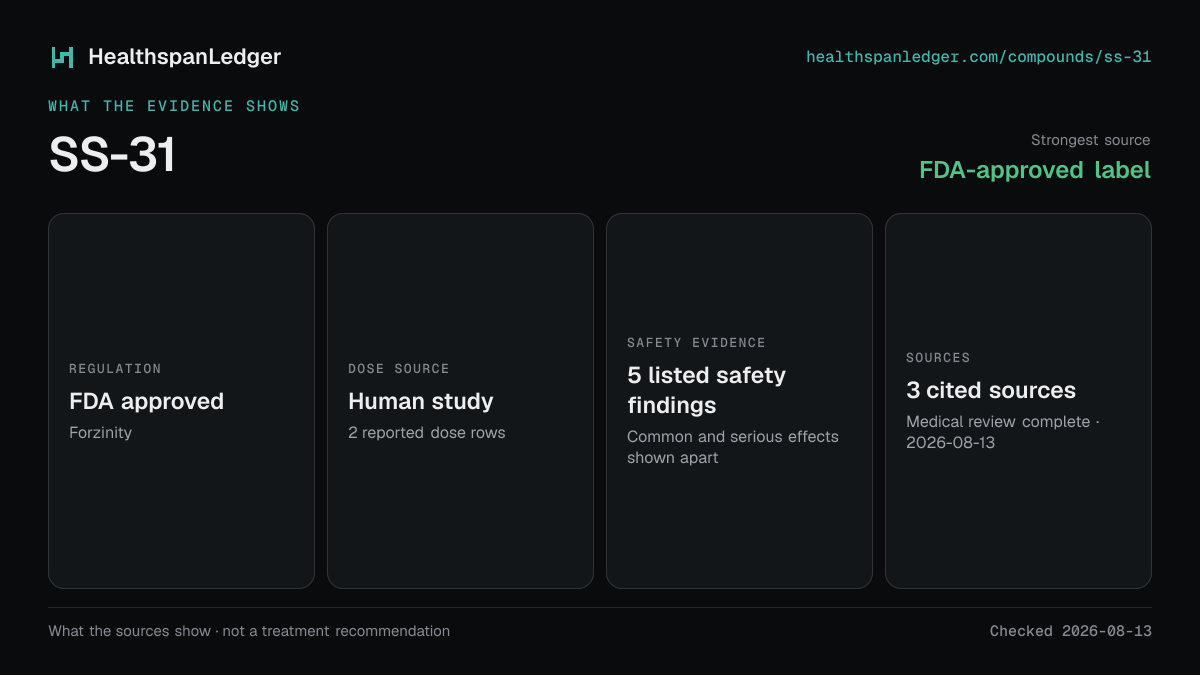
Evidence snapshot
FDA-approved label
- Regulation
- Dose source
- Safety evidence
- Sources
Where SS-31 is in clinical trials
26 registered studies; the program has reached phase 4, and 2 are still enrolling.
The soonest a running study expects to finish measuring people is August 2027. That is when the sponsor expects to finish collecting the main measurement. It is not a results date, and not a date anything goes on sale.
- Phase 4Recruiting
- Phase 3Running, closed to new participants
- Phase 3Completed
ClinicalTrials.gov · retrieved 2026-09-27
Regulatory status
Forzinity holds an accelerated approval.
FDA grants those on a marker rather than on how people function, and the marker here was knee extensor strength. Whether the approval stands depends on a confirmatory trial that has not reported. The approval covers Barth syndrome in people weighing at least 30 kg, and nothing else.
Material sold online as SS-31 is not that product. Forzinity is a ready-to-use solution at 80 mg per mL. The research vials hold a powder to be mixed, and no regulator has examined what is in them.
Full regulatory tracker →Where to go next on SS-31
The related pages keep each topic with its evidence.
SS-31 side effects, as the sources describe them
Use the SS-31 reconstitution calculator for a syringe draw
The 5 mg SS-31 vial: concentrations and example draws
Vial, water and dose for any peptide, with SS-31 as one example
Every dosing schedule, including SS-31
Registered trials for SS-31 and the rest
What the FDA has published on SS-31
Find SS-31 in the compound library
The sourcing rules behind every SS-31 figure
Safety notes
Questions about SS-31
Is SS-31 FDA-approved?
How is SS-31 taken?
How does SS-31 differ from the other compounds in this class?
What is not known about SS-31?
- NCT03323749 — a phase 3 randomized, placebo-controlled trial of 40 mg daily subcutaneous elamipretide in primary mitochondrial myopathy, 218 participants, terminated. The registry records the reason as the double-blind part failing to meet its primary endpoints; the primary measures were six-minute walk distance and a total fatigue scoreretrieved 2026-08-21Human trial
- NCT02245620 — a phase 2 randomized, double-blind, placebo-controlled trial of elamipretide in 41 elderly subjects with existing evidence of mitochondrial dysfunction, with posted results. Change from baseline in maximal ATP synthetic rate was 0.17 mM/sec on drug against 0.12 on placebo, and the phosphate-to-oxygen ratio 0.25 against 0.26retrieved 2026-08-21Human trial
- FORZINITY (elamipretide) injection, for subcutaneous use — FDA prescribing information, Stealth BioTherapeutics Inc., initial U.S. approval 2025 (NDA 215244). Source for the accelerated approval, the Barth syndrome indication, the 40 mg once-daily dose, the 20 mg renal reduction, the 280 mg/3.5 mL solution, and the reaction rates against placeboretrieved 2026-08-13FDA label