Page last checked

How-to · reconstitution

How to reconstitute Thymosin alpha-1 5 mg

Put 1 mL of bacteriostatic water into the 5 mg Thymosin alpha-1 vial. That makes 5.00 mg/mL. A 1.6 mg dose is then 32.0 units on a U-100 syringe.

That volume is the one that lands the draw on a syringe line, so the reading can be checked by eye. More water makes a weaker mix and a bigger draw. Less water makes a stronger mix and a smaller one. The amount of Thymosin alpha-1 in the glass never changes. Only the number of marks it takes does.

What matters first

Water to add
1 mL
Resulting strength
5.00 mg/mL
Example 1.6 mg dose
32.0 U-100 units

What is Thymosin alpha-1?

Thymosin alpha-1 is a peptide 28 amino acids long, first pulled out of calf thymus extract in the 1970s. It acts on how T cells mature and signal.

Medically reviewed by Jennifer Montecillo, MD · non-practicing medical reviewerReviewed 2026-08-12open the primary sources

How much bacteriostatic water for a 5 mg Thymosin alpha-1 vial?

◆ Unique to the 5 mg vialU-100 example draws
Water addedConcentrationPer U-100 unitExample: 1.6 mg =
1 mL5.00 mg/mL50 mcg32.0 units
2 mL2.50 mg/mL25 mcg64.0 units

Straight arithmetic: concentration = 5 mg ÷ water, and 1 U-100 unit = 0.01 mL. The example column shows the math at 1.6 mg; it is not a dose recommendation.

Which volume to use is a practical choice rather than a dose. Pick the one that puts your draw somewhere you can actually read it on the syringe. The flags in the last column mark where that fails. “Hard to measure” means the draw is too small to judge by eye. “Won’t fit” means it is bigger than one U-100 syringe holds.

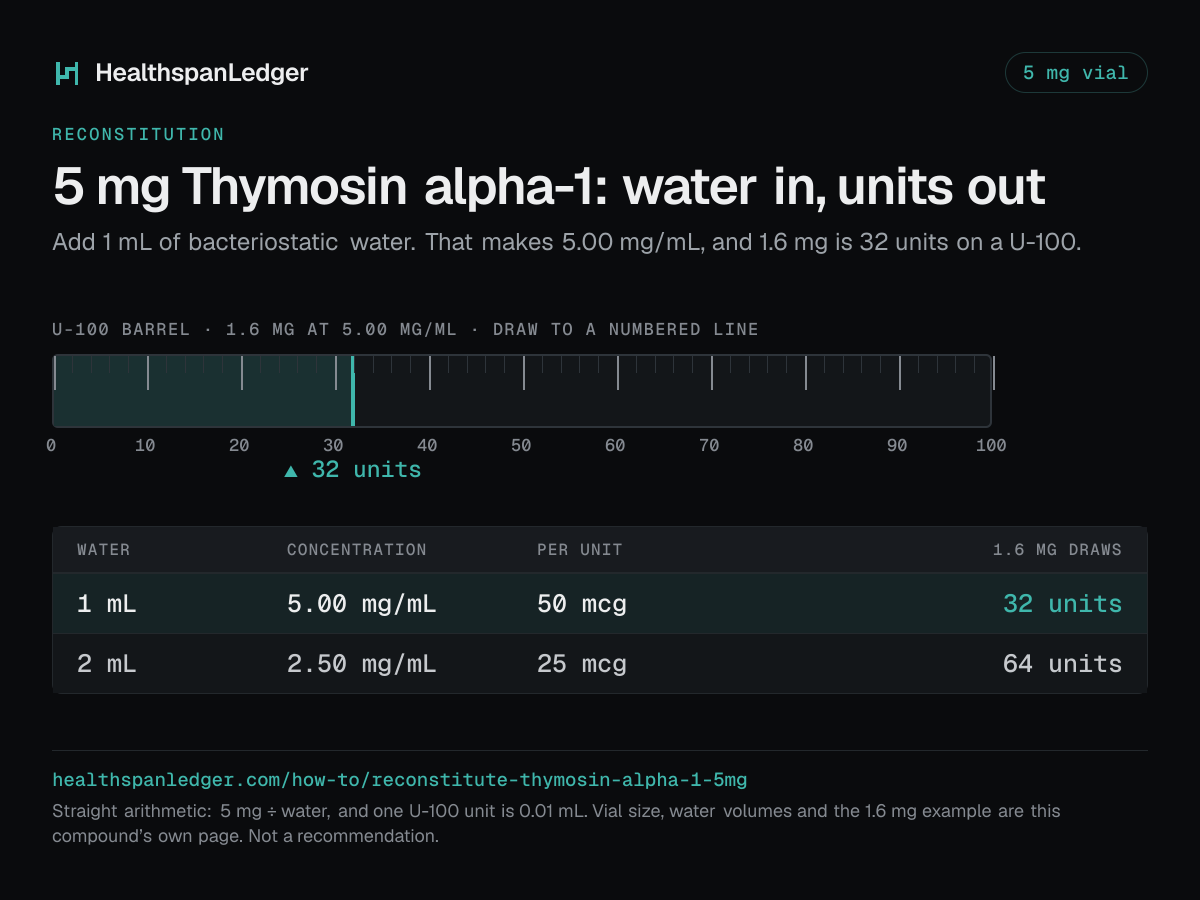
Thymosin alpha-1 5 mg vial: how much water to add. Each row is what that amount draws on a U-100 syringe. 1 mL makes 5.00 mg/mL, or 50 mcg a unit, and 1.6 mg is 32 units. 2 mL makes 2.50 mg/mL, or 25 mcg a unit, and 1.6 mg is 64 units. The barrel drawn here is filled to 32 units, the draw at 1 mL. The sum is 5 mg divided by the water. One U-100 unit is 0.01 mL.
The 5 mg vial at 1 mL on a U-100 barrel. 1.6 mg fills to 32.0 units, at 5.00 mg/mL.

How many units is a documented dose from this vial?

The table above uses one worked example. These are the published quantities, converted into marks on a U-100 barrel at each water volume for a 5 mg vial. Where a quantity was never studied by injection, the row says so.

1.6 mgstudied in a trial

1.6 mg twice a week, for 26 or 52 weeks, in a 98-patient randomized trial in chronic hepatitis B, under the skin.

1.6 mg once daily for the first week, then twice a week to week 12, in a 120-patient randomized trial in hepatitis-B-related acute-on-chronic liver failure, under the skin.

1.6 mg every 12 hours for up to seven days, under the skin. The regimen of the 1,106-participant phase 3 trial that found no mortality benefit.

Water addedConcentrationDraw
1 mL5.00 mg/mL32.0 units
2 mL2.50 mg/mL64.0 units

Human trialChien RN, et al. Hepatitis B virus genotype B is associated with better response to thymosin alpha1 therapy than genotype C. J Viral Hepat 2006;13(12):845-50 · retrieved 2026-08-12

Human trialChen JF, et al. Safety and efficacy of Thymosin alpha1 in the treatment of hepatitis B virus-related acute-on-chronic liver failure: a randomized controlled trial. Hepatol Int 2022;16(4):775-88 · retrieved 2026-08-12

Human trialNCT02867267 — The Efficacy and Safety of Thymosin Alpha 1 for Sepsis (TESTS): multicentre, double-blinded, randomised, placebo-controlled phase 3 trial · retrieved 2026-08-12

1.6–6.4 mgstudied in a trial

1.6–6.4 mg on days 8–11 and 15–18 of each 28-day cycle, under the skin. The three arms (1.6, 3.2 and 6.4 mg) of a 488-participant phase 2 dose-ranging trial in metastatic melanoma.

Water addedConcentrationDraw, low to high
1 mL5.00 mg/mL32.0 to 128.0 unitswon’t fit
2 mL2.50 mg/mL64.0 to 256.0 unitswon’t fit

Human trialNCT00911443 — Phase 2 multicentre randomised dose-ranging study of dacarbazine plus interferon alpha plus thymosin alpha 1 in advanced metastatic malignant melanoma (488 participants) · retrieved 2026-08-12

Three draws of a quantity the trials actually settled on

Unlike most research vials in this family, the amount in the table is one the trials used repeatedly, with only the interval changing between them. This vial holds three of it.

3Read the full vial record 3 notes

Three draws is a short vial

Because the amount is milligram-scale rather than micrograms, the powder divides into very few doses. Most research vials in this family stretch to dozens.

That changes what the page is for. There is no long-storage question to worry about, because the vial does not last long enough to raise one.

Three draws also means the water volume barely affects supply. It only affects how far up the barrel each of the three sits.

The trials mixed a smaller vial than this

Published regimens dissolve a single dose in a milliliter and inject that. A research vial holds several times that mass, so the mixing volume becomes your decision rather than a protocol’s.

Both listed volumes land the reading on a syringe line here, so the decision is comfortable. It is still a decision no trial made for you.

Approved elsewhere is not approved here

This medicine exists under another name in several countries and has never been approved in the United States. Its trial record is large and almost all of it ran in hospital, in acutely unwell people.

Research-grade material is not the product any of those approvals or trials refers to, whatever the milligrams on the glass say.

How do you mix it, step by step?

  1. Wipe both stoppers with an alcohol swab and let them dry.
  2. Draw up the water volume you picked from the table.
  3. Let the water run slowly down the inside wall of the Thymosin alpha-1 vial, rather than jetting it onto the powder.
  4. Swirl gently until it dissolves. Shaking damages peptides.
  5. Store it as the dispensing label directs. What happens after mixing differs by product — some labels direct against refrigerating the mixed solution at all.

What if your water volume is not on the table?

The table shows the offered water volumes. The calculator does the same arithmetic for any volume and any syringe, and shows its working line by line.

Open the Thymosin alpha-1 calculator →

Where to read next about Thymosin alpha-1

The arithmetic on this page is only half the question. These are the pages that carry the other half.

4primary sources, each with the day we read it — open the documents used on this page