Page last checked
Research compound · not FDA-approved
Thymosin alpha-1
Thymosin alpha-1 is a peptide 28 amino acids long, first pulled out of calf thymus extract in the 1970s. It acts on how T cells mature and signal.
What matters first
- Why people look it up
- It is sold for immune support: long COVID, chronic infection, and general resilience.
- What the evidence shows
- It carries a large trial record, and that record is about acutely unwell hospital patients rather than healthy adults. Under the name thymalfasin it is an approved medicine in several countries, mainly for chronic hepatitis B. Its largest trial gave it to 1,106 people with sepsis. By day 28, 23.4% had died on the drug against 24.1% on placebo.
- Dose status
- Thymosin alpha-1 is not FDA-approved, so no dosing label exists for it. The sections below explain what researchers tested and what remains unknown.
What is known about Thymosin alpha-1
Thymosin alpha-1 is a peptide that affects how T cells mature and send signals. It is sold as thymalfasin in several countries, mainly for chronic hepatitis B. It has never been approved in the United States. Large trials used 1.6 mg under the skin. The timing changed by condition.
| Topic | Value |
|---|---|
| Strongest source | limited human data |
| FDA approval | Not FDA-approved |
| Studied dosing | 1.6 mg twice a week, for 26 or 52 weeks, in a 98-patient randomized trial in chronic hepatitis B — from clinical trials |
| Studied dosing | 1.6 mg once daily for the first week, then twice a week to week 12, in a 120-patient randomized trial in hepatitis-B-related acute-on-chronic liver failure — from clinical trials |
| Studied dosing | 1.6 mg every 12 hours for up to seven days — the regimen of the 1,106-participant phase 3 trial that found no mortality benefit — from clinical trials |
| Studied dosing | 1.6–6.4 mg on days 8–11 and 15–18 of each 28-day cycle — the three arms (1.6, 3.2 and 6.4 mg) of a 488-participant phase 2 dose-ranging trial in metastatic melanoma — from clinical trials |
| Typical vials | 5 mg · 10 mg |
Every row links back to a source listed below. These facts are for reference, not a personal recommendation.
What the evidence for Thymosin alpha-1 is
People have received this compound in a documented setting, or it has approval outside the United States. The available human evidence is still too limited to show a clear dose-and-result pattern for US use.
- What it establishes
- What it does not establish
Check the country, study size and reason it was used. Do not treat limited human data as an FDA-approved schedule.
Evidence snapshot and shareable image
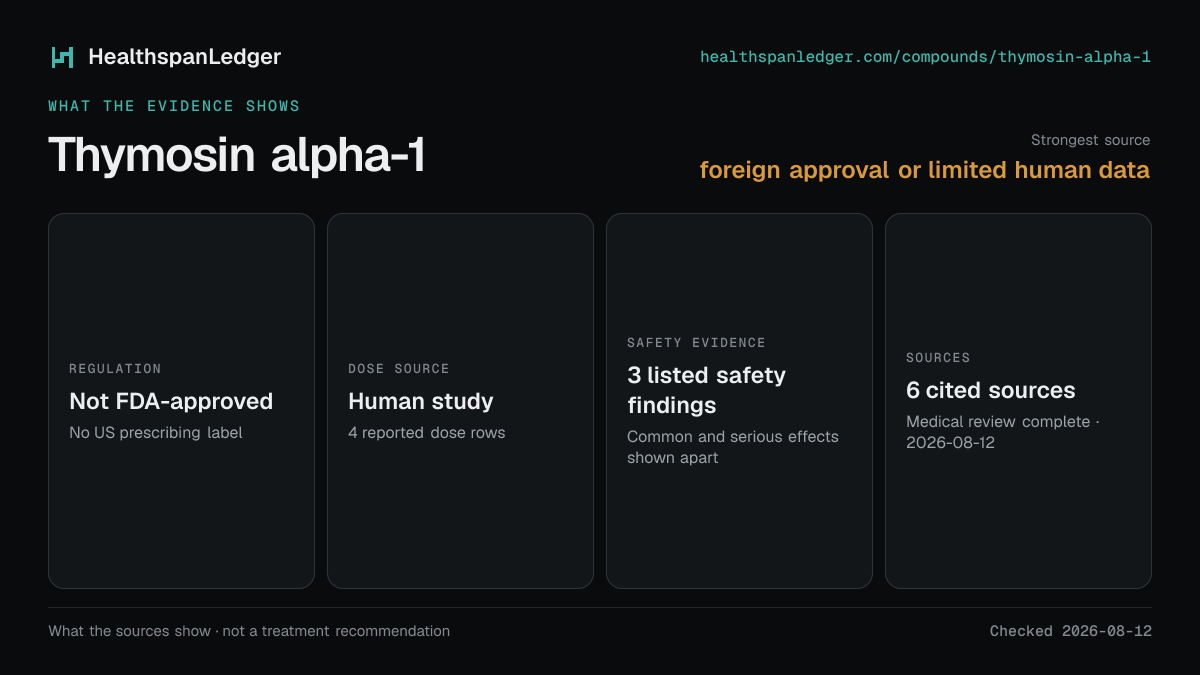
Evidence snapshot
Foreign approval or limited human data
- Regulation
- Dose source
- Safety evidence
- Sources
Where Thymosin alpha-1 is in clinical trials
51 registered studies; the program has reached phase 4, and 8 are still enrolling.
The soonest a running study expects to finish measuring people is December 2026. That is when the sponsor expects to finish collecting the main measurement. It is not a results date, and not a date anything goes on sale.
- Phase 4Completed
- Phase 4Completed
- Phase 4Completed
ClinicalTrials.gov · retrieved 2026-09-27
Regulatory status
An approval elsewhere is real evidence, and it is not an American one.
The review standard, the permitted claims and the safety follow-up all belong to the jurisdiction that granted it. The practical gap shows up in the vial. Trials dissolve 1.6 mg of powder in 1 mL and inject that.
Research vials sold under this name hold 5 mg or 10 mg. So one 10 mg vial holds more than six trial doses. Any quantity quoted from the approved labeling describes a different container entirely.
Full regulatory tracker →Where to go next on Thymosin alpha-1
The related pages keep each topic with its evidence.
Every reaction on the Thymosin alpha-1 page, with its frequency
Thymosin alpha-1 concentration in the Thymosin alpha-1 dosage calculator
Reconstituting Thymosin alpha-1 at 10 mg, step by step
Choosing a water volume for a 5 mg Thymosin alpha-1 vial
Mixing math for any vial, not just Thymosin alpha-1
Where Thymosin alpha-1 sits among the immune support compounds
What backs the Thymosin alpha-1 numbers, and what backs the rest
Where the Thymosin alpha-1 program has actually got to
Primary regulatory documents, including Thymosin alpha-1
Explore the research behind Thymosin alpha-1 and other compounds
Safety notes
Questions about Thymosin alpha-1
Is Thymosin alpha-1 FDA-approved?
How is Thymosin alpha-1 taken?
How does Thymosin alpha-1 differ from the other compounds in this class?
What is not known about Thymosin alpha-1?
Questions readers ask
What is the peptide thymosin alpha-1 used for?
How long does it take thymosin alpha 1 to work?
What are the risks of using thymosin alpha 1?
What is the best peptide for boosting the immune system?
- Chien RN, et al. Hepatitis B virus genotype B is associated with better response to thymosin alpha1 therapy than genotype C. J Viral Hepat 2006;13(12):845-50retrieved 2026-08-12Human trial
- Chen JF, et al. Safety and efficacy of Thymosin alpha1 in the treatment of hepatitis B virus-related acute-on-chronic liver failure: a randomized controlled trial. Hepatol Int 2022;16(4):775-88retrieved 2026-08-12Human trial
- NCT02867267 — The Efficacy and Safety of Thymosin Alpha 1 for Sepsis (TESTS): multicentre, double-blinded, randomised, placebo-controlled phase 3 trialretrieved 2026-08-12Human trial
- NCT00911443 — Phase 2 multicentre randomised dose-ranging study of dacarbazine plus interferon alpha plus thymosin alpha 1 in advanced metastatic malignant melanoma (488 participants)retrieved 2026-08-12Human trial
- Wu J, et al. The efficacy and safety of thymosin alpha1 for sepsis (TESTS): multicentre, double blinded, randomised, placebo controlled, phase 3 trial. BMJ 2025;388:e082583retrieved 2026-08-12Human trial
- Wu J, et al. The efficacy of thymosin alpha 1 for severe sepsis (ETASS): a multicenter, single-blind, randomized and controlled trial. Crit Care 2013;17(1):R8retrieved 2026-08-12Human trial