Page last checked
Research compound · not FDA-approved
AHK-Cu
AHK-Cu is three amino acids holding a copper ion. It differs from the better-known GHK-Cu by a single amino acid, and the two get confused constantly.
What matters first
- Why people look it up
- It is sold mainly for hair — thicker growth, less shedding — as powder for injection or in scalp serums.
- What the evidence shows
- One study of it exists in the indexed literature, published in 2007. It treated human hair follicles kept alive in a dish, not people. The follicles grew longer, and the cell-death finding the authors chased was not statistically significant. No trial registry lists it.
- Dose status
- No completed controlled human trial has shown which dose works for AHK-Cu. A few people may have received it in small reports, but that cannot show which dose works. The sections below separate study findings from what people report using.
What is known about AHK-Cu
AHK-Cu is alanine, histidine and lysine holding a copper ion — one amino acid different from the better-known GHK-Cu, and sold mostly for hair. One study of it exists in the indexed literature, published in 2007. It treated human hair follicles kept alive in a dish and cultured cells from the base of a follicle, and the follicles grew longer. Nobody has been given it in a published study, so no quantity for a person has ever been printed.
| Topic | Value |
|---|---|
| Strongest source | no human dose shown to work |
| FDA approval | Not FDA-approved |
| Typical vials | 10 mg |
Every row links back to a source listed below. These facts are for reference, not a personal recommendation.
What the evidence for AHK-Cu is
No completed controlled human trial has shown which dose works. People may report using a range, but that is not a tested dosing schedule.
- What it establishes
- What it does not establish
If a number appears, it describes what people report using. It is not a trial result or a recommendation. If there is no number, no study has produced one.
Evidence snapshot and shareable image
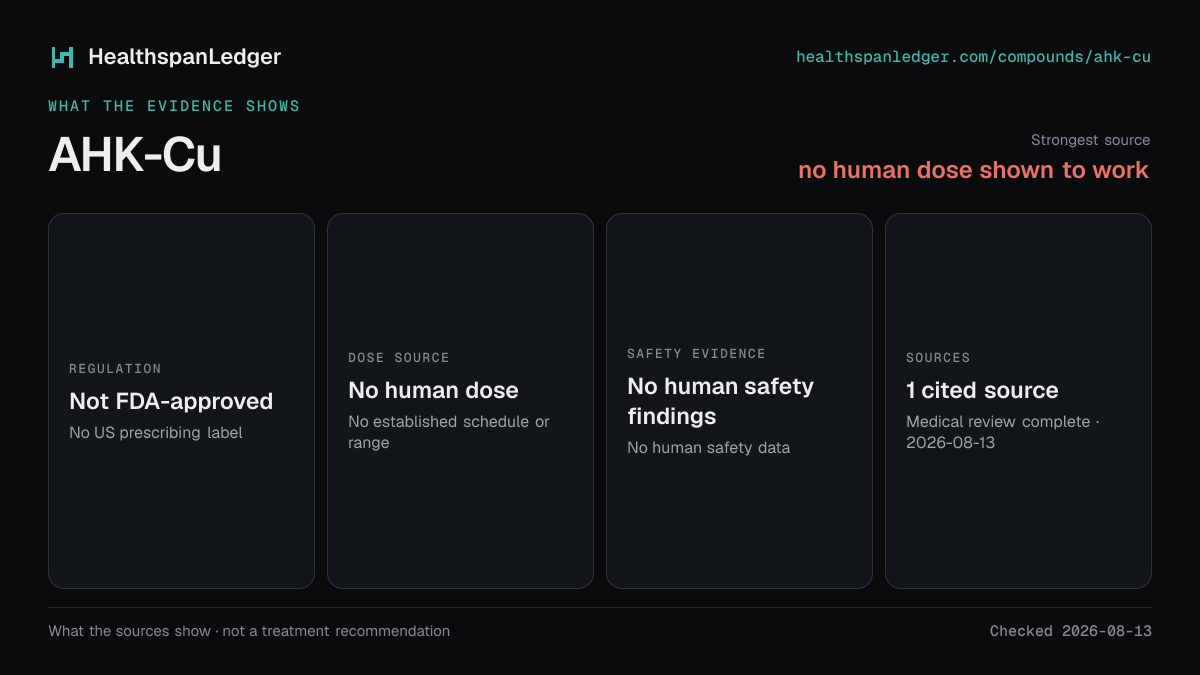
Evidence snapshot
No human dose shown to work
- Regulation
- Dose source
- Safety evidence
- Sources
Where AHK-Cu is in clinical trials
No trial of this compound is registered on ClinicalTrials.gov.
That is worth sitting with. Nobody has registered a study to find out whether AHK-Cu works in people, so no result is coming and no date is worth waiting for. Sellers are not waiting for that work either.
ClinicalTrials.gov · retrieved 2026-09-27
Regulatory status
FDA has approved nothing under this name and holds no label for it.
No study of this peptide appears on any trial registry, and the single published study used human tissue in a dish rather than people. Do not read across from GHK-Cu: that molecule differs by one amino acid and has two controlled human trials, a long cosmetic-ingredient history and an FDA compounding entry scoped to injection. None of that record belongs to this one.
Anything sold under this name is an unapproved substance no regulator has examined.
Full regulatory tracker →Where to go next on AHK-Cu
The related pages keep each topic with its evidence.
What is known about AHK-Cu side effects, and what is not
Doses per 10 mg AHK-Cu vial in the AHK-Cu reconstitution calculator
Every dosing schedule, including AHK-Cu
The generic calculator behind the AHK-Cu one
What is still being tested, including AHK-Cu
What the FDA has published on AHK-Cu
Browse AHK-Cu and other compound guides
The sourcing rules behind every AHK-Cu figure
Safety notes
Questions about AHK-Cu
Is AHK-Cu FDA-approved?
How is AHK-Cu taken?
How does AHK-Cu differ from the other compounds in this class?
What is not known about AHK-Cu?
- The effect of tripeptide-copper complex on human hair growth in vitro.retrieved 2026-08-14indirect evidence