Page last checked
Research compound · not FDA-approved
CJC-1295
CJC-1295 is a redesigned copy of the hormone that tells your pituitary to release growth hormone. One version bonds to a protein in your blood, which stretches its life from minutes into days.
What matters first
- Why people look it up
- It is sold for the same wishlist as ipamorelin, and usually stacked with it: muscle, fat loss, recovery and sleep.
- What the evidence shows
- The human studies measured one thing, and it was growth hormone in the blood. None of them reported muscle, fat, strength or anything a person would notice. Most material sold under the name is the short-acting molecule, which was never in those studies.
- Dose status
- CJC-1295 is not FDA-approved, so no dosing label exists for it. The sections below explain what researchers tested and what remains unknown.
What is known about CJC-1295
CJC-1295 properly names a modified fragment of growth hormone-releasing hormone. The version studied in people carries a reactive chemical arm, the drug-affinity complex, which bonds the peptide to albumin in the blood. That stretches its life from minutes into days. Most material sold under the name has no such arm, so it is a different molecule: modified GRF 1-29, which clears fast. Phase 1 work showed the long-acting version raises growth hormone, but no trial showed what that achieves.
| Topic | Value |
|---|---|
| Strongest source | limited human data |
| FDA approval | Not FDA-approved |
| Studied dosing | 30–60 mcg per kilogram of body weight — the two of four rising single-dose levels the authors singled out as safe and relatively easy for healthy adults aged 21 to 61 to handle, using the version carrying the drug-affinity complex; a single injection raised growth hormone 2- to 10-fold for six days or more and IGF-I 1.5- to 3-fold for nine to eleven days — from clinical trials |
| Studied dosing | 60–90 mcg per kilogram of body weight, as a single injection, with growth hormone sampled overnight a week later in healthy men aged 20 to 40; the two doses did not differ from each other in effect — from clinical trials |
| What people report using | 1–2 mg a week, split over one or two injections of the drug-affinity-complex version; this is reported practice, distinct from the weight-based single and repeated doses in the cited human studies — no trial has tested this quantity |
| Typical vials | 5 mg |
Every row links back to a source listed below. These facts are for reference, not a personal recommendation.
What the evidence for CJC-1295 is
People have received this compound in a documented setting, or it has approval outside the United States. The available human evidence is still too limited to show a clear dose-and-result pattern for US use.
- What it establishes
- What it does not establish
Check the country, study size and reason it was used. Do not treat limited human data as an FDA-approved schedule.
Evidence snapshot and shareable image
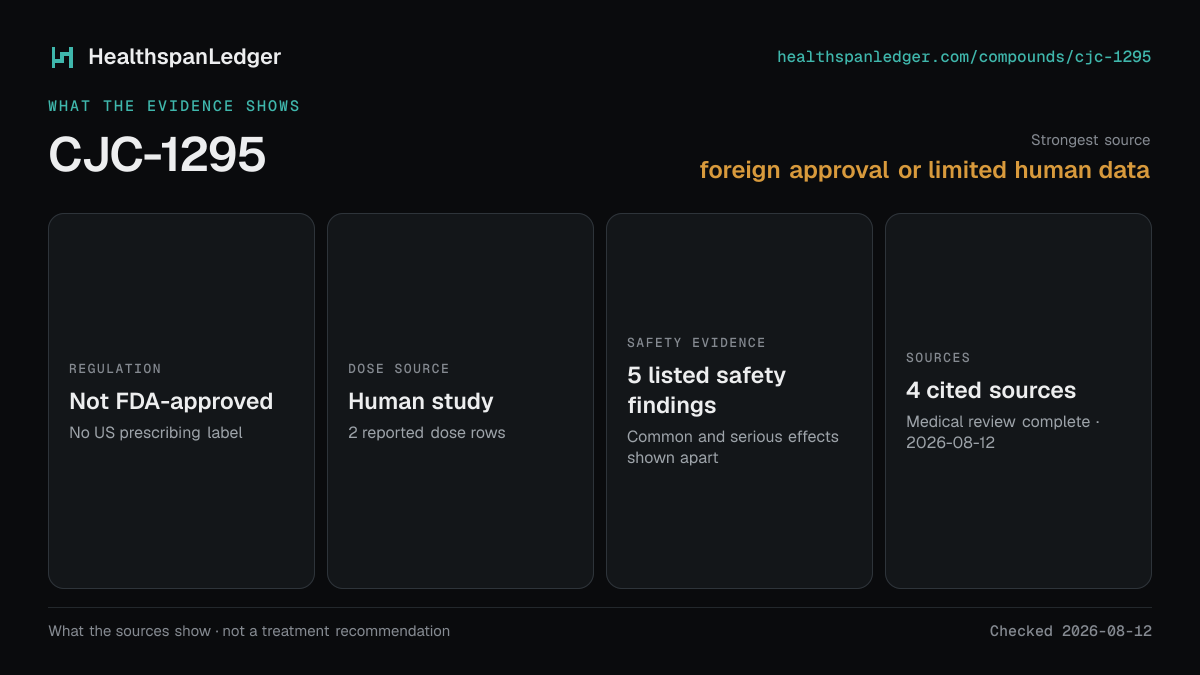
Evidence snapshot
Foreign approval or limited human data
- Regulation
- Dose source
- Safety evidence
- Sources
Where CJC-1295 is in clinical trials
1 registered study; the program has reached phase 2. Nothing is currently open or enrolling.
- Phase 2Stopped early
ClinicalTrials.gov · retrieved 2026-09-27
Regulatory status
One product name covers two substances here, and the difference is not cosmetic.
With the affinity complex the peptide lasts days; without it, minutes. So a protocol, a quantity or a risk written for one does not describe the other. Buyers routinely cannot tell which they hold.
The company that created the long-acting form dropped it, leaving no sponsor, no investigational filing and no pharmacopeial standard for either version.
Full regulatory tracker →How CJC-1295 compares
Each page says which kind of comparison it is: one trial that tested both, or two separate trials read side by side — which is much weaker, however close the numbers look.
Where to go next on CJC-1295
The related pages keep each topic with its evidence.
Why CJC-1295 carries no boxed warning
CJC-1295 dosing evidence, without an approved schedule
CJC-1295 concentration in the CJC-1295 reconstitution calculator
Mixing a 5 mg CJC-1295 vial, water volume by water volume
Where Australia Peptide products access differs from CJC-1295
The stack page CJC-1295 belongs to
Where Canada Peptide products access differs from CJC-1295
Where CJC-1295 sits among the weight loss compounds
Who else is sold for muscle growth besides CJC-1295
Who else is sold for sleep besides CJC-1295
Safety notes
Questions about CJC-1295
Is CJC-1295 FDA-approved?
How is CJC-1295 taken?
How does CJC-1295 differ from the other compounds in this class?
What is not known about CJC-1295?
Is there a CJC-1295 dosing schedule on this site?
Questions readers ask
What exactly does CJC-1295 do?
Does CJC-1295 suppress testosterone?
What are the downsides of CJC-1295?
How many times a week should I take CJC-1295?
- Teichman SL, Neale A, Lawrence B, Gagnon C, Castaigne JP, Frohman LA. Prolonged stimulation of growth hormone (GH) and insulin-like growth factor I secretion by CJC-1295, a long-acting analog of GH-releasing hormone, in healthy adults. J Clin Endocrinol Metab 2006;91(3):799-805retrieved 2026-08-12Human trial
- Ionescu M, Frohman LA. Pulsatile secretion of growth hormone (GH) persists during continuous stimulation by CJC-1295, a long-acting GH-releasing hormone analog. J Clin Endocrinol Metab 2006;91(12):4792-7retrieved 2026-08-12Human trial
- Dominikowski A, Rękoś Z, Olejarz M, Szczepanek-Parulska E, Domin R, Ruchała M. The emerging landscape of performance-enhancing peptides modulating GH-IGF1 axis: bridging the gap between clinical evidence and patient self-administration. Front Endocrinol 2026 — tabulates self-reported online dosing patterns beside the clinical doses, stating the reported values must not be read as clinically validated, regulatory-approved or saferetrieved 2026-08-12indirect evidence
- Dominikowski A, Rękoś Z, Olejarz M, Szczepanek-Parulska E, Domin R, Ruchała M. The emerging landscape of performance-enhancing peptides modulating GH-IGF1 axis: bridging the gap between clinical evidence and patient self-administration. Front Endocrinol 2026;17 — Table 1, CJC-1295 (with DAC) safety-signal rowretrieved 2026-08-12limited human data