Page last checked
Research compound · not FDA-approved
MariTide
MariTide is the short name for maridebart cafraglutide, an experimental shot for weight management.
What matters first
- Why people look it up
- Researchers are studying MariTide for weight management.
- What the evidence shows
- A Phase 2 trial reported average weight loss in groups with and without type 2 diabetes. Two Phase 3 studies are active but have no results.
- Dose status
- MariTide is not FDA-approved, so no dosing label exists for it. The sections below explain what researchers tested and what remains unknown.
What is known about MariTide
MariTide is the short name for maridebart cafraglutide, an experimental shot for weight management. It activates GLP-1 receptors and blocks GIP receptors. In a 592-person Phase 2 trial, average weight change after 52 weeks was a loss of 12.3% to 16.2% across study groups without type 2 diabetes, compared with 2.5% with placebo. In study groups with type 2 diabetes, the range was 8.4% to 12.3%, compared with 1.7% with placebo. Two Phase 3 studies are active but have no results.
| Topic | Value |
|---|---|
| Strongest source | Human trial |
| FDA approval | Not FDA-approved |
| Studied dosing | 140–420 mg every four weeks in most Phase 2 groups; one 420 mg group received it every eight weeks, and two groups increased doses gradually — from clinical trials |
| Presentation | MariTide has no approved vial or mixing instructions; its studies use prepared subcutaneous injections. |
Every row links back to a source listed below. These facts are for reference, not a personal recommendation.
How MariTide works
MariTide acts at GIP + GLP-1. Here is what that means.
A dual agonist switches on the receptors for both hormones your gut releases after eating: GLP-1 and GIP (glucose-dependent insulinotropic polypeptide). Both were first understood as insulin boosters, and combining them started out as a diabetes idea. The weight loss that followed was bigger than the GLP-1 half alone would explain, and researchers still do not agree on why.
| Receptor | MariTide | What it does |
|---|---|---|
| GLP-1 | Insulin release while blood sugar is rising, less glucagon, slower stomach emptying, and less appetite — the same physiology a single-target drug produces, carried here by the same molecule. | |
| GIP | pancreatic isletGIP is the other gut hormone, released higher up the small intestine. It boosts insulin alongside GLP-1, which is why the two together move blood sugar more than either does alone.adipose tissue and brainGIP receptors also sit on fat cells. There, the hormone has a hand in how nutrients get stored and how blood moves through fat tissue. These receptors also sit in the brain regions handling appetite and nausea. What GIP actually contributes to weight loss is disputed — blocking the same receptor has also produced benefit in experiments. | |
| Glucagon | — | |
| Amylin | — |
The same four receptor groups are shown for every drug, so the differences are easy to compare. Targets come from the drug class. Any result specific to MariTide comes from the cited sources.
The honest summary: the two-receptor design has beaten single-target GLP-1 in trials, and the explanation is unfinished. One leading idea is that GIP signaling in the brain dampens the nausea that limits GLP-1 dosing. In that hypothesis, a dual agonist can be pushed further before side effects stop it. That is a hypothesis, not a finding — any confident story about what GIP does is running ahead of the evidence.
What the evidence for MariTide is
These numbers come from a study in people that was published in a peer-reviewed journal. The drug or dose may still be experimental and may not have FDA approval.
- What it establishes
- What it does not establish
Read each result with the study length, dose and number of participants. Results from separate trials are not a direct comparison because the people and study designs differ.
Evidence snapshot and shareable image
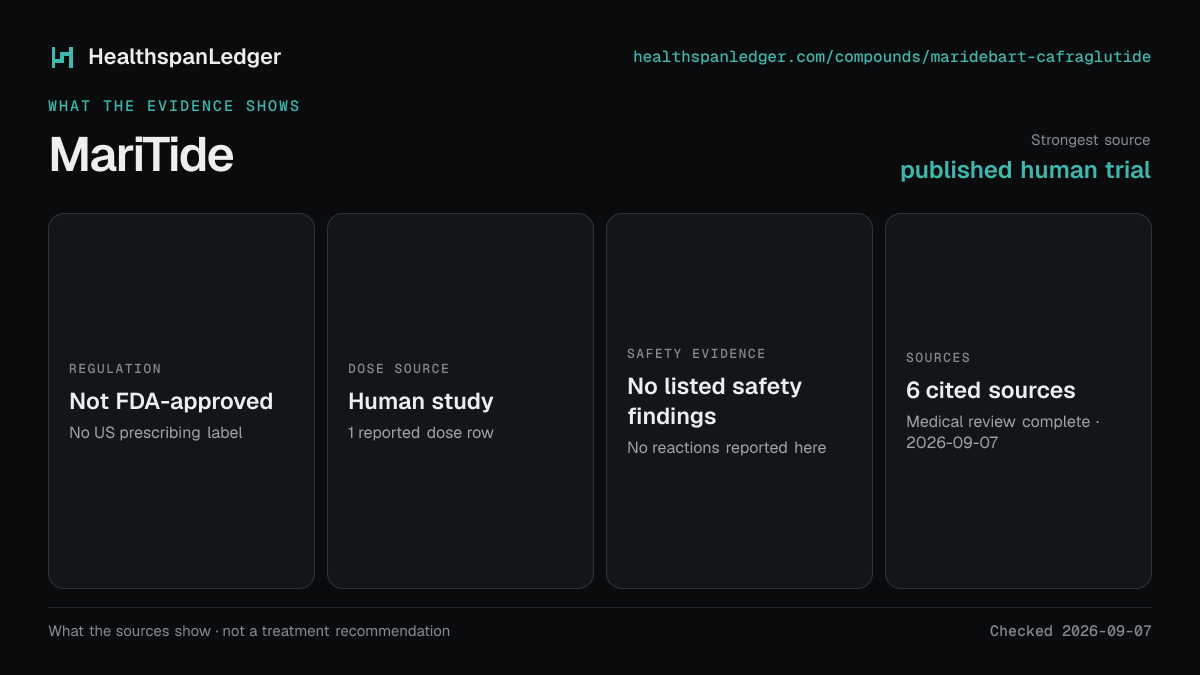
Evidence snapshot
Published human trial
- Regulation
- Dose source
- Safety evidence
- Sources
Where MariTide is in clinical trials
28 registered studies; the program has reached phase 3, and 7 are still enrolling.
The soonest a running study expects to finish measuring people is November 2026. That is when the sponsor expects to finish collecting the main measurement. It is not a results date, and not a date anything goes on sale.
- Phase 3Recruiting
- Phase 3Recruiting
- Phase 3Recruiting
ClinicalTrials.gov · retrieved 2026-09-27
Regulatory status
MariTide is investigational and has no FDA-approved product or prescribing schedule.
The amounts below belong to monitored Phase 2 study groups. They are not instructions for personal use or a forecast of one person’s result.
Full regulatory tracker →Where to go next on MariTide
Vial, water and dose for any peptide, with MariTide as one example
Petrelintide on its own page, separate from MariTide
The source-checked survodutide entry, beyond the MariTide one
The source-checked pemvidutide entry, beyond the MariTide one
What the mazdutide page carries, separate from MariTide
What the zenagamtide page carries, separate from MariTide
What the retatrutide page carries, separate from MariTide
The source-checked eloralintide entry, beyond the MariTide one
Cagrilintide on its own page, separate from MariTide
Liraglutide in the full list, alongside MariTide
Safety notes
Questions about MariTide
Is MariTide FDA-approved?
How is MariTide taken?
How does MariTide differ from the other compounds in this class?
What is not known about MariTide?
- Amgen — scientific approach to obesity and the MariTide programretrieved 2026-08-29Current sponsor program and mechanism overview
- Véniant MM et al. Phase 1 maridebart cafraglutide study (PMID 38316982)retrieved 2026-08-29Human trial
- Jastreboff AM et al. Phase 2 MariTide obesity trial (PMID 40549887)retrieved 2026-08-29Human trial
- NCT05669599 — completed Phase 2 MariTide weight-management studyretrieved 2026-08-29Human trial
- NCT06858839 — MARITIME-1 Phase 3 study without type 2 diabetesretrieved 2026-08-29Human trial
- NCT06858878 — MARITIME-2 Phase 3 study with type 2 diabetesretrieved 2026-08-29Human trial