PEG-MGF is a short piece of a growth factor your muscle makes for itself after hard exercise. A polyethylene glycol chain is attached to it, to slow down how fast it clears.
What matters first
Why people look it up
It is sold for muscle repair and growth after training.
What the evidence shows
Nobody has given it to a person in a study. The human research here biopsies muscle and measures what the body makes on its own. Even that research disagrees about whether training raises it at all. The only work on the peptide went onto cultured cells and mice, using a fragment with no glycol chain on it.
Dose status
No completed controlled human trial has shown which dose works for PEG-MGF. A few people may have received it in small reports, but that cannot show which dose works. The sections below separate study findings from what people report using.
Mechano-growth factor is a splice variant of IGF-1 that skeletal muscle transcribes after mechanical loading; the peptide sold as PEG-MGF is that variant’s short C-terminal E-domain with a polyethylene glycol chain attached to slow its clearance. Human research on MGF exists, but it measures the transcript muscle makes by itself in biopsied tissue — and disagrees with itself about whether exercise raises it. The peptide has only been put on cultured cells and animals. No study has given it, PEGylated or not, to a person and reported a dose.
PEG-MGF research and regulatory details: evidence quality, approval status, doses, handling, and presentation.
Topic
Value
Strongest source
no human dose shown to work
FDA approval
Not FDA-approved
What people report using
200–400 mcg two or three times a week after training, by injection under the skin or into muscle; the same review prints the same quantity again as a daily amount, calls the protocols it collects internally inconsistent, and notes that the only work ever done on this peptide put a fragment carrying no polyethylene glycol onto cultured cells and into mice— no trial has tested this quantity
Typical vials
2 mg
Every row links back to a source listed below. These facts are for reference, not a personal recommendation.
The row headed “what people report using” is not evidence. No trial produced that quantity. It is printed because it is what circulates, and because it is better read here, beside what the studies actually did, than on a page that is selling the vial. It describes a practice. It is not a starting point.
What the evidence for PEG-MGF is
No completed controlled human trial has shown which dose works. People may report using a range, but that is not a tested dosing schedule.
no human dose shown to work
What it establishes
Animal studies or small reports can show that researchers are exploring the compound. They cannot show which dose works in people.
What it does not establish
A validated dose, schedule, duration, safety margin, or reliable figure for how long it stays in the body.
If a number appears, it describes what people report using. It is not a trial result or a recommendation. If there is no number, no study has produced one.
Evidence snapshot and shareable image
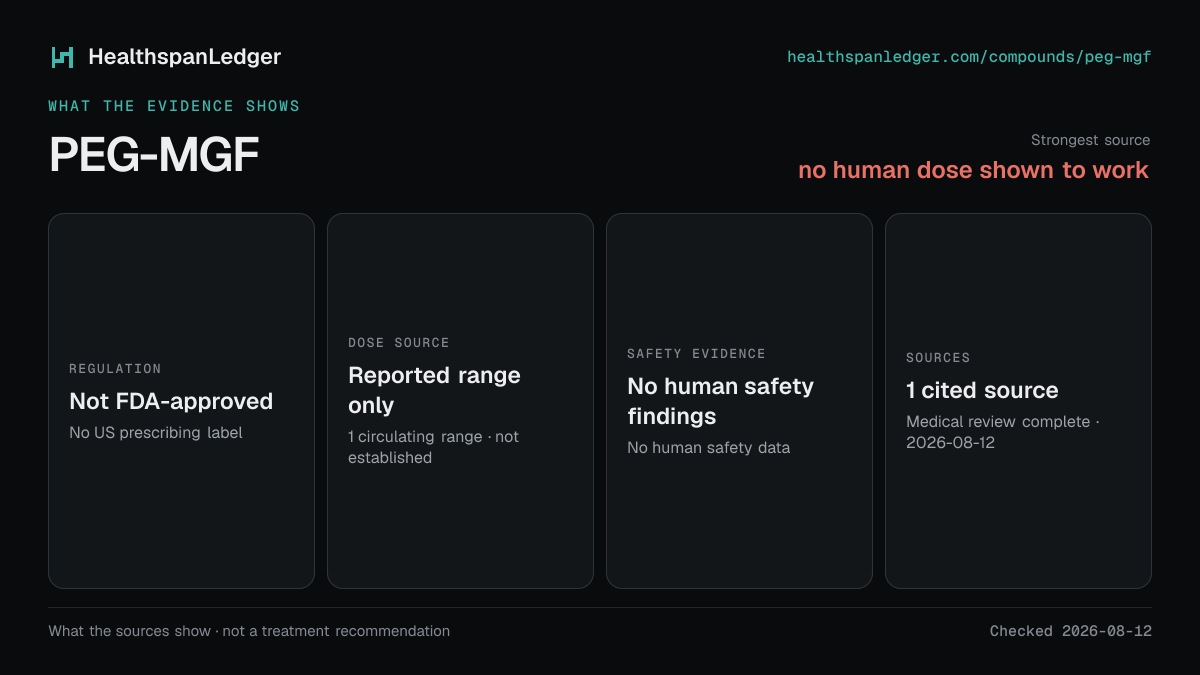
PEG-MGF at a glance: no human dose shown to work, dosing basis, regulatory status, safety coverage, and cited-source count. These details summarize the available sources; they are not treatment recommendations.
Evidence snapshot
No human dose shown to work
The fastest way to see what kind of evidence this page is built on.
Regulation
Not FDA-approvedNo US prescribing label
Dose source
Reported range only1 circulating range · not established
Safety evidence
No safety findings listedAn empty list does not establish safety
PEG-MGF at a glance: no human dose shown to work, dosing basis, regulatory status, safety coverage, and cited-source count. These details summarize the available sources; they are not treatment recommendations.
Where PEG-MGF is in clinical trials
No trial of this compound is registered on ClinicalTrials.gov.
That is worth sitting with. Nobody has registered a study to find out whether PEG-MGF works in people, so no result is coming and no date is worth waiting for. Sellers are not waiting for that work either.
A registered study means a sponsor filed a plan and started enrolling. It is not evidence the drug works, and most drugs tested in people never reach a pharmacy. Sponsors write and update these sources themselves; the National Library of Medicine publishes them without checking them.
PEGylation is a chemical modification, not a formulation choice.
So the conjugate and the native splice variant are different substances, and evidence about one does not transfer to the other. No sponsor has filed to test either. Neither appears in any pharmacopeia.
No label a buyer sees says how much PEG is attached. FDA has looked at it, though. Somebody put it forward for compounding and then withdrew, so FDA files it under nominated but withdrawn.
It is also one of five named for a compounding committee meeting before the end of February 2027.
No human trial has studied the PEGylated conjugate or the native splice variant it derives from. The quantity on this page is the one that circulates on forums, printed in a review that tabulates such protocols. No study produced it
That review prints this compound’s protocol at two different frequencies in one entry — a few times a week, and then daily. It says plainly that the sources it collected are internally inconsistent, so there is not even a settled convention here to report
The human MGF literature is expression research. It biopsies muscle and measures the transcript the body makes on its own. That is a different experiment from injecting a peptide
Even that expression research disagrees with itself. One study found MGF messenger RNA rose 163% after five weeks of resistance training. Another found it unchanged after resistance exercise
The only work on the peptide itself used a 24-amino-acid E-domain fragment, on cultured cells and in mice. That fragment carried no polyethylene glycol, so it is not the molecule sold under this name
Results from human muscle cells in a dish are routinely quoted as human evidence. They are not, and no cell-culture result carries a quantity for a person
Nobody discloses the extent of polyethylene glycol conjugation, so vials sold under one name are not necessarily one substance
Somebody has asked for this compound to be allowed in compounding. FDA lists it among substances nominated but withdrawn, which it describes as having once been in category 2 for a significant safety risk. A withdrawal is not a finding against the substance
FDA has also named it for a compounding advisory committee review, as one of five substances being considered for inclusion on the 503A bulks list. The agency says that meeting will happen before the end of February 2027. No date, docket or Federal Register notice exists for it yet
Questions about PEG-MGF
Is PEG-MGF FDA-approved?
No. There is no prescribing label for it, so no approved dose exists — the regulatory status section above has the detail.
How is PEG-MGF taken?
No completed controlled human trial has established a dose, frequency or route. A separately labeled protocol from reported practice is available, but it is not study dosing. The reported cadence is two or three times a week after training, by injection under the skin or into muscle.
How does PEG-MGF differ from the other compounds in this class?
PEG-MGF works through a different system from GLP-1 and amylin drugs. No completed human study has set a dose, so a direct comparison would be misleading.
What is not known about PEG-MGF?
A validated dose, schedule, duration, safety margin, or reliable figure for how long it stays in the body.
Is there a PEG-MGF dosing schedule on this site?
Not a schedule — there is no approved schedule to publish here. What you get instead is the trial dosing program: the doses each arm received and how the protocol worked up to them. See what the trials tested.
1primary source, each with the day we read it — open the documents used on this page